

Luis Alberto Solari biography
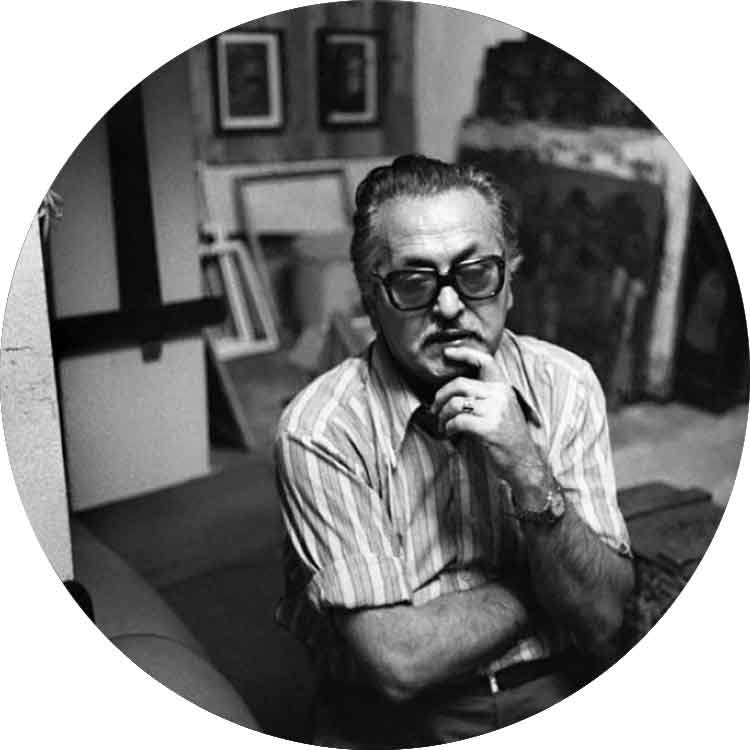
Luis Alberto Solari is a Uruguayan artist famous for his contribution to magical realism. Born in Fray Bentos, Uruguay, on October 17, 1918, his artistic career began in Montevideo in 1925, where he developed an early interest in painting and its techniques.
In 1932, his artistic career took a significant turn when he met the painter Zoma Baitler. The following year, he joined the decorative painting workshop at the Industrial School, led by Guillermo Laborde. During this period, he collaborated on the creation of large-scale scenographies and decorations, such as those for the Hotel Miramar and the Municipal Casino of Parque Rodó. His enrollment in 1934 at the Círculo de Bellas Artes of Montevideo led him to explore artistic movements like post-impressionism and symbolism, influenced by Gauguin, D'Hastrel, Rugendas, Morel, Monvoisin, Adolfo Pastor and Carlos González.
In 1937, Luis Alberto Solari moved to Buenos Aires to further his studies, where he was influenced by the painting of Argentine artists such as Pettoruti, Butler, Berni, Quinquela Martín and Spilimbergo. Returning to Fray Bentos, he dedicated himself to various artistic projects, including scenography and decoration for the city carnival, a commitment he would maintain for many years.
During the '40s, he carries out his artistic work alongside other activities, such as veterinary inspection at the Anglo meat packing plant and street vending. These experiences bring him into contact with Uruguayan popular culture, greatly influencing his work. In 1941 he receives his first major recognition, the Acquisition Prize at the Municipal Fine Arts Hall. On May 20, 1944, he marries Nora D'Agosto.
In 1948, his career takes a fundamental turn when he begins to focus on the theme of carnival in his artworks. This interest materializes in a participation at the São Paulo Biennial in 1951. The following year, Solari travels to Europe for an official assignment, studying artistic teaching methods. In Paris, he becomes a member of the Jeune Contemporaine group and begins working on engraving under the guidance of Edouard Goerg at the Ecole de Beaux Arts. His European experience exposes him to the artwork of masters such as Tiziano, Brueghel, Ensor, Klee, Rouault and Gauguin, and he is particularly impressed by Renaissance painting.
Upon his return to Uruguay in 1953, he founds the Taller de Artes Plásticas a Fray Bentos and continues to receive awards and recognitions. In 1959, on the occasion of the centenary of Fray Bentos, he organizes several cultural events, including the Grupo 8 exhibition. In the '60s, Luis Alberto Solari returns to Europe, inspired by Chagall's stained glass in Paris, and begins to explore new techniques such as collage and texture.
In 1967, he moves to the United States to perfect his engraving technique at the Pratt Graphics Center and the New York Graphics Workshop, collaborating with artists such as Liliana Porter and Luis Camnitzer. During this period, he exhibits at the Zegry Gallery in New York and the La Ruche Gallery in Buenos Aires, and in 1970 decides to settle in the United States. In the '70s, his work receives further recognition and is exhibited in several international exhibitions.
In 1974, Luis Alberto Solari moves his studio to Port Washington, Rhode Island, and begins working on an edition of Aesop's Fables. He continues to exhibit in America and Europe, and in 1981 resides in Jerusalem, invited by the Israeli Ministry of Foreign Affairs. This experience influences his exploration of biblical themes, already present in other phases of his career.
Luis Alberto Solari definitively returns to Uruguay in 1986 and in 1989 holds important retrospectives. That same year, the Solari Museum is inaugurated in Fray Bentos. In 1992, he receives the Lifetime Achievement Award for the plastic arts from the Ministry of Education and Culture. Luis Alberto Solari dies on October 13, 1993, leaving a significant artistic legacy and a lasting influence in the world of artwork.