
Painter
Adolf Frohner
Austria, 1934–2007
Stay up to date with this artist
Leave your email to receive updates on newly available artworks and news about this artist.
Artworks by Adolf Frohner
5 artworks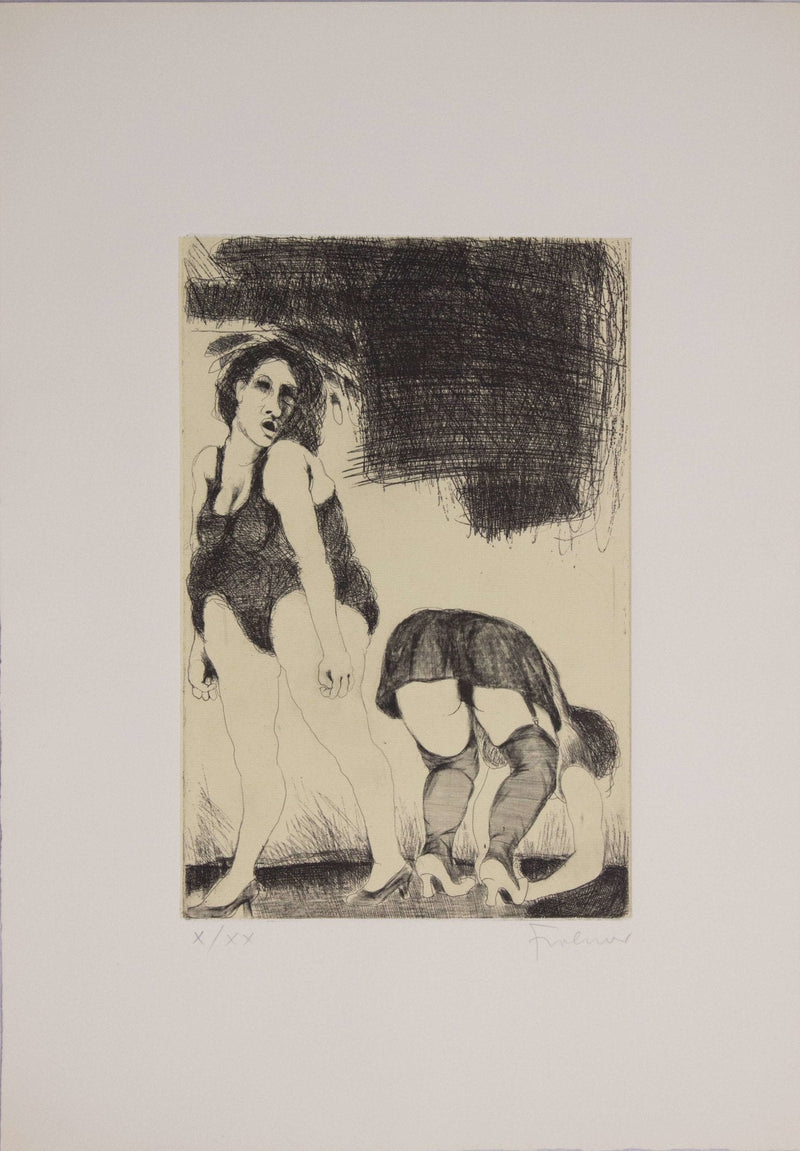


Biography of Adolf Frohner
Distorted bodies, dense surfaces, and energetic marks characterize the artwork of Adolf Frohner, a leading figure in Austria’s art scene in the second half of the 20th century. Associated with the beginnings of Viennese Actionism, Frohner soon moved away from action as his preferred form of expression, choosing instead to focus mainly on painting and drawing. The human body nevertheless remained at the center of…
Read the full biographyClose the biography
Distorted bodies, dense surfaces, and energetic marks characterize the artwork of Adolf Frohner, a leading figure in Austria’s art scene in the second half of the 20th century. Associated with the beginnings of Viennese Actionism, Frohner soon moved away from action as his preferred form of expression, choosing instead to focus mainly on painting and drawing. The human body nevertheless remained at the center of an intense exploration of vulnerability, violence, and psychological tension.
Early artwork and Actionist experience
Frohner was born on March 12, 1934, in Groß-Inzersdorf, Lower Austria, and moved to Vienna in 1952. He studied commercial graphic design, also worked as an art critic, and largely taught himself painting, auditing some courses at the Academy of Fine Arts Vienna, including Herbert Boeckl’s life drawing classes. After initially engaging with Cézanne, Picasso, and Léger, he gravitated toward Tachisme and gestural painting, taking an interest in material and the spontaneity of working on the surface.
In 1961, he received a UNESCO scholarship that allowed him to stay in Paris. There, he came into contact with the Nouveaux Réalistes and the circle around Pierre Restany, exploring the expressive possibilities of objects and everyday materials. Lhe following year, he took part with Hermann Nitsch and Otto Muehl in a collective action associated with the Blutorgel manifesto, considered one of the early episodes of Viennese Actionism. LAction, the body, and material became tools for challenging conventions in art and society.
Frohner does not, however, remain within the movement for long. He prefers to focus his oeuvre on painting and drawing, retaining from his Actionist experience the intensity of gesture and attention to physicality. His language returns to the figure without reviving an ideal of classical beauty or offering a reassuring representation.
The figure and painterly material
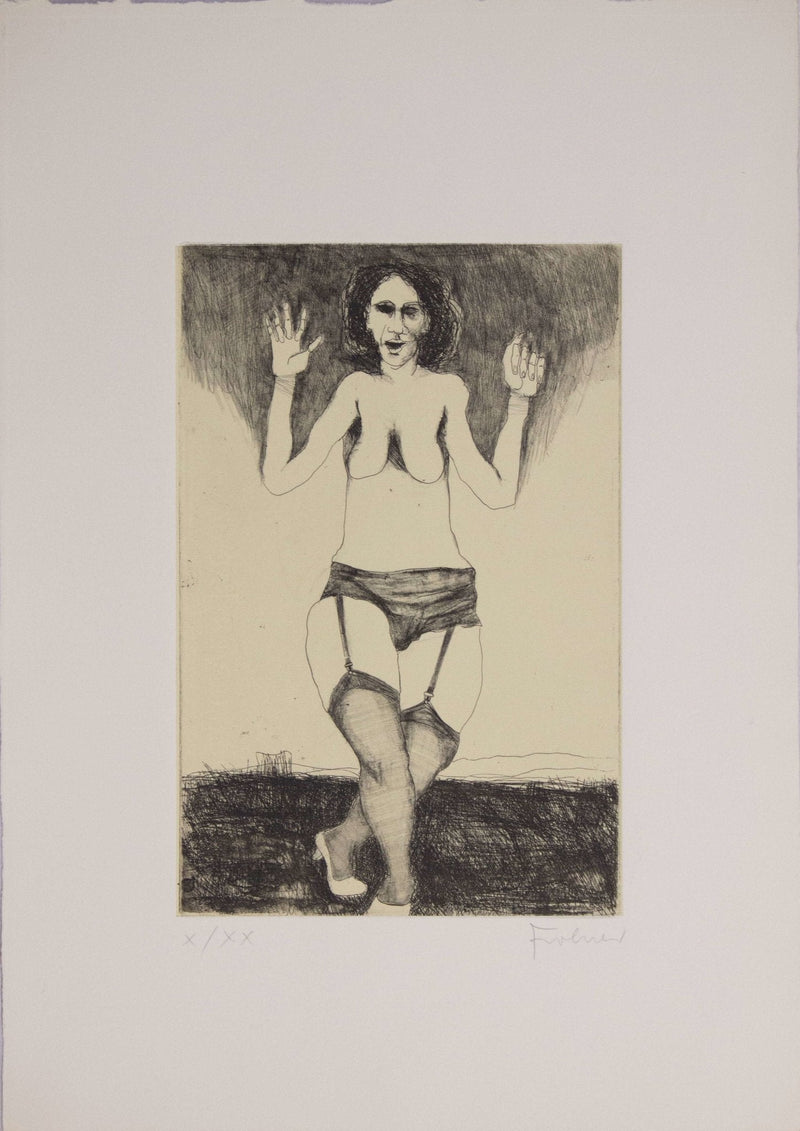
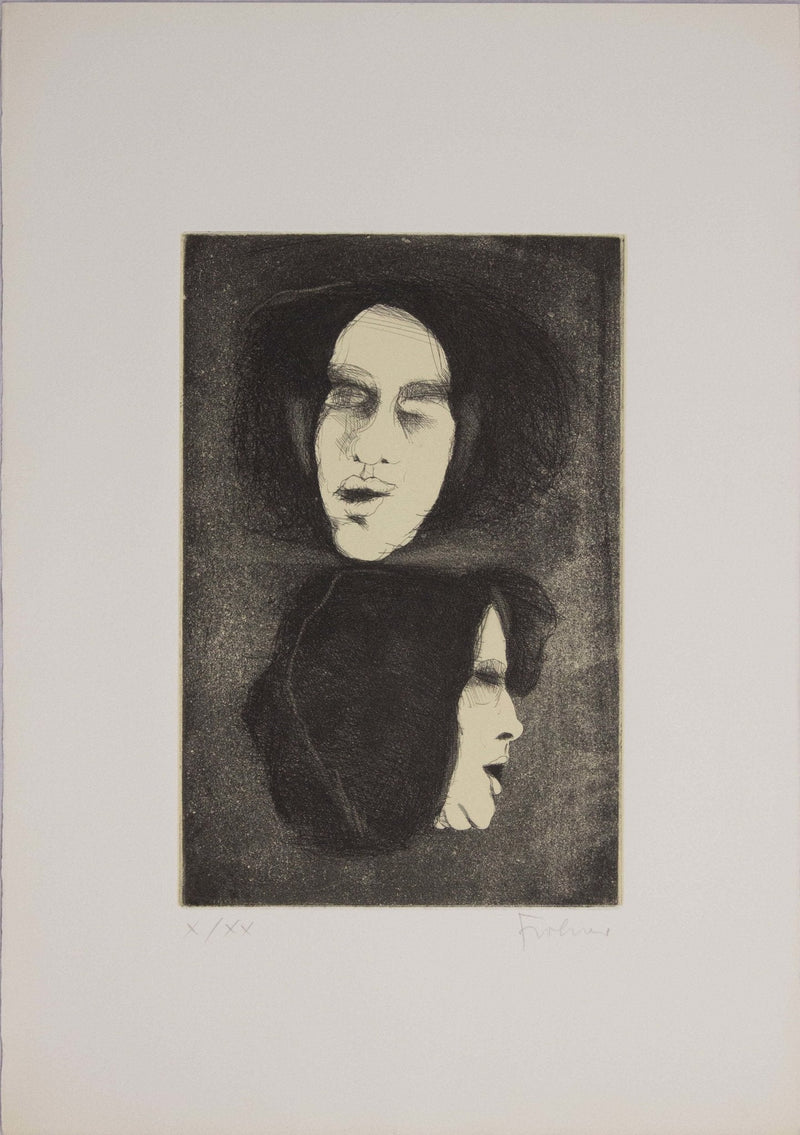
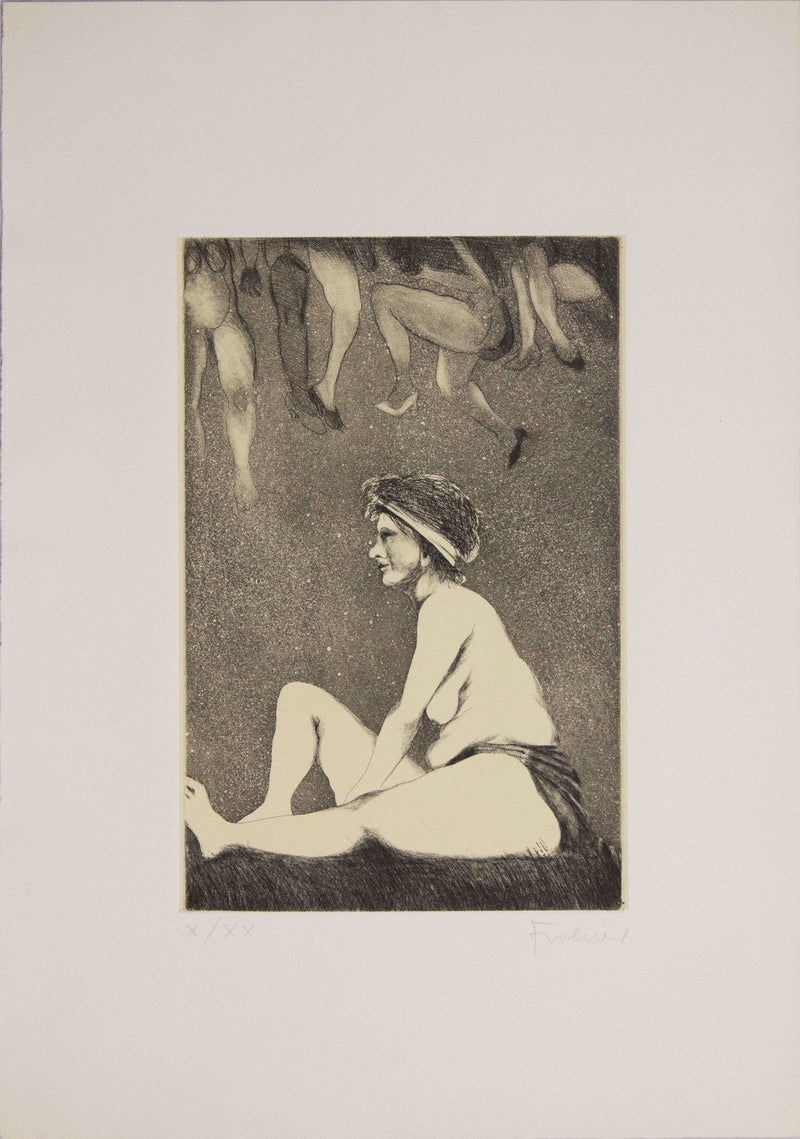
In his mature oeuvre, bodies, nudes, and female figures often appear, marked by distortions, tensions, and frequently uncomfortable poses. The figures may seem compressed in space, crossed by broken lines, or immersed in layered paint. The body thus becomes a place where vulnerability and conflict manifest themselves, while distortion takes on an expressive rather than merely formal value.
Frohner's painting is built through contrasts, incisive marks, and dense surfaces. Color and material do not serve a decorative function: they make the tension of the creative process perceptible. Drawing is also an autonomous language, in which rapid, emphatic, or fragmented strokes give the figure movement and intensity. His output also includes artworks on paper and artworks in print; to identify their techniques correctly, it is necessary to distinguish engravings, lithographs, screen prints, and reproductions, without inferring the process from visual appearance alone.
Public artworks, teaching, and recognition
His experimentation with materials also extends to architecture. In 1964, Frohner receives a commission to create sgraffito decorations in a Vienna residential complex: the technique involves removing parts of a surface layer to reveal the one beneath. LThe project demonstrates his interest in the surface as a physical element and in the relationship between image and space.
His oeuvre gains international visibility through participation in the São Paulo Biennial in 1969 and the Venice Biennale in 1970. In 1972, he is appointed professor at the University of Applied Arts Vienna, and in 1985 he takes charge of a painting class. LTeaching accompanies his artistic work for many years, helping to pass on to new generations a conception of the image based on the energy of the mark and the presence of the body.
Frohner dies in Vienna on January 24, 2007. His career, from the radical experiments of the early 1960s to mature figurative artwork, demonstrates that it is possible to maintain a strong expressive tension even within the traditional languages of painting and drawing.
Do you like Adolf Frohner?
Leave your email to receive updates on newly available artworks and news about this artist.
Adolf Frohner
Art that lives in your spaces
Choosing an artwork by Adolf Frohner means making room for an individual artistic language. The artworks gathered here suggest combinations and perspectives to bring into your own surroundings, letting art guide your gaze.
DISCOVER THE ARTIST
Frequently asked questions
Answers to common questions about Adolf Frohner, the artist’s life, artworks and value on the art market.
Who was Adolf Frohner?
Adolf Frohner (1934–2007) was an Austrian painter, draftsman and sculptor. It is linked to the experiments of the Viennese avant-garde and to intense figurative research, often centered on the human body.
What was the relationship between Adolf Frohner and Viennese Actionism?
Frohner participated in the initial phase of the experiments that led to Viennese Actionism, but subsequently developed an independent path, especially in painting and drawing.
Why does the body appear deformed in Frohner's artworks?
The expressive deformation serves to communicate psychological and physical tension, not to describe the body in a naturalistic way. Energetic signs and contrasts accentuate the emotional strength of the images.
What techniques did Adolf Frohner use?
He worked with painting, drawing, graphics and sculpture. For a specific artwork it is important to distinguish materials and procedures, because they influence both artistic reading and conservation.
How do you evaluate a graphic by Adolf Frohner?
Authenticity, signature, edition, technique, dating, condition and provenance must be verified. An original limited edition print should not be confused with a poster or reproduction.
Discover more artists
Explore more leading figures in modern and contemporary art


