

Ennio Morlotti biography
- ENNIO MORLOTTI PAINTER
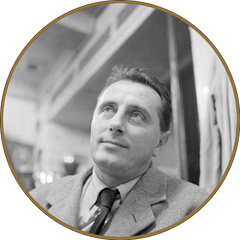
Ennio Morlotti was an Italian painter among the main protagonists of the Italian and European artistic scene of the second half of the twentieth century. He was born in Lecco, on Lake Como, in 1910, into a modest family. His childhood was spent in a boarding school, where he showed exceptional talent in his studies.
In 1923, he began working as an accountant in an oil mill and later as an employee in a paint factory and a worker in a mechanical factory until 1936. Despite the difficulties in his life, Ennio Morlotti dedicated himself to the study of ancient art in churches and museums, also developing an interest in contemporary art. He decided to pursue his passion for painting and obtained his artistic maturity diploma as a private candidate at Brera.
After leaving the factory, he moved to Florence and enrolled at the Academy of Fine Arts, where he was mentored by Felice Carena and graduated with top marks presenting a thesis on Giotto. In 1937, thanks to the proceeds from the sale of three paintings exhibited in a competition dedicated to the Lecco landscape, Ennio Morlotti went to Paris, where he had the opportunity to admire the original works of his beloved artists Cézanne and Picasso. This trip had a significant impact on his artistic formation.
In 1940, Ennio Morlotti joined the artistic group called Corrente, inspired by the magazine Corrente di vita giovanile, directed by Ernesto Treccani. The movement was oriented towards French expressionism, from Van Gogh to the Fauves. In 1945, he married Anna and the following year joined the Italian Communist Party, remaining a member for six months. Despite economic difficulties, this period was very productive culturally for the artist. He signed the Manifesto of Realism, joined the New Front of the Arts, and held his first solo exhibition at the Galleria Il Camino in Milan.
In 1948, after the XXIV Venice Biennale, Ennio Morlotti defined his artistic position, distancing himself from the members of the group who defined themselves as realists. In the 1950s, he produced some of the most significant works of informal art not only in Italy but also in Europe. The Venice Biennale hosted his works several times, recognizing his talent and artistic importance.
In the following years, Ennio Morlotti continued to exhibit in important national and international exhibitions. In 1988, at the Venice Biennale, his large material figures amazed critics for their expressive power and the sense of space that characterizes them. Ennio Morlotti worked passionately until the last years of his life, dedicating himself to larger paintings and developing a new interest in Romanesque architecture.
Ennio Morlotti died suddenly in Milan in 1992, leaving a legacy of works that testify to his importance in Italian and European art of the second half of the twentieth century. His painting is distinguished by its organic density, deep participation in nature, and his desire to achieve harmony and hallucination in light. Ennio Morlotti remains forever one of the great masters of contemporary art, whose work continues to inspire and fascinate art lovers worldwide.