

Painter
Piero Dalle Ceste
Italy, 1912–1974
Stay up to date with this artist
Leave your email to receive updates on newly available artworks and news about this artist.
Artworks by Piero Dalle Ceste
1 artwork

Biography of Piero Dalle Ceste
In the history of twentieth-century Italian painting, alongside the avant-garde and abstract experimentation, a figurative tradition capable of engaging with large architectural spaces and the demands of religious narrative survives. Piero Dalle Ceste is a significant exponent of this tradition: a painter of monumental frescoes, but also the creator of portraits, landscapes, and still lifes, he skillfully alternated the solemnity of ecclesiastical commissions with more…
Read the full biographyClose the biography
In the history of twentieth-century Italian painting, alongside the avant-garde and abstract experimentation, a figurative tradition capable of engaging with large architectural spaces and the demands of religious narrative survives. Piero Dalle Ceste is a significant exponent of this tradition: a painter of monumental frescoes, but also the creator of portraits, landscapes, and still lifes, he skillfully alternated the solemnity of ecclesiastical commissions with more intimate easel painting, sensitive to light and everyday life.
L'childhood and formative years
Born on November 1, 1912, in Refrontolo, in the Treviso area, Dalle Ceste spent his childhood marked by his father's death in 1918 and his time in orphanages, first in Veneto and then in Turin. It was in this city that his talent for drawing found a structured path of training. He attended the Enrico Reffo School of Sacred Art, studying with Luigi Guglielmino, and continued his studies at the Albertina Academy of Fine Arts, where he would later also teach. L’interest in architecture, explored through university courses, helped develop his particular attention to the relationship between image and building, which would become decisive in his large-scale mural decorations.
Early commissions and religious painting
L’s sacred art was one of the artist’s main fields of activity from the outset. Among his early artworks is the Madonna of the Rosary, created in the early 1930s for the parish church of Refrontolo. Subsequent commissions led him to work on increasingly challenging surfaces: altarpieces, apses, presbyteries, and domes required not only mastery of drawing but also the ability to arrange figures and movement in relation to the space and the viewer’s point of view.
In his decorative cycles, the composition often unfolds through diagonals, upward movement, and groups of figures linked by light. The style remains clearly figurative and easy to read, but the construction of the scenes reveals rigorous technical preparation: each figure must find its place in a whole designed to be viewed from below, at a distance, and under varying lighting conditions. The decoration is therefore not simply an enlarged image, but a project conceived to engage with the architecture.
Frescoes of Piedmont
One of his most representative projects is the decoration of the dome of the New Sanctuary of Our Lady of the Flowers in Bra, dedicated to the Coronation of the Virgin. The scene is arranged according to the geometry of the dome, with the Virgin Mary at the center of a complex arrangement of angels and other figures; the pendentives depict female figures from the Old Testament, including Eve, Esther, Judith, and Mary. The distribution of colors, warm tones, and movement of the figures guide the eye toward the focal point of the composition, creating unity in a complex architectural space.
L’s oeuvre extended to numerous other religious buildings, especially in Piedmont, including the Sanctuary of Mary Help of Christians and the Church of Saint Rita in Turin, the Church of the Assumption in Montanaro, and places of worship in Alba, Alessandria, Asti, and Caramagna Piemonte. Alongside fresco painting and oil painting, he also worked with mosaics and stained glass, disciplines in which drawing and design remain essential. This variety of techniques reflects a unified vision of the religious setting, in which images help create an overall visual experience.
Portraits, Landscapes, and Easel Painting
Away from large mural surfaces, the artist cultivated a more intimate body of work, devoted mainly to portraits of women and children, interiors, landscapes, and still lifes. Here, the solemnity of monumental decoration gives way to more immediate observation: faces, complexions, and atmospheres become opportunities to modulate light and color. His easel painting is often associated with a post-impressionist sensibility in realism, which also reflects a connection with the Venetian color tradition.
The human figure remains a connecting thread between the two fields. In frescoes, it takes part in a collective narrative, while in portraits it acquires an individual identity, conveyed through drawing and tonal nuances. Although her activity is documented primarily in painting, there is insufficient evidence relating to individual artworks to present prints or lithographs as a central area of her oeuvre: here, too, it is necessary to distinguish between original drawings and prints.
Recognition and Artistic Legacy
In 1967, Dalle Ceste received the Chamber of Commerce of Alessandria Award for La Maddalena; two years later, in 1969, he held his first solo exhibition at the Art Gallery of the Piemonte Artistico e Culturale Association in Turin. L’The exhibition offered an opportunity to consider independently a body of work that the public knew mainly through church commissions. He died in Turin in 1974, leaving an artistic legacy spread across churches, sanctuaries, and private collections. His oeuvre attests to the vitality of figurative painting, which, even in the mid-20th century, could maintain a direct connection with the tradition of the great fresco and the sensibility of portraiture.
Do you like Piero Dalle Ceste?
Leave your email to receive updates on newly available artworks and news about this artist.
ART IN YOUR SPACES
The art of Piero Dalle Ceste in your spaces
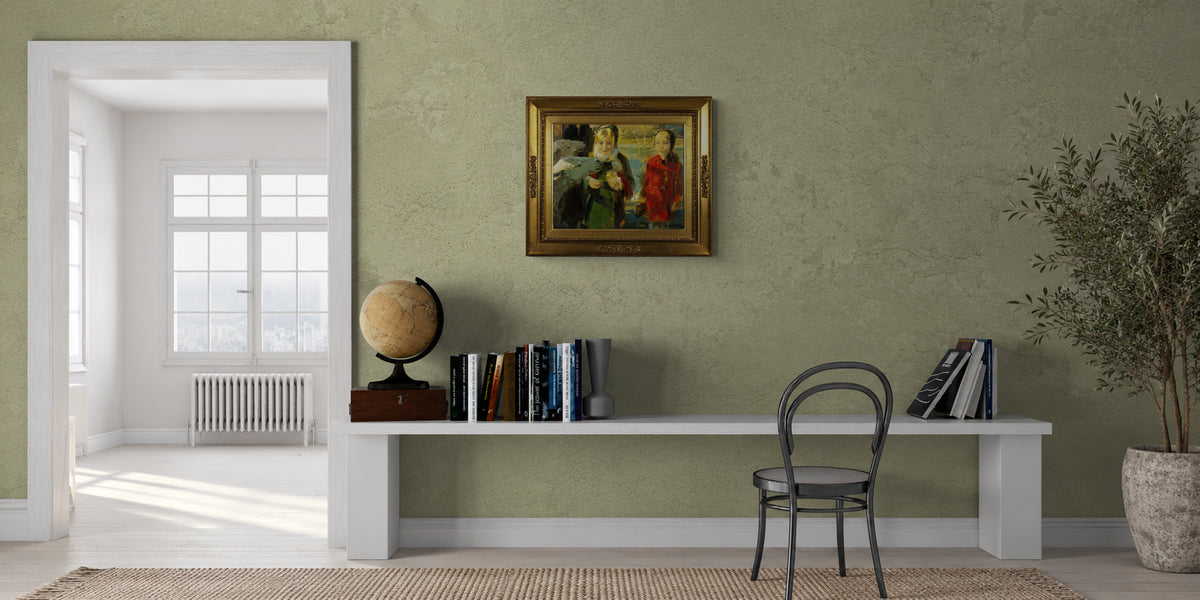
Choosing an artwork by Piero Dalle Ceste means making room for an individual artistic language. The artworks gathered here suggest combinations and perspectives to bring into your own surroundings, letting art guide your gaze.
DISCOVER THE ARTIST
Frequently asked questions
Answers to common questions about Piero Dalle Ceste, the artist’s life, artworks and value on the art market.
Who was Piero Dalle Ceste?
Piero Dalle Ceste was an Italian painter of the twentieth century, trained at the Albertina Academy in Turin. He is best known for his sacred art, with frescoes, altarpieces and decorations created in numerous churches, particularly in Piedmont.
What subjects did Piero Dalle Ceste paint?
In his production, mainly religious subjects are documented: Virgins, saints, evangelical episodes and large choral compositions. His artworks include the altarpieces from the church of Santa Chiara in Bra and the Last Supper frescoed in Nizza Monferrato in 1943. His activity also includes easel painting and portraits.
How to recognize an authentic signature of Piero Dalle Ceste?
The signature is a clue, not independent proof. Comparison with documented specimens, provenance, examination of the technique and any archival documentation are important.
What is the difference between a painting and a print attributed to Dalle Ceste?
A painting is generally a unique example; a print can be an original art, if created through an authorized matrix and edition, or a reproduction. Technique and edition size must be clearly declared.
What does the value of an artwork by Piero Dalle Ceste depend on?
The evaluation depends on authenticity, technique, size, conservation, provenance and truly relevant market comparisons. Without verifiable data it is not reliable to indicate figures.
Discover more artists
Explore more leading figures in modern and contemporary art

