
Painter
Gastone Breddo
Italian, 1915 – 1991
Stay up to date with this artist
Leave your email to receive updates on newly available works and news about this artist.
Works by Gastone Breddo
1 work

Gastone Breddo
Gastone Breddo (Padua, 1915 – Calenzano, 1991) was an Italian painter, printmaker, art critic, and teacher. His artistic exploration developed from tonal painting toward an increasingly free form of figuration, characterized by lyrical relationships between color and form. After studying in Venice and Bologna, he actively participated in Italian artistic life through exhibitions, writing, and teaching. In 1958, he was awarded a solo room at…
Read the full biographyClose the biography
Gastone Breddo (Padua, 1915 – Calenzano, 1991) was an Italian painter, printmaker, art critic, and teacher. His artistic exploration developed from tonal painting toward an increasingly free form of figuration, characterized by lyrical relationships between color and form. After studying in Venice and Bologna, he actively participated in Italian artistic life through exhibitions, writing, and teaching. In 1958, he was awarded a solo room at the Venice Biennale and a national prize. His output includes paintings, drawings, and artworks in print, including important lithographs created for literary editions. From 1964 to 1983, he directed the Academy of Fine Arts in Florence.
Training in Padua, Venice, and Bologna
Gastone Breddo was born in Padua on June 15, 1915. His father was a goldsmith and engraver, a family environment that fostered contact with the arts and the working of materials. He studied art in Venice and later in Bologna, where he came into contact with Virgilio Guidi's teaching. His training took place during a period of transformation in Italian painting. Alongside the experiences of the Italian Novecento, artists pursued explorations of color and light and less rigidly naturalistic representation. From the outset, Breddo showed particular attention to the tonal construction of the image.
Early painting studies
Breddo's early artworks belong to the field of figurative painting. The relationship between color and light plays a fundamental role. L'artista looks to the Venetian tradition, but also to the example of Giorgio Morandi, especially in his attention to compositional balance. Forms are arranged through measured chromatic relationships. The representation retains recognizable references, but gradually tends to prioritize atmosphere. This approach would become one of the most characteristic aspects of his artistic research.
L's exhibition debut and Italian artistic life
From the second half of the 1930s, Breddo took part in Italy's major art exhibitions. His exhibition activity intensified from 1936 onward. During the same years, he was also very active in publishing. He contributed to cultural magazines and periodicals, including Italian Youth, Il Bò and L'Architrave. Writing was an important part of his career. Breddo did not limit himself to producing artworks, but also took part in the debate on the transformations of contemporary painting.
Venice and artistic encounters
During the years he spent in Venice, he came into contact with numerous leading figures in Italian art. The artists mentioned in biographical sources include Arturo Martini, Filippo de Pisis, Giorgio Morandi, Renato Birolli, Osvaldo Licini, Giuseppe Santomaso and Virgilio Guidi. Exposure to different experiences helped broaden his sensibility. Particularly important was the opportunity to observe artistic languages ranging from lyrical figuration to freer experiments with color. Breddo's painting gradually developed a personal character, in which nature was reinterpreted through chromatic structure.
Color as an expressive element
One of the fundamental aspects of Breddo's artistic research is the role of color. The composition does not depend exclusively on drawing. It is above all the relationships between hues that construct space and define the atmosphere. The forms may appear simplified and immersed in a suspended dimension. Color does not merely describe objects, but also helps express an emotional state. Critics have recognized a lyrical component in his painting, sometimes accompanied by a feeling of melancholy. This sensibility distinguishes Breddo from more rigidly geometric approaches.
From naturalism to abstract synthesis
As he matures, Breddo gradually moves away from naturalistic representation. Landscape and figure may remain starting points, but they are transformed through independent relationships between line and color. Composition tends to become freer. Recognizable elements lose some of their descriptive function. L’artist seeks a kind of painting capable of suggesting emotions without depending on faithful reproduction of reality. This evolution leads him toward a personal form of lyrical abstraction. The transition does not represent a sudden break, but rather the development of a sensibility already present in his early artworks.
The 1958 Venice Biennale
One of the most important moments in his career is his participation in the 1958 Venice Biennale. On this occasion, Breddo has a room of his own and receives one of the official national prizes. The recognition confirms the position the artist has achieved in the Italian art scene. His presence at the Biennale is part of a long exhibition career that began at earlier editions. His artworks are also presented at the Rome Quadriennale and in numerous national exhibitions. Institutional recognition accompanies a now mature painterly practice.
L’s critical work and publications
Breddo pursues an intense career as a critic and journalist. He collaborates with cultural and art periodicals, writes essays, and takes part in conferences. Among his most significant experiences is his collaboration with the Gazzetta Veneta between 1947 and 1948. He also directs the bulletin of the Galleria Antico Martini in Venice. This activity testifies to an interest in art that extends beyond individual production. Breddo considers critical reflection an integral part of artistic life.
Prints and lithographs
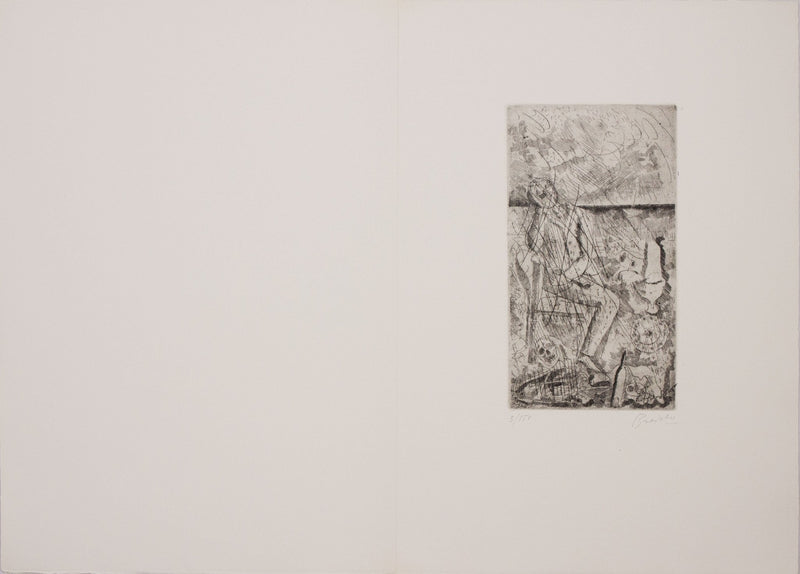
Original printmaking represents an important component of Breddo's production. Alongside paintings, he creates prints and lithographs, developing a language in which painterly sensibility engages with the possibilities of printmaking. Lithography allows him to construct images through the relationship between mark and surface. The chromatic element, fundamental to painting, finds new possibilities for synthesis in printmaking. Breddo also participates in important publishing projects. These include illustrating the volume Man of My Time by Salvatore Quasimodo, together with other Italian artists.
In 1973, he created ten lithographs for the volume dedicated to 50 Years of Poetry by Eugenio Montale, published by Mondadori-Gallimard. These works testify to the relationship between image and literature, particularly significant for an artist also involved in writing.
Leaching and directing the Academy of Florence
In 1963, Breddo was appointed to a teaching position at the Liceo Artistico in Venice. That same year, he was appointed professor of painting at the Accademia di Belle Arti di Firenze. From 1964 to 1983, he directed the institution. Learning and administrative work therefore occupied a significant part of his career. Through teaching, he helped train new generations of artists. His leadership of the Academy complemented his painting and graphic work, confirming his role in the artistic culture of Italy in the second half of the twentieth century.
The final years and artistic legacy
Gastone Breddo died in Calenzano, in the province of Florence, on March 11, 1991. His work represents a significant journey between figuration and abstraction. The lyrical character of his color and the increasing freedom of his forms are the main elements of his artistic inquiry. His engravings and lithographs extend this sensibility through the language of original printmaking. His contribution to the history of Italian art also includes his critical, editorial, and teaching work, carried out over many decades.
Do you like Gastone Breddo?
Leave your email to receive updates on newly available works and news about this artist.
Gastone Breddo
Art that lives in your spaces
Choosing a work by Gastone Breddo means making room for an individual artistic language. The works gathered here suggest combinations and perspectives to bring into your own surroundings, letting art guide your gaze.

DISCOVER THE ARTIST
Frequently asked questions
Answers to common questions about Gastone Breddo, the artist’s life, works and value on the art market.
Who was Gastone Breddo?
Gastone Breddo was an Italian painter of the twentieth century, associated with a figurative research in which colour, landscape and image construction play an important role. For a precise biographical reconstruction and for the dating of individual works it is preferable to consult exhibition catalogs and specific documentation, avoiding generic attributions.
What subjects do we encounter in Gastone Breddo's paintings?
In his production, figurative and landscape themes come together, addressed with attention to the chromatic relationships and the structure of the composition. The subjects and solutions change in the different phases: to correctly identify a painting it is useful to start from the title, the date and reliable photographs of the work.
How to read color in Gastone Breddo's works?
Color is not just used to describe an object: it can organize space, suggest depth and determine the rhythm of the surface. To understand a painting it is best to observe contrasts, backgrounds, tonal transitions and the relationship between figure and background, avoiding attributing undocumented symbolic meanings.
How to verify the signature of a painting by Gastone Breddo?
The signature must be compared with documented examples and read together with the support, technique, provenance and any labels on the back. A graphic similarity is not definitive proof of authenticity. In case of doubt, the verification should be entrusted to a specialist with access to documentation and comparative works.
What elements influence the value of Gastone Breddo's works?
Technique, dimensions, period, subject, state of conservation, provenance and comparable sales results count. An oil on canvas and a work on paper do not necessarily have the same market. For a reliable evaluation it is necessary to precisely identify the work and compare it with truly similar works.