
Painter and illustrator
Flavio Costantini
Italy, 1926–2013
Stay up to date with this artist
Leave your email to receive updates on newly available artworks and news about this artist.
Artworks by Flavio Costantini
1 artwork

Biography of Flavio Costantini
Flavio Costantini (Rome, 1926 – Genoa, 2013) developed an immediately recognizable figurative language, in which precise drawing coexists with an unsettling vision of history. A painter, illustrator, and graphic designer, he transformed political episodes, literary narratives, and places of memory into images of great formal clarity. Black outlines, rigorous perspectives, and controlled fields of color define scenes that, beneath an apparent narrative clarity, question the…
Read the full biographyClose the biography
Flavio Costantini (Rome, 1926 – Genoa, 2013) developed an immediately recognizable figurative language, in which precise drawing coexists with an unsettling vision of history. A painter, illustrator, and graphic designer, he transformed political episodes, literary narratives, and places of memory into images of great formal clarity. Black outlines, rigorous perspectives, and controlled fields of color define scenes that, beneath an apparent narrative clarity, question the violence of power, the fragility of the individual, and the contradictions of modernity.
From the Sea to the Discovery of Literature
Born in Rome on September 21, 1926, Costantini did not pursue a traditional academic education. After qualifying as a deep-sea captain, he served in the Italian Navy and then in the Merchant Navy, sailing international routes between 1951 and 1954. Travel broadened his cultural horizons, while reading became a decisive experience: he was particularly drawn to Franz Kafka, whose Amerika and The Trial he began illustrating. L’his fascination with characters trapped in dark and relentless mechanisms of authority foreshadows many themes in his later painting. In 1955, he abandoned sailing and settled in Rapallo, choosing to devote himself to art full-time.
Graphic Design and the Development of a Style
Back in Italy, he works in applied graphic design, collaborating in Santa Margherita Ligure on the design of fabrics for Portofino Prints. In this environment, he meets Emanuele Luzzati, with whom he establishes a lasting personal and professional relationship; he later works at the Firma graphic design studio in Genoa and creates projects for companies and publishers. L’experience teaches him to organize image spaces with extreme precision, control the relationship between line and color, and make even a complex composition easy to read. These skills do not remain confined to commercial graphics, but become the foundation of his painting.
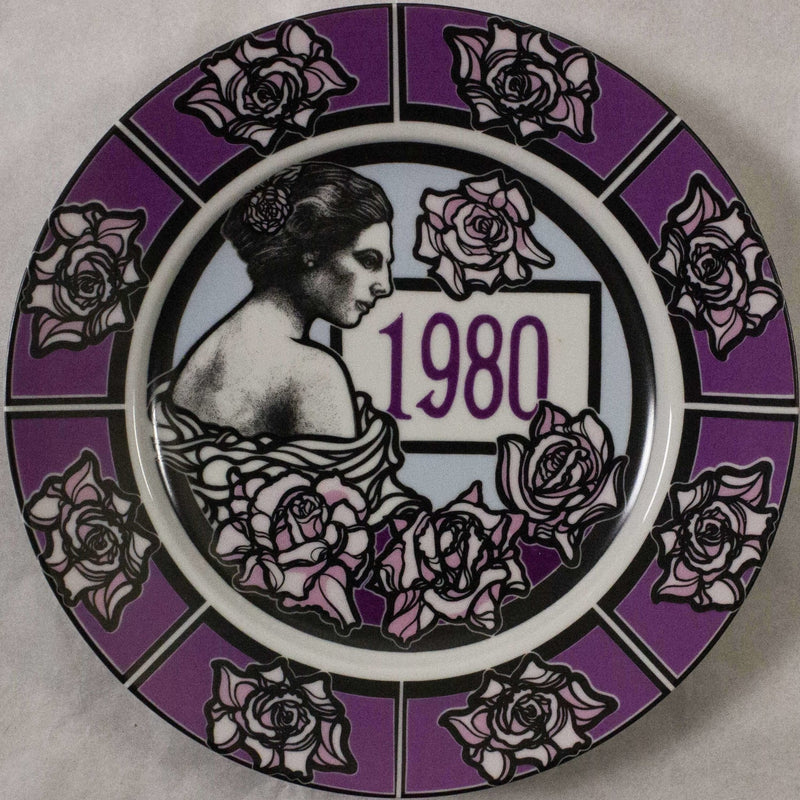
The figures, buildings, and objects are outlined with a crisp black line, often accompanied by almost architectural perspectives and colors laid down in solid areas. The meticulous detail is not an end in itself, however: it creates a sense of stillness and tension, as if the image were holding the moment before or after a dramatic event. It is precisely this contrast between formal order and the unease of the subject matter that makes his style unmistakable.
The history of anarchism and its relationship with power
From 1963 onward, Costantini systematically explored the history of the anarchist movement, also delving into the subject through readings on revolutionary movements and a trip to the Soviet Union. Before painting, he studied photographs, documents, testimonies, and visual materials, carefully reconstructing clothing, uniforms, buildings, and settings. His tempera paintings of attacks, trials, executions, and leading figures of anarchism from the nineteenth and twentieth centuries thus take on the character of meticulous visual chronicles, while still retaining his personal interpretation.
L’s interest is not limited to illustrating a political position. Through these events, the artist reflects on the conflict between individual freedom and authority, the responsibility of institutions, and the way violence runs through history. Even when the figures are identifiable and the places are described precisely, the image retains a symbolic dimension: the individual episode becomes a starting point for a broader question about the human condition.
Tempera, screenprint and prints
Tempera occupies a central place in Costantini’s oeuvre because it makes it possible to control color surfaces and preserve the crispness of the drawing. The same need for definition finds a natural counterpart in screenprint, a printing technique that produces uniform areas of color and precise outlines through successive applications of color. L’artista uses it for historical compositions, urban views, and symbolic images, alongside drawings, collages, and other graphic experiments.
For those exploring his prints, it is important to distinguish an original screenprint from a reproduction by checking the stated technique, print run, any numbering, the signature, and the publisher. The graphic quality of his style can also be found in various kinds of published objects, which are not necessarily of the same artistic or collectible nature.
Kafka, the Titanic, and spaces of memory
Literature remained with him throughout his career. In addition to Kafka, Costantini engaged with Joseph Conrad and Fyodor Dostoevsky and, among other artworks, created illustrations for Edmondo De Amicis’s Cuore, published in a 1977 Olivetti edition, and for Heart of Darkness. The relationship between word and image was also essential in his collaborations with periodicals such as Corriere della Sera, la Repubblica, Panorama, and L'Espresso: his drawings do not merely accompany a text, but convey its deeper tensions.
In the 1980s, he explored the sinking of the Titanic, interpreting it as a metaphor for modern faith in progress and its vulnerability. The ocean liner’s architecture, furnishings, and objects are depicted with almost obsessive order; knowing the fate that awaits them makes that perfection even more dramatic. In his mature oeuvre, his interest in empty spaces becomes more pronounced, with human presence surviving in them as a trace. Costantini also created portraits of writers, philosophers, and cultural figures, approached with the same graphic intensity.
An original position in Italian art
He died in Genoa on May 20, 2013, leaving behind a body of work that is difficult to associate with any single movement. His originality lies in bringing together painting, illustration, documentary research, and literary reflection without subordinating one form of expression to another. The precision of his images does not diminish the complexity of their themes, but makes it more evident: every building, object, or figure seems to hold a story that continues to challenge us.
Do you like Flavio Costantini?
Leave your email to receive updates on newly available artworks and news about this artist.
Flavio Costantini
Art that lives in your spaces
Choosing an artwork by Flavio Costantini means making room for an individual artistic language. The artworks gathered here suggest combinations and perspectives to bring into your own surroundings, letting art guide your gaze.

DISCOVER THE ARTIST
Frequently asked questions
Answers to common questions about Flavio Costantini, the artist’s life, artworks and value on the art market.
Who was Flavio Costantini?
Flavio Costantini (1926–2013) was an Italian artist and illustrator also known for his representations of historical episodes and figures linked to anarchism. His figurative language combines graphic precision, narrative construction and a personal use of color.
Why did Flavio Costantini paint the history of anarchism?
Costantini dedicated an important part of his research to events and characters of the anarchist movement, transforming them into images with a strong narrative impact. The artworks reflect a specific historical and political interest, but not all of his production is reduced to this theme.
What characteristics does Flavio Costantini's style have?
Many compositions show clear drawing, defined architecture and figures, almost theatrical shots and controlled chromatic backgrounds. The formal precision often contrasts with the tension of the events depicted.
Has Flavio Costantini created serigraphs and graphic artworks?
His production includes artworks on paper and images also disseminated through printing processes. For each example it is essential to verify whether it is an original artwork, published art graphics or editorial reproduction, as well as signature and print run.
How is the authenticity of an artwork by Flavio Costantini verified?
Provenance, purchase documents, publications, comparisons with known artworks and, when available, archival references are useful. The mere presence of a signature does not constitute definitive proof; for a print the nature of the edition must also be verified.