
Sculptor
Eliseo Mattiacci
Italy, 1940–2019
Stay up to date with this artist
Leave your email to receive updates on newly available artworks and news about this artist.
Artworks by Eliseo Mattiacci
2 artworks

Biography of Eliseo Mattiacci
Eliseo Mattiacci (Cagli, 1940 – Fossombrone, 2019) was one of the most original Italian sculptors of the second half of the twentieth century. His research has transformed industrial materials, metallic structures and essential shapes into artworks that question energy, gravity, space and the cosmic dimension. Close to the experiments of Arte Povera, but difficult to reduce to a single current, Mattiacci has constructed a language…
Read the full biographyClose the biography
Eliseo Mattiacci (Cagli, 1940 – Fossombrone, 2019) was one of the most original Italian sculptors of the second half of the twentieth century. His research has transformed industrial materials, metallic structures and essential shapes into artworks that question energy, gravity, space and the cosmic dimension. Close to the experiments of Arte Povera, but difficult to reduce to a single current, Mattiacci has constructed a language in which sculpture seems to compete with invisible forces.
The beginnings and the breakdown of the traditional form
Trained in a climate of radical renewal, Mattiacci established himself in the 1960s with artworks that abandoned the idea of sculpture as a statue placed on a pedestal. The artwork could extend across the floor, articulate itself in space, use objects and materials from the industrial world. An emblematic example is "Tube" (1967), a large flexible structure that makes the relationship between matter, environment and physical behavior evident.
The importance of these experiences lies in the change of perspective: the sculpture is no longer necessarily a closed volume to be contemplated from a distance, but a presence that redefines the place in which it is installed. The material retains its own characteristics, and these characteristics become part of the meaning of the artwork.
The artwork of the 1960s must be understood in the climate of a broader transformation of sculpture. The artwork was no longer necessarily a finished object to be observed frontally: it could involve duration, arrangement in space and even the methods of its assembly. Mattiacci contributed to this transformation without giving up the physical presence of the materials. On the contrary, he enhanced its weight, elasticity, resistance and possibility of movement.
Pipe is significant precisely because the industrial material is not disguised to imitate something else. Its concrete identity remains evident and becomes the starting point of the aesthetic experience. The shape arises from the behavior of the object in space and from the relationship it establishes with the place and with those who pass through it.
Energy, weight and movement
Apparently opposite tensions recur in Mattiacci's oeuvre. On the one hand there are weight, attraction and gravity; on the other momentum, suspension and movement. Metallic elements, discs, rods and geometric structures can evoke measuring instruments or scientific devices, without turning into illustrations of science.
The artist seems to wonder how to make forces perceivable that we do not see directly. Sculpture then becomes a kind of poetic experiment: it does not explain the world with formulas, but puts us face to face with its energy. The balance of a structure, the direction of an axis or the relationship between two masses acquire an almost narrative intensity.
The tension between weight and suspension introduces a temporal dimension. Even an immobile structure can suggest a possible movement: a disk seems to be able to rotate, a rod indicates a direction, a mass makes you perceive the force that holds it. The viewer thus imagines an energy that is not necessarily represented in a literal way.
This quality distinguishes his research from a simple spectacular use of industrial materials. The shapes do not try to imitate a machine, but to make us perceive fundamental relationships: attraction and distance, balance and imbalance, measure and openness towards the unknown. The language may appear essential, but requires attention to the proportions and concrete conditions of the installation.
The cosmic dimension
A significant part of his production looks at the universe, at celestial bodies and at the relationships between the planet and space. The cosmic reference should not be understood as astronomical decoration: it is a way of placing human experience in a broader dimension. The shapes can recall orbits, magnetic fields or systems of forces, but they maintain a concrete presence, made of iron, surfaces and real measurements.
The landscape and the environment play an essential role, especially in large-scale artworks. Some sculptures seem to dialogue with the horizon, the sky and the ground. The viewer does not just observe an object: he perceives a relationship between his own body, the artwork and the surrounding space.
In large-scale artworks, the sky and horizon can become visual elements as important as the metal. The distance between two parts of the sculpture is not a neutral void: it allows the surrounding space to enter the artwork. The same structure can therefore be perceived differently in a closed environment and in an open landscape.
The reference to the cosmos is also connected to the desire to measure what goes beyond the human scale. Disks, trajectories and alignments can recall astronomical phenomena, but their effectiveness derives from the immediate relationship with the spectator's body. The dimension of the universe is felt precisely through the comparison with heavy, tangible objects placed on the earth.
Design, project and authenticity of the editions
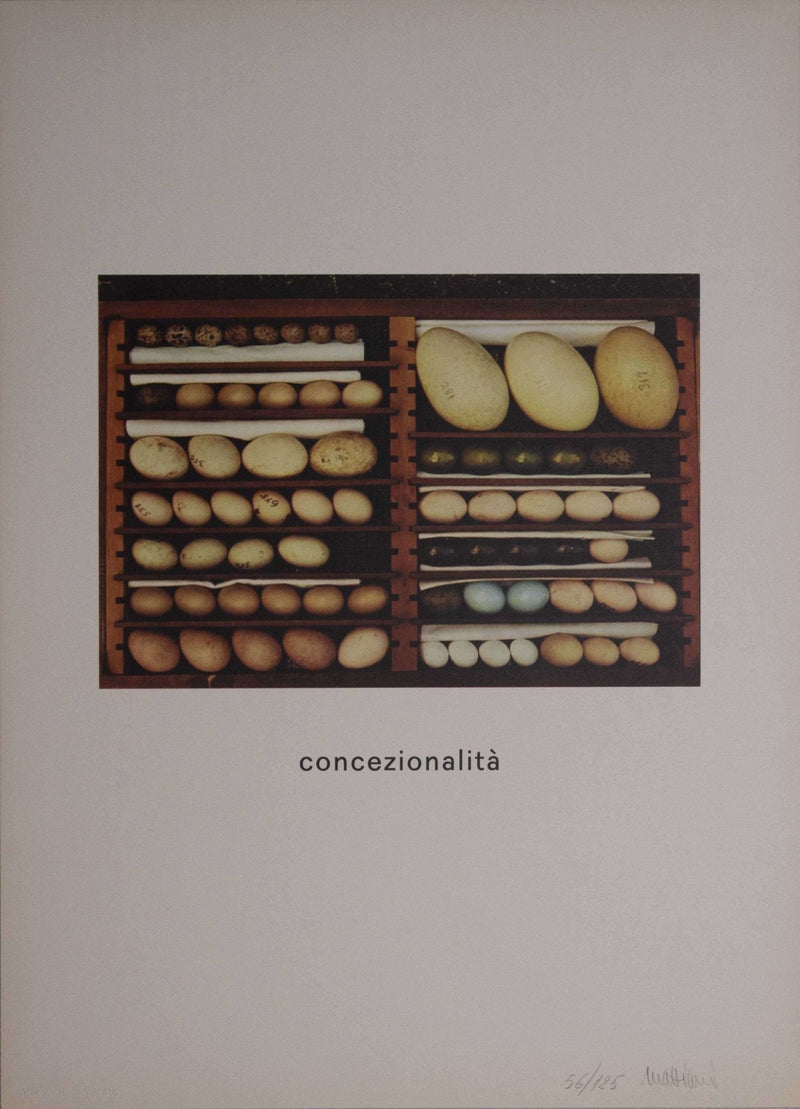
Drawings, studies and artworks on paper allow us to understand the relationship between intuition and construction. They are not necessarily simple preparations for sculpture: they can possess an autonomous expressive value. For graphic or multiple artworks it is necessary to verify the technical procedure, signature, print run and documentation, avoiding automatically attributing a technique based on the appearance of the image.
Drawing takes on a particular role in research so attentive to spatial relationships. A sheet can record the intuition of a balance, indicate the arrangement of elements or develop an autonomous image. For this reason it is useful to distinguish design studies from artworks conceived as completed artworks, avoiding considering them all simple preparatory documents.
Photographs of installations also require careful reading: they may be essential evidence of an installation, but they do not automatically coincide with original photographic artworks. In graphic editions, however, it is necessary to identify the actual process and the artist's relationship with the matrix or with the printing project. The correct definition of the medium is fundamental to understanding what you are observing.
Mattiacci's lesson is that sculpture can speak about something immense through very concrete materials. Iron and space, gravity and imagination, precision and mystery coexist in a language that continues to question our way of being in the world.
The conservation and presentation of these artworks pose specific questions. In a sculpture composed of different elements, position, orientation and method of assembly can be part of the identity of the artwork. For an artwork on paper, support, state of conservation, possible print run and documentation become central. The precision of the information helps to respect the nature of the individual specimen.
The strength of his research also lies in relating two apparently incompatible scales: that of the human body and that of the universe. The artworks do not claim to explain the cosmos scientifically, but they make perceivable the desire to establish contact with what surpasses us. It is a form of concrete imagination, built with weight, measure and matter.
Do you like Eliseo Mattiacci?
Leave your email to receive updates on newly available artworks and news about this artist.
Eliseo Mattiacci
Art that lives in your spaces
Choosing an artwork by Eliseo Mattiacci means making room for an individual artistic language. The artworks gathered here suggest combinations and perspectives to bring into your own surroundings, letting art guide your gaze.
DISCOVER THE ARTIST
Frequently asked questions
Answers to common questions about Eliseo Mattiacci, the artist’s life, artworks and value on the art market.
Who was Eliseo Mattiacci?
Eliseo Mattiacci (1940–2019) was an Italian sculptor associated with experimental research that developed from the late 1960s. His artworks explore matter, energy, space and relationships with cosmic and natural phenomena.
Was Eliseo Mattiacci part of Arte Povera?
His research is close to the experimental climate of Arte Povera and shares its attention to materials and processes, while maintaining a personal path. The classification should therefore be understood as a historical context, not as an exhaustive definition of his oeuvre.
Why did Mattiacci use industrial materials?
Metals, tubes and other industrial materials allowed him to relate weight, balance, tension and movement. The physical qualities of the objects become part of the meaning, rather than being hidden by a traditionally figurative form.
What role does the cosmos have in Mattiacci's artworks?
The interest in planets, orbits and invisible forces passes through different phases of his research. The sculptures suggest connections between the human body, terrestrial space and cosmic dimensions, often through essential structures.
How to document an artwork by Eliseo Mattiacci?
For sculptural or installation artworks, materials, measurements, any assembly instructions, provenance, exhibitions and photographic documentation are important. Artworks on paper instead require a specific analysis of the technique and possible edition.