
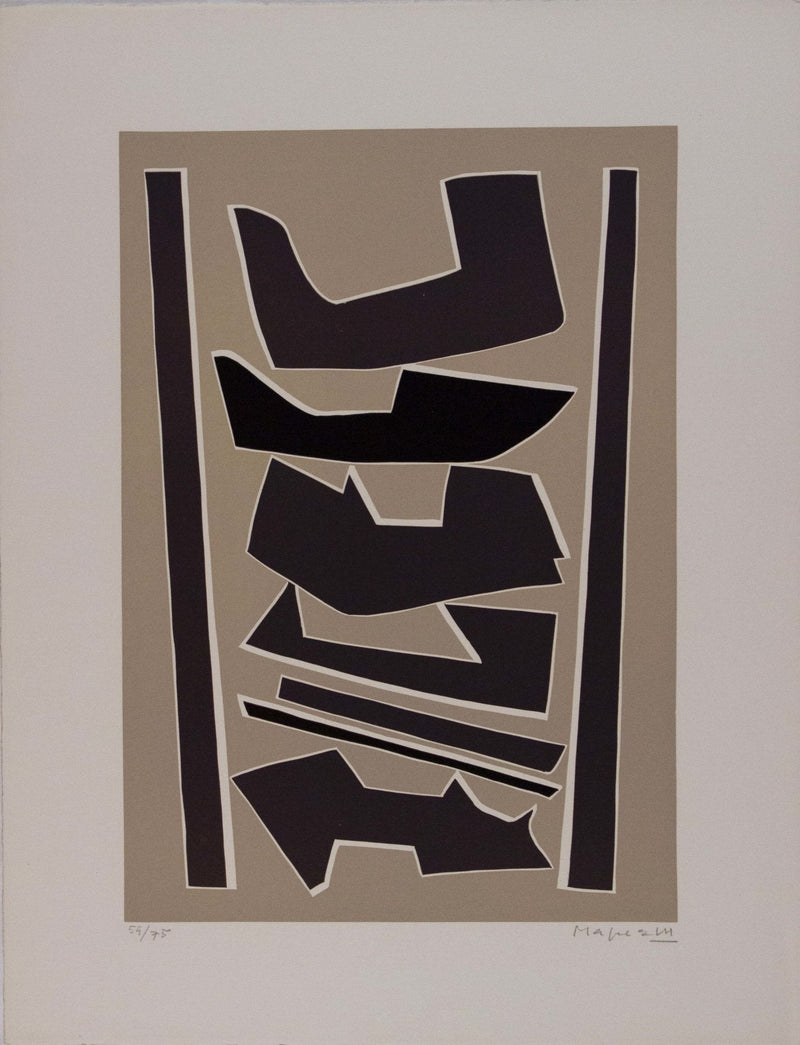
Painter
Alberto Magnelli
Italy, 1888–1971
Stay up to date with this artist
Leave your email to receive updates on newly available artworks and news about this artist.
Artworks by Alberto Magnelli
1 artwork

Biography of Alberto Magnelli
Alberto Magnelli (Florence, 1888 – Meudon, 1971) is a fundamental figure in the history of European abstractionism. His research demonstrates how a language constructed with shapes, surfaces and colors can possess poetic force without representing recognizable objects. Self-taught, he soon developed a personal vision, going through figurative and non-figurative phases before arriving at a rigorous synthesis, in which each element seems to find its own…
Read the full biographyClose the biography
Alberto Magnelli (Florence, 1888 – Meudon, 1971) is a fundamental figure in the history of European abstractionism. His research demonstrates how a language constructed with shapes, surfaces and colors can possess poetic force without representing recognizable objects. Self-taught, he soon developed a personal vision, going through figurative and non-figurative phases before arriving at a rigorous synthesis, in which each element seems to find its own balance.
Florence, Paris and the first abstractions
Magnelli's training occurred through direct observation of painting, with particular attention to the Tuscan masters of the fourteenth and fifteenth centuries. His interest in the construction of images and the organization of space remained important even when he abandoned figuration. He frequented the Florentine Futurist environment without permanently joining the movement; during a stay in Paris in 1914 he came into contact with the climate of the avant-garde and with personalities such as Guillaume Apollinaire, Fernand Léger and Pablo Picasso.
Already in 1915 he created abstract artworks of notable precociousness, in which simplified forms and chromatic backgrounds acquired autonomy. It was not a question of eliminating reality to obtain a geometric exercise, but of seeking a new visual energy. The so-called lyrical explosions of 1918 show a more dynamic and fragmented phase, followed in the 1920s by a temporary return to figurative images, often constructed with a strong architectural sense.
The precociousness of this choice acquires particular significance if we consider that, in those years, abstraction did not yet constitute a shared language. Magnelli did not follow a linear progression from figure to geometry: he experimented, returned to dealing with the visible and then resumed the non-figurative path with greater awareness. This movement between different possibilities makes his path less schematic than the image of an exclusively abstract painter might suggest.
In the first experiments, the interest in the distribution of masses and the tension between neighboring elements is already evident. Color is not just used to fill an outline: it determines the weight of the shapes and the rhythm of the whole. Even when a composition retains references to the outside world, the space is organized as a system of autonomous relationships. It is a principle that will remain recognizable in mature artworks.
The «Stones» and the return to abstraction
Having moved to Paris in 1931, Magnelli faced a new decisive transition. The "Stones" series, inspired by rocky shapes, transformed a natural starting point into a reflection on the volume, weight and organization of masses. Blocks and profiles appear suspended in measured spaces: color helps to make monumental shapes that do not require a narrative.
From the mid-1930s, the artist progressively returned to more rigorous abstraction. The compositions are built through the dialogue between curves, straight lines, compact surfaces and color intervals. Balance is never purely mathematical: a curve can soften a severe structure, while an intense background introduces unexpected tension.
To understand the quality of his compositions it is useful to focus on the intervals. Shapes do not act in isolation: a dark surface acquires energy next to a brighter one, a curve seems to ideally continue beyond the limit of a background, a diagonal introduces movement into an otherwise stable structure. The gaze thus travels through the artwork in directions that do not coincide with a story or a perspective vanishing point.
His geometry, moreover, is never just a repertoire of regular figures. Profiles can be irregular, masses sometimes appear clipped or overlapped, and color relationships produce sensations of closeness, distance and depth. An important part of its originality compared to other European abstract experiences lies in this balance between rigor and freedom.
Research during the war and the post-war period
During the years of the Second World War he stayed in Grasse, in the south of France, entering into relationships with other protagonists of modern art, including Hans Arp and Sonia and Robert Delaunay. He also experimented with different media and processes, including collage and artwork on slate. These experiences broadened his reflection on surfaces, matter and the arrangement of elements.
After the war, his painting consolidated a language recognizable for compositional precision and chromatic refinement. Magnelli's abstraction does not renounce emotion: it concentrates it in the relationships between forms. A color changes meaning depending on what surrounds it; a surface appears to advance or retreat without resorting to traditional perspective.
The international reception of his oeuvre contributed to consolidating Magnelli's role as a point of reference for non-figurative painting of the second half of the twentieth century. His experience, gained between Italy and France, demonstrates how much cultural exchanges have influenced the formation of the avant-garde: it is not a history divided into national schools, but a network of research that influences each other.
Even the apparent simplicity of his later artworks is the result of a selection process. Deleting one element means modifying all the others; moving a surface alters the perception of nearby colors. For this reason his compositions require a slow vision: what initially appears stable gradually reveals contrasts, oscillations and internal tensions.
Artworks on paper and attention to technique
Alongside the paintings, drawings, collages and graphic artworks allow us to observe his creative process. When evaluating a print attributed to Magnelli it is essential to distinguish original graphic artwork, editorial reproduction and subsequent print: the mere presence of an abstract composition does not identify a technique. Title, date, printing process, publisher, possible print run and documentation must be verified for each copy.
Artworks on paper are particularly interesting because they allow us to follow the relationship between invention and discipline. A drawing can make the path of a line more evident, while collage highlights the physical overlap of surfaces. In prints, however, the relationship between project, matrix and impression introduces further steps: the color can be organized in successive layers and the precision of the margins becomes part of the reading of the image.
For a correct commercial description it is therefore important to avoid generic formulas such as "abstract printing" when it is possible to identify the process. Lithography, screen printing and offset reproduction involve different processes; the pencil signature or numbering, alone, are not enough to define originality. Bibliographic documentation and comparison with known examples help to place each artwork in the artist's production and present it with transparency.
Its historical importance lies in having contributed to defining an autonomous and international abstraction, capable of uniting formal discipline and invention. Looking at an artwork by Magnelli means observing how form itself becomes content.
Do you like Alberto Magnelli?
Leave your email to receive updates on newly available artworks and news about this artist.
Alberto Magnelli
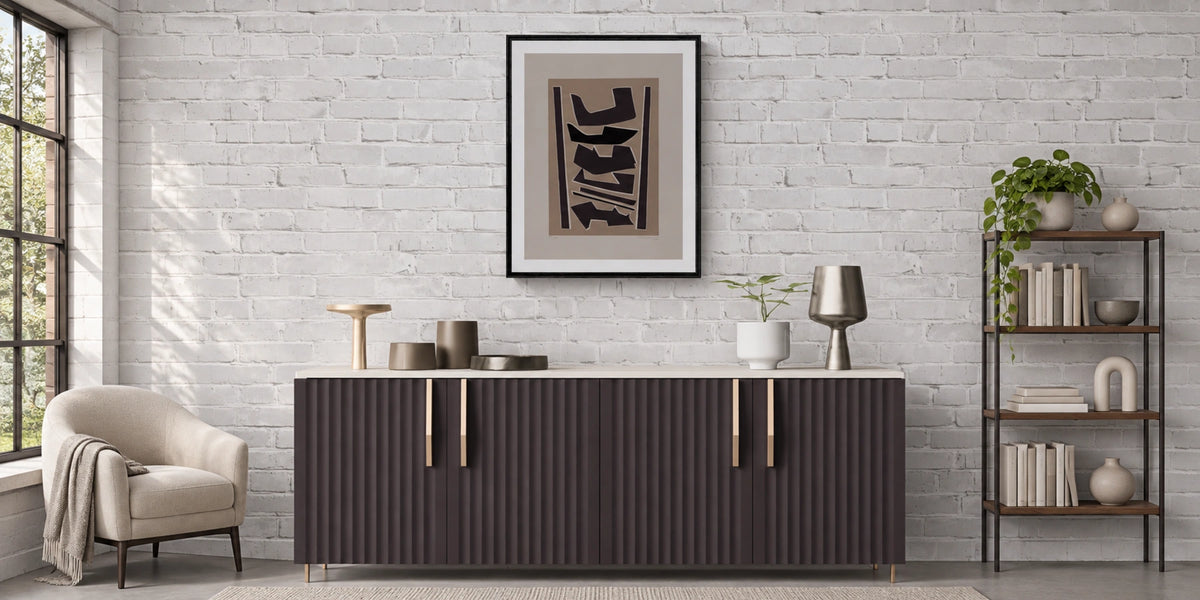
Art that lives in your spaces
Marks, rhythms and forms: artworks by Alberto Magnelli bring a new sense of balance to a space. Understated furnishings give the composition room to breathe and invite you to rediscover it every day from a different perspective.
DISCOVER THE ARTIST
Frequently asked questions
Answers to common questions about Alberto Magnelli, the artist’s life, artworks and value on the art market.
Who was Alberto Magnelli?
Alberto Magnelli (1888–1971) was an Italian painter among the protagonists of European abstraction. After figurative experiences and avant-garde experiments, he developed a painting based on geometric shapes, chromatic relationships and rigorous structures, working for a long time in France.
When did Alberto Magnelli start painting abstract artworks?
Magnelli tackled non-figurative language early on as early as the 1910s, and then went through other phases before consolidating mature abstract research. His path is not linear: precisely the alternation between recognizable forms and autonomous constructions is one of the most interesting aspects.
What are Alberto Magnelli's painted stones?
During the 1930s Magnelli created artworks inspired by stones and rock masses, transforming them into stylized volumes. This phase constitutes an important passage between the observation of reality and the subsequent abstract compositions.
How can you recognize Magnelli's abstract style?
In his mature artworks there are clear backgrounds, irregular geometric shapes and a studied balance between colors and spaces. More than representing objects, Magnelli constructs autonomous visual relationships, often with a strong architectural sense.
What elements influence the value of an artwork by Magnelli?
The period, technique, dimensions, provenance, documentation and presence in catalogs or exhibitions count. A unique painting and an original print have different market characteristics: for a reliable evaluation it is necessary to examine the specific example.