
Sculptor and Painter
Marino Marini
Italy, 1901–1980
Stay up to date with this artist
Leave your email to receive updates on newly available artworks and news about this artist.
Artworks by Marino Marini
1 artwork

Biography of Marino Marini
Marino Marini (Pistoia, 1901 – Viareggio, 1980) is one of the greatest Italian sculptors of the twentieth century. His oeuvre is immediately recognizable for some recurring themes - horses and riders, female figures, portraits and jugglers - which the artist has transformed into images of extraordinary symbolic strength. Through sculpture, painting and graphics, Marini has explored the relationship between balance and fall, vitality and fear,…
Read the full biographyClose the biography
Marino Marini (Pistoia, 1901 – Viareggio, 1980) is one of the greatest Italian sculptors of the twentieth century. His oeuvre is immediately recognizable for some recurring themes - horses and riders, female figures, portraits and jugglers - which the artist has transformed into images of extraordinary symbolic strength. Through sculpture, painting and graphics, Marini has explored the relationship between balance and fall, vitality and fear, harmony and restlessness.
The roots of the form
Trained in the Tuscan artistic environment, Marini initially also dedicated himself to painting and engraving, before concentrating on sculpture. He looked carefully at Etruscan art, ancient sculpture and Italian tradition, but his language was not a simple revival of the past. Archaic forms offered him a way to search for essential images, capable of communicating without superfluous details.
In the first decades of the twentieth century he developed figures with a compact construction, often characterized by vibrant surfaces and deliberately simplified proportions. His interest focused on volume and physical presence: a figure must not only be observed, but perceived as a body in space.
Marini's training took place in a period in which many European artists were looking for an alternative to both naturalistic imitation and the extreme fragmentation of the avant-garde. The comparison with ancient cultures offered him a different path: recovering the clarity of a silhouette, the weight of a body and the strength of a gesture without giving up the anxieties of the present. The reference to archaism, therefore, was not a nostalgic escape, but a resource for inventing new forms.
Light plays a decisive role in modeling surfaces. A newly smoothed area can alternate with a rougher part; a twist of the body changes the pattern of the shadows and suggests an internal tension. These choices become particularly evident when observing the sculpture from multiple points of view, because no single image exhausts the relationship between figure and space.
The horse and the rider: a changing symbol
The theme of the knight became central to his research. In a first phase, horse and man may appear united by a firm, almost solemn balance. As the years pass, especially in the dramatic climate of war and post-war times, this relationship breaks down: the horse tenses, becomes agitated, raises its neck; the rider loses confidence, opens his arms or seems about to fall.
The transformation should not be read as a simple stylistic variation. The image of the knight becomes a reflection on the crisis of modern man. The harmonious relationship between human beings and nature, once a symbol of dominance and trust, gives way to an unstable condition. Marini thus manages to transform an ancient subject into a profoundly contemporary figure.
The equestrian motif also allows us to clearly follow the evolution of his language. The first images often retain a collected measure and a sense of stability; the subsequent ones accentuate the fracture of relationships, the opening of the arms, the tension of the horse's neck and the instability of the whole. It is not necessary to read each sculpture as a direct illustration of a historical episode: the value of the symbol lies precisely in the ability to collect collective experiences in an essential form.
The rider is no longer just the one who leads. It becomes a figure exposed to the risk of losing control, and the horse ceases to be a simple attribute of power. This reversal makes the theme understandable even to those who do not know the history of sculpture: balance and its loss belong to everyone's experience.
Pomone, portraits and jugglers
Alongside the knights, the Pomone - female figures ideally linked to fertility and vital fullness - represent another fundamental nucleus. Their solid bodies, often frontally exposed, suggest a relationship with the earth and with generating energy. In portraits, however, the artist searches for character through a plastic synthesis that avoids meticulous description. The jugglers and circus figures introduce the theme of movement and precariousness.
The variety of subjects reveals a profound coherence: Marini does not seek the anecdote, but the human condition expressed through the body. Even deformations and simplifications are tools of emotional intensification.
The Pomone offer a significant counterpoint to the more dramatic images of knights. Their compact presence recalls stability and continuity, while the variations in installation and surfaces prevent the theme from turning into a fixed pattern. Even in portraits, Marini searches for a truth that does not coincide with photographic resemblance: character emerges from the relationship between head, neck, inclination and material.
Jugglers introduce another form of precarious balance. The body is caught in the possibility of movement and in the tension that precedes or follows a gesture. Through these thematic nuclei, the artist builds a recognizable but non-repetitive vocabulary, in which each variation modifies the meaning of the image.
Painting, lithography and etching
Marini's oeuvre does not end in bronze. Drawings, paintings and prints show an autonomous research on color and sign. In lithography, the image is processed on a matrix suitable for planographic printing, exploiting the repulsion between fatty substances and water; in etching, however, the design is chemically engraved on metal. The two techniques produce different visual qualities and should not be confused with reproductions of sculptures or paintings.
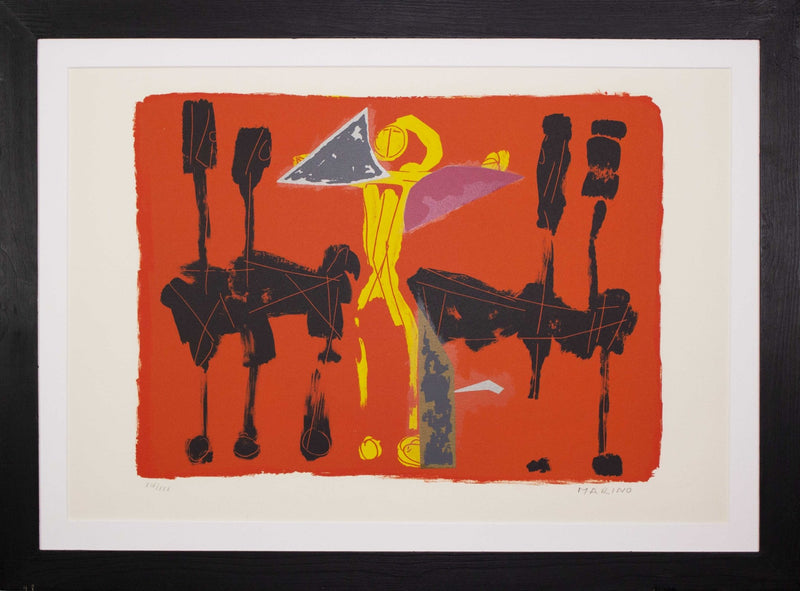
Marini's graphic production should not be considered a simple two-dimensional translation of the sculptures. On the sheet, color can become the protagonist, freeing itself from the constraints of volume and building autonomous relationships between figures and background. The horse, the rider or the female figure maintain their identity, but are reinterpreted through backgrounds, overlays and signs that belong specifically to the language of print.
The original lithograph allows you to obtain effects close to the freedom of drawing and, in color editions, requires careful organization of the printing steps. The etching instead highlights the relationship between the engraved line and the surface of the paper. However, not all of Marini's graphic artworks belong to these two techniques: each sheet must be described on the basis of verified data, not by analogy with other examples.
For graphic artworks, identification of the technique, print run, signature, paper, publisher and catalog references are particularly important. Sculptural castings also require specific verification of edition, foundry and provenance. Marini's legacy consists in having given apparently simple forms a rare ability to speak of the tensions of their time.
The distinction between a single artwork, a sculptural multiple and an original print is particularly important in an artist who has worked with different media. A bronze casting may belong to a documented edition; a lithograph can be part of a portfolio; a drawing on paper, on the other hand, is a unique example. These are characteristics to be presented clearly, without automatically attributing greater value to one medium than another.
For the collector, direct observation remains essential: quality of the paper, intensity of the impression, margins and conservation contribute to understanding the single sheet. The catalog information then allows it to be linked to the artist's production history. It is in this dialogue between image and documentation that Marini's graphics fully reveal their autonomy.
Do you like Marino Marini?
Leave your email to receive updates on newly available artworks and news about this artist.
Marino Marini
Art that lives in your spaces
Choosing an artwork by Marino Marini means making room for an individual artistic language. The artworks gathered here suggest combinations and perspectives to bring into your own surroundings, letting art guide your gaze.

DISCOVER THE ARTIST
Frequently asked questions
Answers to common questions about Marino Marini, the artist’s life, artworks and value on the art market.
Who was Marino Marini?
Marino Marini (1901–1980) was one of the greatest Italian sculptors of the twentieth century, also active in painting and graphics. It is particularly famous for its equestrian figures and for the representation of the relationship between man, animal and balance.
What do Marino Marini's horses and riders represent?
The horse and rider are a central theme of his oeuvre. Over time the figures become more tense and dramatic: the rider loses stability and the harmonious relationship with the animal transforms into an image of human fragility.
Did Marino Marini also make lithographs and etchings?
Yes. In addition to sculpture, Marini developed an important graphic production, using original printing techniques. The artworks on paper allow us to follow the transformations of his recurring subjects through line, color and composition.
What is the difference between an original sculpture and a reproduction by Marino Marini?
An authentic sculpture must be studied in relation to the model, casting, edition, brands, provenance and specialist documentation. A decorative reproduction is not equivalent to an authorized copy of the artwork. Qualified checks are essential for attributions and authentications.
What does the price of Marino Marini's artworks depend on?
Technique, dating, dimensions, subject, rarity, provenance and exhibition history have an impact. Original sculptures, paintings, drawings and prints belong to different market segments and should not be compared based on the artist's name alone.
Discover more artists
Explore more leading figures in modern and contemporary art


