
Painter
Giuseppe Santomaso
Italy, 1907–1990
Stay up to date with this artist
Leave your email to receive updates on newly available artworks and news about this artist.
Artworks by Giuseppe Santomaso
4 artworks

Biography of Giuseppe Santomaso
Giuseppe Santomaso (Venice, 1907–1990) developed one of the most refined researches in Italian abstract painting of the twentieth century. His oeuvre arises from a profound relationship with Venice, not so much as a repertoire of recognizable views but as an experience of light, color and stratification. In the canvases and artworks on paper, chromatic surfaces, signs and intervals seem to preserve the memory of walls,…
Read the full biographyClose the biography
Giuseppe Santomaso (Venice, 1907–1990) developed one of the most refined researches in Italian abstract painting of the twentieth century. His oeuvre arises from a profound relationship with Venice, not so much as a repertoire of recognizable views but as an experience of light, color and stratification. In the canvases and artworks on paper, chromatic surfaces, signs and intervals seem to preserve the memory of walls, reflections and architecture, while progressively freeing themselves from the direct representation of the landscape.
Training and comparison with Europe
Trained in the Venetian environment, Santomaso soon developed an interest in modern European painting. His attendance at the Biennials and his comparison with the avant-garde contributed to moving him away from a purely descriptive figuration. In the 1940s he participated in the experiences of renewal of Italian art and was among the artists involved in the Fronte Nuovo delle Arti, born in 1946 to promote research open to the transformations of contemporary language.
The subsequent polarization of the debate between realism and abstraction led him to consolidate an autonomous position. In the early 1950s he joined the Group of Eight, promoted critically by Lionello Venturi, together with figures such as Afro, Birolli, Corpora, Moreni, Morlotti, Turcato and Vedova. It was not a question of imposing a uniform style, but of recognizing common ground in the freedom of painting. Santomaso developed in this context a language that would maintain a particularly subtle relationship with the visual memory of his hometown.
The transition towards abstraction does not erase his experience of figurative painting. On the contrary, the ability to observe the structures of an environment and to grasp the relationships between shades continues to act even when the objects are no longer recognisable. The story of the Fronte Nuovo delle Arti also shows how complex it was, in the post-war period, to find a common language between artists who shared the need for renewal but not a stylistic formula. For Santomaso, painting remains a territory of individual experimentation. Membership of the Group of Eight should therefore be understood as participation in a debate, not as adherence to a uniform grammar. This autonomy explains the continuity of his research through different seasons, in which the surface always takes on new configurations without losing its sensitivity to light.
Colour as surface architecture
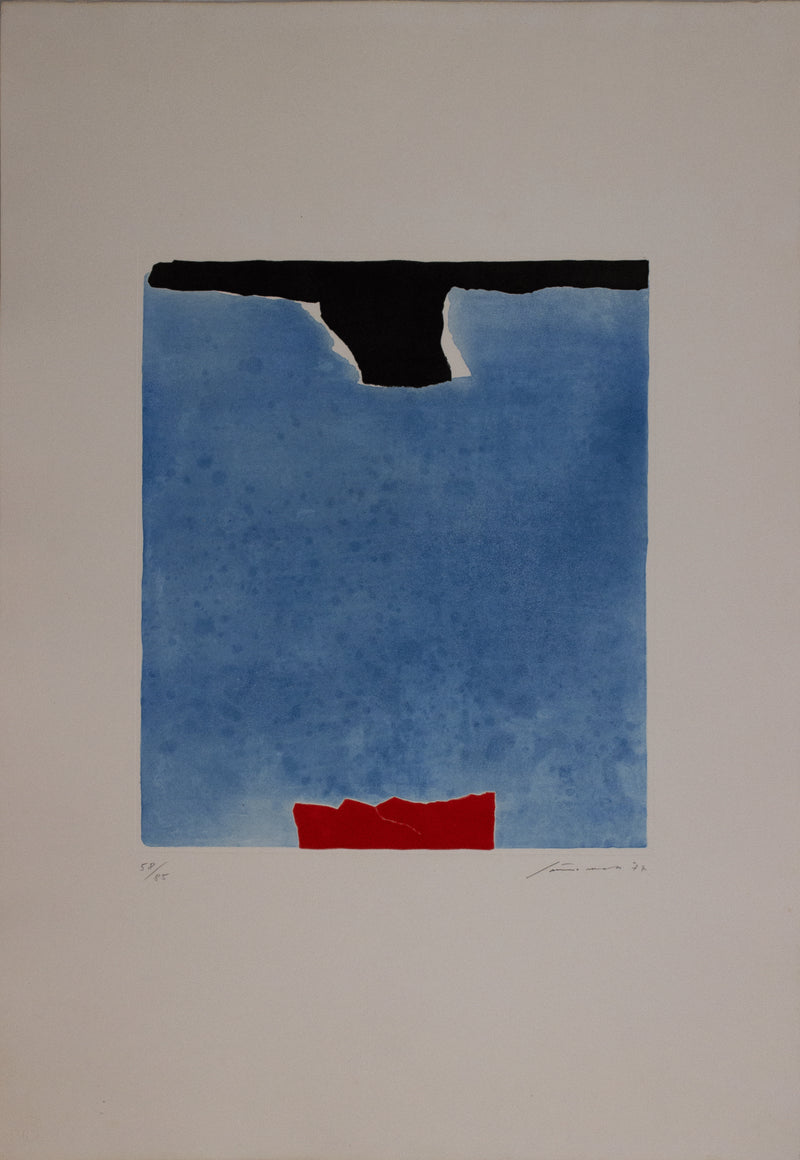
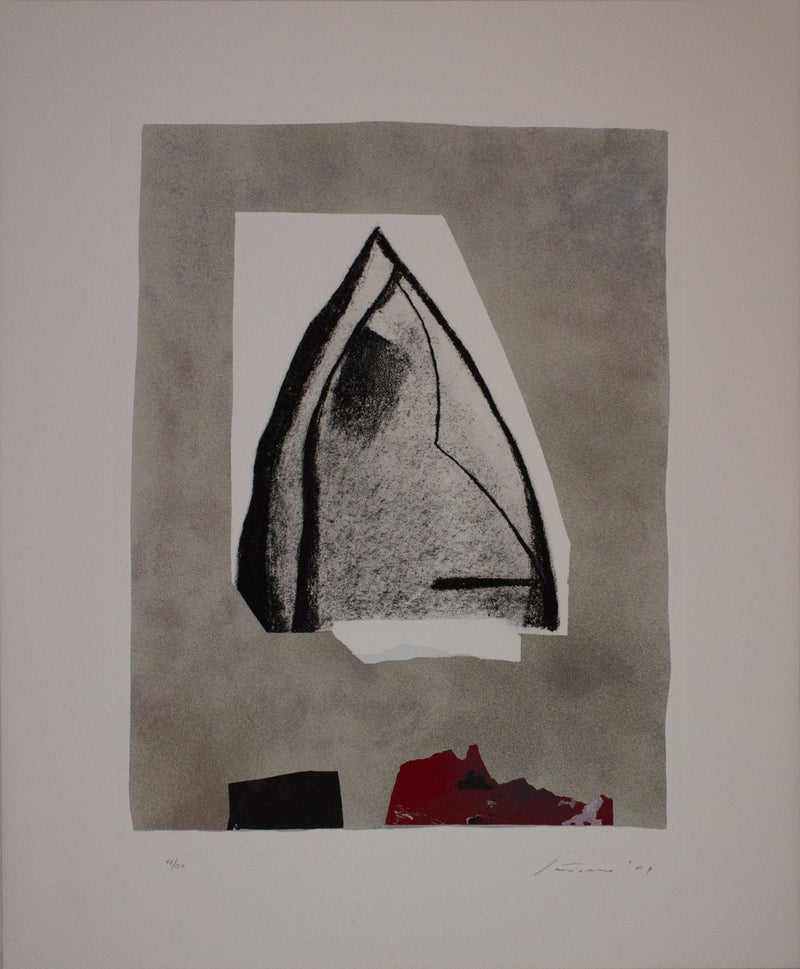
In his mature paintings, color does not simply describe things: it builds space. Light and dark backgrounds, overlaps, glazes and sudden chromatic highlights create a mobile balance, in which each element modifies the perception of the others. The painting sometimes seems to organize itself like a wall worn by time, other times like a set of suspended luminous fragments. It is an abstract vision, but not foreign to sensitive experience.
The Venetian light acts as a memory rather than a naturalistic effect. Even when canals or buildings do not appear, the dialogue between matter and reflection can evoke the city. This ability to transform visual data into pictorial structure distinguishes Santomaso from a purely geometric abstraction: his surfaces maintain an atmospheric, almost tactile quality that invites slow contemplation.
A useful key to understanding is the relationship between construction and appearance. The backgrounds may recall wall fragments, overlapping papers or luminous openings, but they are not organized like a traditional landscape. It is the intervals that create the sensation of depth: a light area can advance in relation to a darker background, while a thin trace connects distant parts. The chromatic matter sometimes seems to absorb the light, sometimes to suddenly return it. In these variations we recognize a profoundly Venetian experience, without the need to identify a specific building or place. Painting does not depict water or stone; however, it can suggest the instability of the reflection and the memory of worn surfaces. The result requires slow observation, because the relationships between the planes emerge progressively. The perception of the surface also changes with distance. Up close, the qualities of the writing and the relationships between the tracks emerge; from a distance the composition can appear as a set of large bright areas. Painting holds these two experiences together without reducing itself to either the material detail or the overall effect.
Lithographs, engravings and artworks on paper
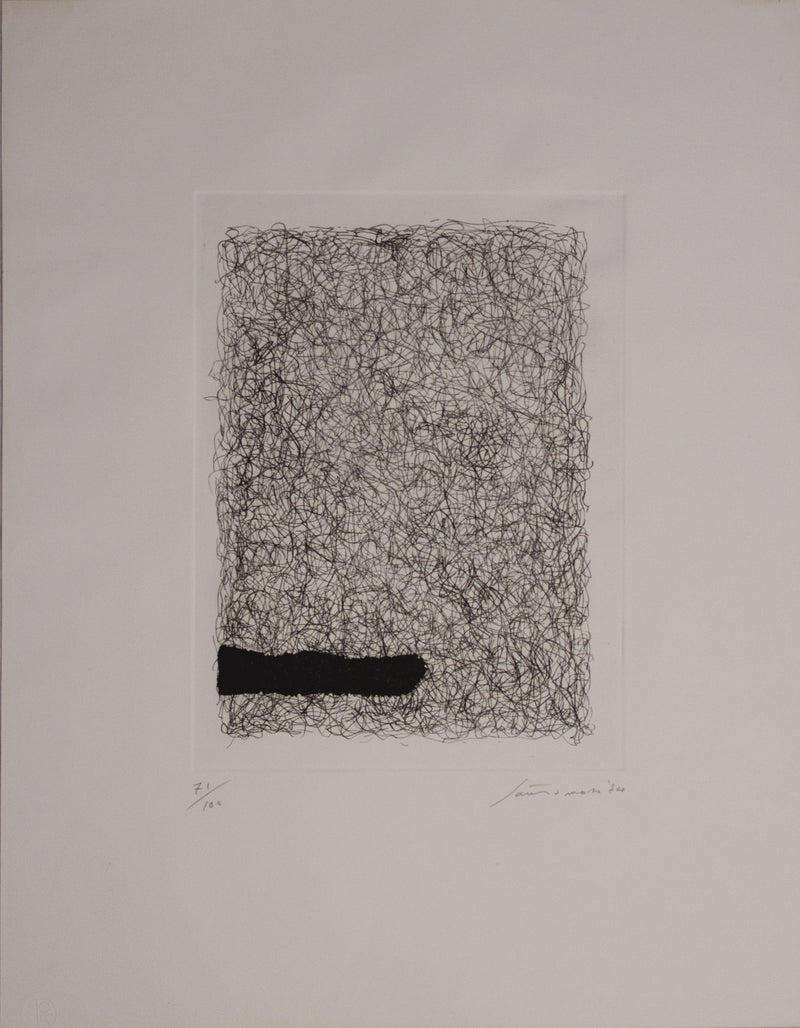
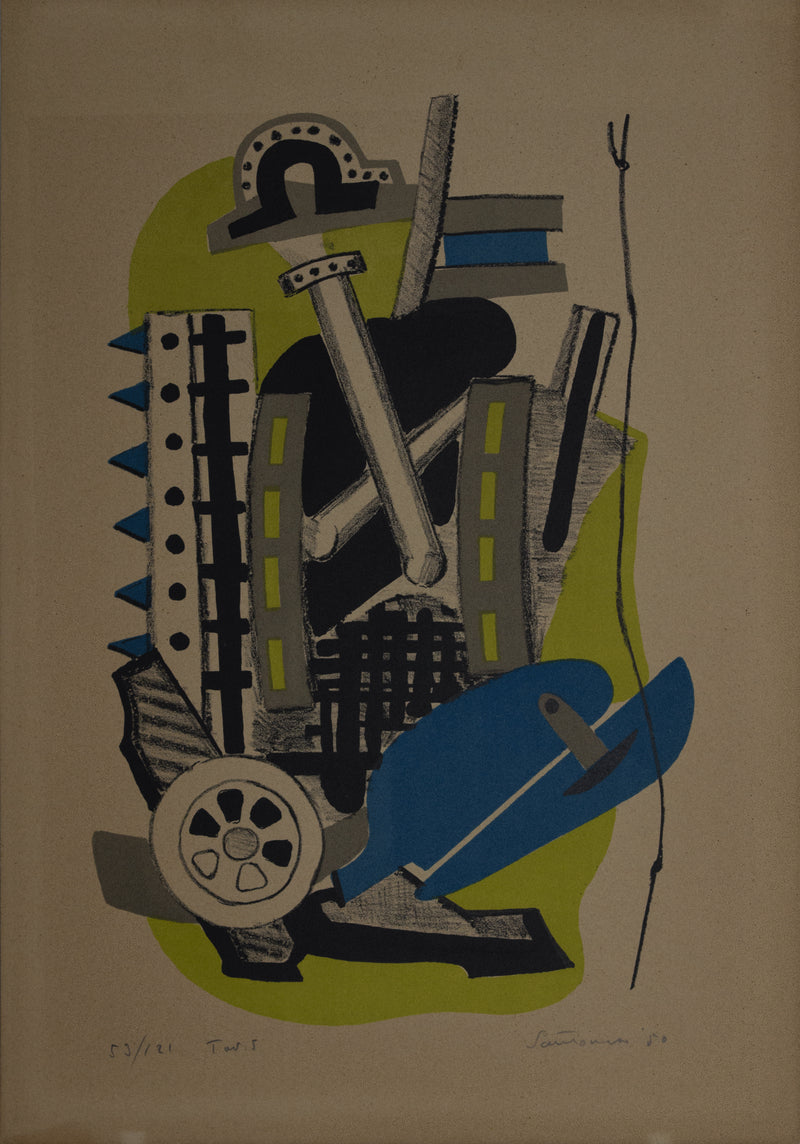
Art graphics occupies a significant place in his career. Lithographs and other artworks on paper allow him to investigate the relationship between sign and color on a scale different from that of large canvases. In lithography, the planographic matrix allows chromatic transitions and line quality that can interact closely with the painting; other procedures, however, produce specific effects and must be identified on a case-by-case basis.
When evaluating an example, it is important to distinguish an original print conceived by the artist from an editorial reproduction. Signature, edition, paper, printer and bibliographical references help to reconstruct the history of the artwork. Santomaso remains a fundamental figure because he showed how abstraction can arise from a concrete experience of the world and transform it into a language of extraordinary chromatic sensitivity.
The artworks on paper deserve an independent reading, not only as evidence of compositions created on canvas. The choice of paper, the quality of the ink and the sequence of chromatic transitions modify the perception of the sign. In the original lithograph the artist can work on a matrix designed for printing; in intaglio techniques the sign instead derives from the engraving of a surface, with different effects of pressure and density. Editorial reproductions, even when of good quality, do not necessarily share the creative process of an original print. For this reason, the description of a copy should indicate, when ascertained, printer, publisher, print run, image and sheet format. In Santomaso's case these details help recognize how color and light have been reimagined for the graphic medium, rather than simply transferred from a painting.
Do you like Giuseppe Santomaso?
Leave your email to receive updates on newly available artworks and news about this artist.
Giuseppe Santomaso
Art that lives in your spaces
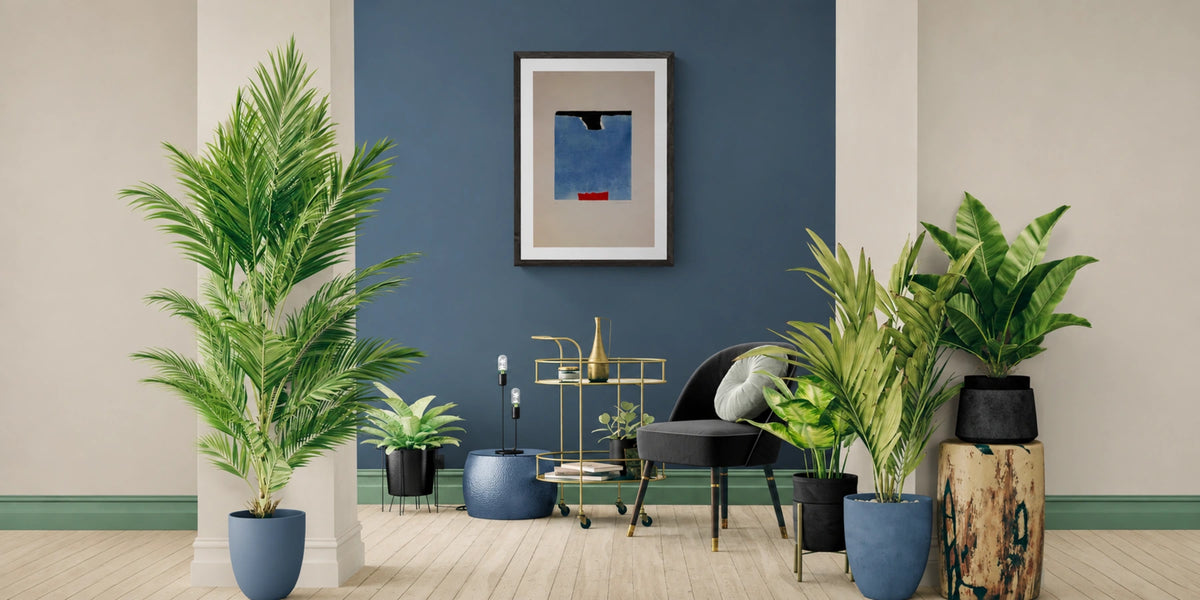
Marks, rhythms and forms: artworks by Giuseppe Santomaso bring a new sense of balance to a space. Understated furnishings give the composition room to breathe and invite you to rediscover it every day from a different perspective.
DISCOVER THE ARTIST
Frequently asked questions
Answers to common questions about Giuseppe Santomaso, the artist’s life, artworks and value on the art market.
Who was Giuseppe Santomaso?
Giuseppe Santomaso (1907–1990) was a Venetian painter among the protagonists of twentieth-century Italian art. From figuration he progressively oriented himself towards an abstract language, in which light, color and structure of the composition become determining elements.
Was Giuseppe Santomaso part of the Fronte Nuovo delle Arti?
Yes, Santomaso participated in the experience of the Fronte Nuovo delle Arti, active after the Second World War. The group brought together different personalities, committed to the renewal of artistic language. Santomaso's subsequent research stands out for its lyrical abstraction and chromatic sensitivity also linked to his Venetian training.
What characteristics do Santomaso's abstract artworks have?
In Santomaso's abstract compositions there are backgrounds of colour, bright contrasts, superimpositions and balanced relationships between shapes. The artwork does not necessarily describe a recognizable subject: it is the relationship between the colors that constructs the visual space. The style varies significantly depending on the period.
Did Santomaso produce original lithographs and screenprints?
The artist's production also includes graphic artworks. For each sheet it is necessary to ascertain the exact technique, because lithography, screen printing and printed reproduction are not equivalent. Numbering, signature and edition information, if present, help identify the specimen.
What to check before purchasing an artwork on paper by Giuseppe Santomaso?
It is advisable to check the support, technique, dimensions of the sheet and image, conservation, provenance and any inscriptions. In the case of an original print it is useful to know the publisher or printer, when documented. A comparison with catalogs and reliable publications can help to correctly identify the artwork.
Discover more artists
Explore more leading figures in modern and contemporary art


