
Painter and printmaker
George Elbert Burr
United States, 1859–1939
Stay up to date with this artist
Leave your email to receive updates on newly available artworks and news about this artist.
Artworks by George Elbert Burr
1 artwork

Biography of George Elbert Burr
George Elbert Burr (Munroe Falls, Ohio, 1859 – Phoenix, Arizona, 1939) was an American painter, draftsman, and printmaker, best known for his etchings devoted to the American landscape. His oeuvre includes mountain views, deserts, trees, architecture, and European landscapes. After a long career as an illustrator for American magazines, Burr developed a personal approach grounded in observing nature. His stays in Colorado and Arizona became…
Read the full biographyClose the biography
George Elbert Burr (Munroe Falls, Ohio, 1859 – Phoenix, Arizona, 1939) was an American painter, draftsman, and printmaker, best known for his etchings devoted to the American landscape. His oeuvre includes mountain views, deserts, trees, architecture, and European landscapes. After a long career as an illustrator for American magazines, Burr developed a personal approach grounded in observing nature. His stays in Colorado and Arizona became especially important in shaping his style. Through etched lines and the interplay of light and shadow, the artist conveyed the atmosphere of the vast spaces of the American West, contributing to the history of landscape printmaking between the nineteenth and twentieth centuries.
Training and an interest in drawing
George Elbert Burr was born on May 14, 1859, in Munroe Falls, Ohio. From a young age, he showed an interest in drawing and observing nature. His artistic training developed largely through practice and professional experience. L's attention to landscape soon became one of the fundamental elements of his oeuvre. Burr observed trees, mountains, waterways, and architecture, seeking to capture their characteristics through line. Precise drawing formed the basis of his later printmaking.
L's work as an illustrator
During the early part of his career, Burr worked as an illustrator for major American periodicals. He collaborated with publications such as Harper's, Cosmopolitan, and Frank Leslie's Weekly. Editorial work required powers of observation, precision, and speed in composing images. He also had the opportunity to travel across the United States for Frank Leslie's Weekly. These experiences allowed him to discover very different landscapes. The geographic diversity of the American land became a fundamental source of inspiration.
The European journey
In 1896, Burr undertook a long journey through Europe. The stay lasted almost five years and included visits to several countries. L's artist observed landscapes, cities, and architecture, further developing his sensitivity. During this period, he created drawings and paintings devoted to the places he visited. Among the documented artworks is Bay at Nevin, Wales, held in the collection of the Smithsonian American Art Museum. The European journey allowed Burr to engage with landscape traditions different from those in America. The depiction of nature nevertheless retained a personal character, founded on attention to light and atmosphere.
The return to the United States
After his stay in Europe, Burr returned to the United States. His oeuvre increasingly focused on creating independent artworks. Landscape became the primary subject. L'the artist was especially interested in the possibilities offered by engraving. The technique makes it possible to construct images through a network of marks capable of conveying depth, light, and structure. The precision he developed through illustration combined with a growing atmospheric sensitivity.
Colorado and mountain landscapes
Burr later settled in Colorado, where he found new subjects. Mountains, trees, and wide-open natural spaces became central to his oeuvre. The mountain landscape offered compositional possibilities different from those of European views. Rocky formations and changes in light made it possible to create images characterized by strong contrasts. Burr sought to convey not only the shape of places, but also their atmosphere. L'engraving became a particularly suitable tool for this exploration.
L'Arizona and the American desert
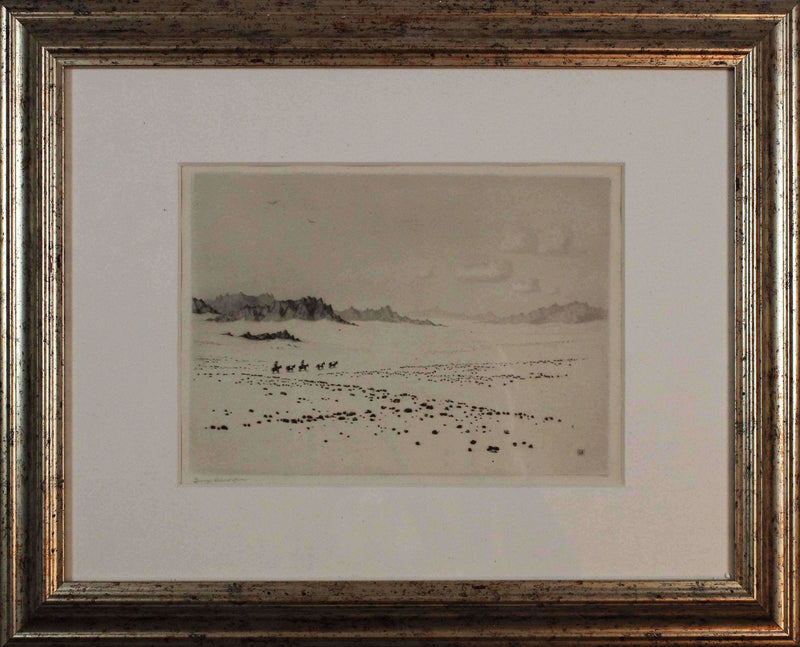
In the following years, Burr moved to Arizona. The desert landscape became one of the most recognizable subjects in his oeuvre. Distant mountains, sparse vegetation, cacti, and vast open expanses offered new expressive possibilities. The desert light profoundly changes how forms are perceived. Shadows can be sharply defined, while spaces appear characterized by a particular brightness. Burr uses engraved marks to suggest these atmospheric conditions. The desert is not portrayed as an empty space. It becomes an environment rich in structures, variations, and details.
L'etching as an artistic language
The etching technique plays a central role in Burr's oeuvre. The process makes it possible to create images using lines engraved on a metal plate. The varying density of the marks helps build tonal values. Burr uses these possibilities to depict rocky surfaces, trees, vegetation, and atmospheric changes. His oeuvre is distinguished by its attention to light. The darkest areas can emphasize the depth of a landscape, while the lighter areas suggest open spaces and brightness.
L'engraving is not used merely as a means of reproduction. It constitutes an independent language, capable of interpreting nature.
The relationship between drawing and printmaking
Drawing forms the basis of Burr's printmaking practice. L'artist observes places directly and studies their structure. Translating them into etchings requires selecting elements. Not every detail needs to be represented with the same intensity. The composition emerges from the relationship between lines, surfaces, and areas of light. This ability to synthesize allows Burr to convey the character of a landscape through relatively simple means. The original print thus maintains a balance between descriptive precision and personal interpretation.
Views and atmospheric sensibility
One of the most important aspects of Burr's oeuvre is its atmospheric quality. Mountains may appear distant and immersed in light. Trees may emerge through delicate contrasts. The desert may be depicted as a succession of planes stretching toward the horizon. L'artist seeks to convey the feeling of a place. Nature is not transformed into a purely decorative image. It retains a tangible presence, observed with care.
The American landscape between the nineteenth and twentieth centuries
Burr's oeuvre is part of the American landscape tradition. Between the late nineteenth and early twentieth centuries, many artists took an interest in the vast spaces of the West. Burr contributed to this tradition through a style closely tied to graphic art. His etchings helped disseminate images of places often far from major cultural centers. The value of his oeuvre lies in its ability to unite geographical observation and artistic sensibility.
The final years and artistic legacy
George Elbert Burr died in Phoenix in 1939. His oeuvre represents a significant contribution to the history of American printmaking. Through etchings, drawings, and paintings, he documented and interpreted European and American landscapes. The images devoted to Colorado and Arizona are particularly important. His oeuvre demonstrates the expressive possibilities of original prints in depicting nature. The engraved line becomes a tool capable of conveying space, light, and atmosphere, transforming the observed landscape into an image of great sensitivity.
Do you like George Elbert Burr?
Leave your email to receive updates on newly available artworks and news about this artist.
George Elbert Burr
Art that lives in your spaces
Choosing an artwork by George Elbert Burr means making room for an individual artistic language. The artworks gathered here suggest combinations and perspectives to bring into your own surroundings, letting art guide your gaze.

DISCOVER THE ARTIST
Frequently asked questions
Answers to common questions about George Elbert Burr, the artist’s life, artworks and value on the art market.
Who was George Elbert Burr?
George Elbert Burr (1859–1939) was an American artist and engraver, known above all for landscapes and views created with graphic techniques. It is particularly associated with representations of the American West and desert landscapes, in which light and atmosphere play a central role.
Why is George Elbert Burr known for desert landscapes?
Burr paid great attention to the arid territories of the Western United States. In his engravings the desert becomes a study of distances, mountains, vegetation and light, not a simple background. The subtle tonal variations allow us to suggest the warmth and breadth of space even in small-sized images.
What printing techniques did George Elbert Burr use?
Burr worked mainly with engraving techniques, including etching, and also produced graphic artworks in which the treatment of shades is important. For each example, the exact technique indicated by reliable catalogs or data sheets must be verified, because terms such as engraving, etching and drypoint are not always interchangeable.
How to recognize an original etching by George Elbert Burr?
A verification considers the engraved sign, any imprint of the plate, the paper, the signature and the origin. The imprint of the plate can be useful, but it does not alone prove originality. For Burr too, it is essential to distinguish a print obtained from an original matrix from a subsequent reproduction of an engraving.
What does the value of George Elbert Burr's engravings depend on?
Subject, rarity, quality of the impression, condition of the paper, signature and provenance influence the market. Some views of the West may be of particular interest, but each print must be examined individually. Stains, yellowing, restorations and trimming can significantly affect the evaluation.
Discover more artists
Explore more leading figures in modern and contemporary art


