

ARTISTIC TECHNIQUES
Mezzotint
From darkness to light, the depth of chiaroscuro.
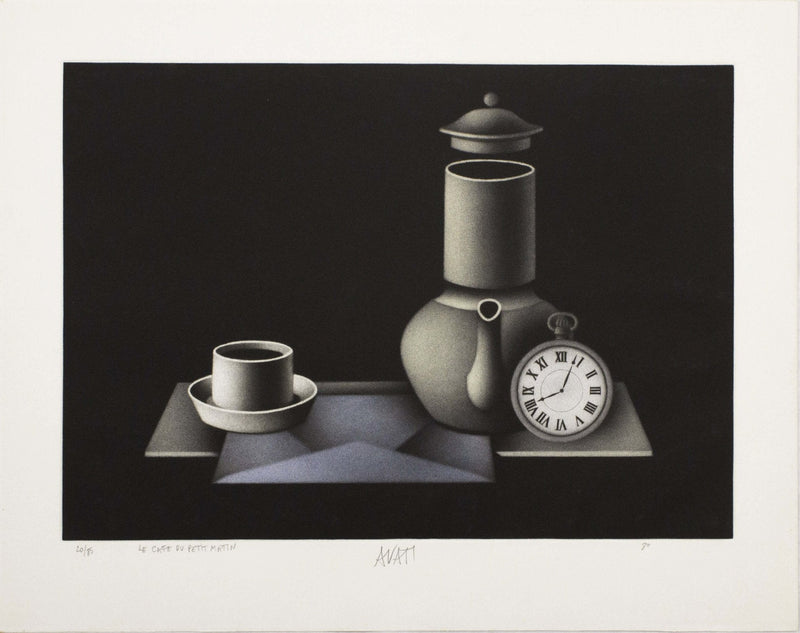
An intaglio technique in which the image emerges from black through soft gradations and finely modulated light.
OUR MEZZOTINTS
Works to discover, choose and live with every day.


UNDERSTANDING ARTISTIC TECHNIQUES
What is mezzotint?
Mezzotint, also known as maniera nera, is a direct intaglio printing technique that produces images characterized by deep chiaroscuro effects and particularly soft tonal transitions. Unlike etching, in which the image is built primarily through incised lines, mezzotint allows the artist to work with gradations of light, creating surfaces that transition gradually from deep black to more delicate tones.
The traditional process involves preparing a metal plate, usually copper, whose surface is made uniformly rough using a tool called a rocker or crescent. This particular preparation allows the plate to hold a large amount of ink and, if printed without further intervention, to produce a black, velvety surface.
The artist then builds the image by reducing or removing the roughness in the areas intended to appear lighter.
Mezzotint is therefore a technique in which the image emerges gradually from darkness through a subtle modulation of tones.
Origins — How and when mezzotint was invented
Mezzotint developed in the first half of the seventeenth century, a period when European artists and printmakers were particularly interested in the representation of light and the expressive possibilities of chiaroscuro.
The invention of the technique is generally attributed to Ludwig von Siegen, a German-born amateur artist who, in 1642, created a portrait of Amalia Elisabeth of Hesse-Kassel using a process capable of producing delicate tonal gradations.
The innovation was considerable. The most common intaglio techniques, such as engraving and etching, generally built shadows using parallel lines, cross-hatching, and varying depths of incision.
Mezzotint, by contrast, offered the possibility of creating continuous tonal surfaces, in which the transition from light to shadow was particularly soft.
The process was later perfected by other printmakers, including Prince Rupert of the Rhine, who helped spread it throughout Europe.
During the second half of the seventeenth century, the technique attracted considerable interest, especially for its ability to translate the luminous qualities of paintings into print.
However, it was in England, between the eighteenth and early nineteenth centuries, that mezzotint achieved particularly widespread popularity.
Numerous British printmakers used it to create portraits and reproductions of paintings, enhancing the softness of flesh tones, the depth of backgrounds, and the richness of surfaces.
Artists and printers such as John Smith, Richard Earlom, and Valentine Green helped develop a printmaking tradition in which mezzotint achieved results of remarkable refinement.
The technique became particularly suited to translating the paintings of major portraitists, including Joshua Reynolds and Thomas Gainsborough, into print.
With the nineteenth century and the spread of new reproduction processes, its commercial use gradually declined.
Mezzotint continued, however, to be practiced as an independent artistic technique, valued for its expressive qualities, which were difficult to achieve with other processes.
In the twentieth century and in contemporary art, some printmakers rediscovered its possibilities, using it not only for figurative images but also for abstract compositions and explorations of light.
Among the most significant contemporary practitioners is the Japanese artist Kiyoshi Hasegawa, who helped establish mezzotint as an original medium characterized by intimate atmospheres and profound tonal contrasts.
Today, mezzotint retains a distinctive position in fine art printmaking, partly due to the complexity of the process and the remarkable sensitivity required to build the image.
How it is made — From preparing the plate to printing
Creating an original mezzotint print begins with preparing a metal plate, usually copper, which is carefully cleaned and polished.
The surface is then worked using a tool called a rocker, or crescent, which has a curved edge fitted with numerous small teeth.
The printmaker rocks the tool across the plate, creating a multitude of tiny incisions and irregularities.
The process is repeated in different directions until the surface is uniformly granulated.
This stage requires great patience and precision. Completely preparing the plate can be a long and repetitive task, because the quality of the grain determines the depth and uniformity of the black that can be achieved in print.
If the plate were inked and printed at this stage, it would produce an almost entirely black surface, thanks to the ability of the tiny irregularities to hold ink.
The artist then begins to build the image through a process that proceeds, ideally, from darkness toward light.
To create the lighter areas, they primarily use scrapers and burnishers.
The scraper allows the artist to gradually remove the irregularities from the surface, reducing the amount of ink the plate can hold.
The burnisher, by contrast, compresses and polishes the metal, further reducing the roughness.
The areas left more granulated will produce dark tones, while those that are more polished will yield lighter tones.
Through gradual working, the printmaker can achieve extremely delicate tonal transitions, building volumes, surfaces, and luminous atmospheres.
Once the image is complete, the plate is inked with intaglio ink, which is spread over the surface and worked into the worked areas.
Excess ink is then removed through controlled wiping.
The plate is then covered with a sheet of appropriately dampened paper and passed through an intaglio press.
The pressure allows the paper to pick up the ink held in the irregularities of the surface, transferring the image.
Before the final edition, the artist may make test prints to check the balance of the tones and make further adjustments to the plate.
Preparing the plate and the subsequent working require advanced technical skills, as even small changes to the surface can significantly affect the tonal gradations.
Its characteristics — What distinguishes an original mezzotint
The most recognizable characteristic of mezzotint is the extraordinary depth of its dark tones, accompanied by the ability to achieve soft, gradual chiaroscuro transitions.
Unlike techniques that build the image primarily through lines, mezzotint allows the artist to work directly on tonal surfaces.
The image appears to emerge gradually from the black through a succession of gradations that can give the forms a particular sense of volume and depth.
These qualities make the technique particularly suited to representing portraits, still lifes, night landscapes, and compositions in which light plays a central role.
Mezzotint can, however, also be used for abstract explorations, in which the relationship between darkness and light becomes the subject of the work itself.
Another important characteristic is the delicacy of the plate.
The tiny irregularities that hold the ink can gradually flatten during printing, reducing the intensity of the blacks.
For this reason, the quality of the impressions may vary throughout the edition, especially if the plate is not subjected to surface reinforcement processes.
In historical prints, the state of the plate and the quality of the impression can be important factors in evaluating the print.
An original mezzotint is created by working directly on the plate and subsequently making an intaglio print. It must therefore be distinguished from a photographic reproduction of an image made using this technique.
Like other forms of original printmaking, it may belong to an edition consisting of multiple copies.
In modern and contemporary editions, the copies may be signed and numbered by the artist. A notation such as 25/100 conventionally indicates a copy belonging to an edition of one hundred numbered copies.
In old prints, however, a handwritten signature and numbering are not necessarily standard features: identification requires, above all, the study of the artist, the edition, the state of the plate, and the provenance.
The presence of a plate mark, often visible on the paper, may be consistent with the intaglio process, but it does not by itself provide sufficient proof of authenticity.
The quality of the paper, the depth of the inking, and the state of preservation also contribute to the evaluation of the work.
Mezzotint remains one of the most fascinating techniques in the history of printmaking, capable of transforming a metal surface into an image of extraordinary luminous richness.
For the collector, it represents a particularly refined graphic language, in which the precision of the craftsmanship combines with the artist's sensitivity in modulating light, shadow, and atmosphere.
Art in interiors
A mezzotint, a thousand possibilities.
Velvety blacks and subtle gradations add depth to a wall and come into their own in diffuse light.


FREQUENTLY ASKED QUESTIONS
Everything about mezzotint
Simple, clear answers to the most common questions.
Are mezzotint and manner noire the same technique?
Yes. Mezzotint is another name for manner noire, an intaglio process that creates light tones by polishing a granulated plate.
What is the difference between mezzotint and aquatint?
Mezzotint works the metal surface with mechanical tools. Traditional aquatint creates the grain through chemical biting. Both allow for tonal gradations.
How can you identify an original mezzotint?
The quality of the impression, the paper, the state of the plate, the edition, and the provenance are evaluated. Any plate mark should be examined along with the available documentation.
What does 25/100 mean?
It indicates the copy marked with the number 25 in an edition of 100 numbered copies. The numbering may follow a different order from that of printing.
Must an old mezzotint be signed by hand?
In historical prints, a handwritten signature and numbering may be absent. Attribution is also based on comparison with documented copies and the study of the edition and provenance.
Explore other art techniques
 Etching
The appeal of the etched line
 Aquatint
The nuances of intaglio
 Lithography
Freedom of line
 Screenprint
Colour takes shape
 Linocut
The strength of shapes
 Woodcut
The line cut into wood