
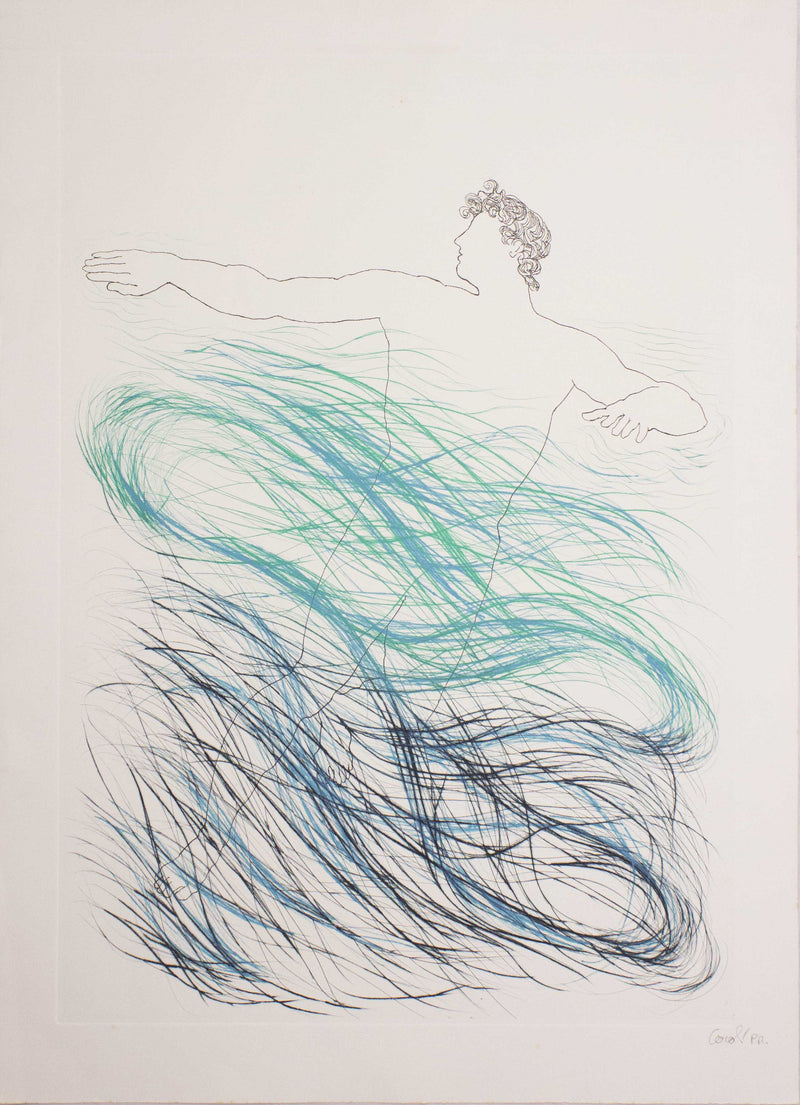
Sculptor and stage designer
Mario Ceroli
Italy, 1938
Stay up to date with this artist
Leave your email to receive updates on newly available artworks and news about this artist.
Artworks by Mario Ceroli
1 artwork

Biography of Mario Ceroli
Mario Ceroli (Castel Frentano, 1938) is one of the leading figures in contemporary Italian sculpture. His oeuvre is distinguished by the use of rough wood, transformed into figures, objects, and environmental structures through cut-out and repeated shapes. Associated with the Italian Pop and Arte Povera movements, he developed a personal language in which sculpture, painting, architecture, and set design continually interact. Artworks such as Leonardo's…
Read the full biographyClose the biography
Mario Ceroli (Castel Frentano, 1938) is one of the leading figures in contemporary Italian sculpture. His oeuvre is distinguished by the use of rough wood, transformed into figures, objects, and environmental structures through cut-out and repeated shapes. Associated with the Italian Pop and Arte Povera movements, he developed a personal language in which sculpture, painting, architecture, and set design continually interact. Artworks such as Leonardo's Man, L'ultima cena, China, and Sistine Box testify to his ability to transform recognizable images into monumental constructions. His oeuvre also includes ceramics, drawings, theatrical projects, and experiments with different materials.
Training in Rome
Mario Ceroli was born in Castel Frentano, in the province of Chieti, on May 17, 1938. He moved to Rome as a child and attended the Art Institute. His training developed through his engagement with artists such as Leoncillo Leonardi, Pericle Fazzini, and Ettore Colla. L'ambiente romano del dopoguerra was undergoing profound changes. Traditional sculpture was gradually being joined by artistic approaches that placed greater importance on materials, objects, and space. From the outset, Ceroli showed an interest in constructing forms and in the relationship between artwork and setting.
The first ceramics
During the 1950s, Ceroli devoted himself to ceramics. In 1958, he held his first solo exhibition at the Galleria San Sebastianello in Rome. Ceramics allowed him to experiment with the relationship between material and volume. His contact with Leoncillo's oeuvre contributed to his understanding of the material's expressive possibilities. This phase preceded his choice of wood, which would become the most distinctive medium in his oeuvre.
The discovery of wood
Starting in the second half of the 1950s, Ceroli developed a growing interest in wood. The material was often used with its original characteristics preserved. Surfaces could be left rough, showing grain and irregularities. This choice made it possible to move beyond the idea of sculpture as the modeling of a compact mass. L'artista instead worked through cutting, assembly, and construction. Wood became a tool for transforming images and concepts into three-dimensional structures.
The silhouettes
In the 1960s, Ceroli developed the language of cut-out silhouettes. Human figures, letters, numbers, and objects were transformed into wooden silhouettes. The shapes could be repeated and arranged in sequences. Repetition produced a particularly intense visual effect. L’individual image became part of a collective structure. The process engaged with Pop culture while retaining a strong focus on the material.
Galleria La Tartaruga
In 1964, Ceroli exhibited at Galleria La Tartaruga di Roma, one of the leading centers of artistic experimentation in Italy. He presented letters, numbers, and everyday objects made of wood. The exhibition helped define his visual language. L'artista explores the transformation of the everyday object into an artwork. The choice of wood, however, introduces a material dimension different from the industrial imagery of American Pop Art.
Uomo di Leonardo
One of the fundamental artworks is Uomo di Leonardo, from 1964. Ceroli reworks Leonardo da Vinci's image of Vitruvian Man through his own visual language. The reference to Renaissance tradition is transformed into a contemporary structure. L'opera testifies to a sustained interest in art history. Images from the past are not simply imitated, but reinterpreted through different materials and processes.
L'ultima cena
In 1965, Ceroli created L'ultima cena, now held at the National Gallery of Modern and Contemporary Art in Rome. L'opera takes up the famous subject painted by Leonardo. The figures are transformed into wooden silhouettes. The composition takes on a theatrical dimension. The repetition and arrangement of forms help construct the space. The artwork is one of the most significant examples of the dialogue between tradition and experimentation.
Cassa Sistina
In 1966, Ceroli created Cassa Sistina, an artwork awarded the Gollin Prize at the Venice Biennale. The project explores the relationship between objects, container, and space. The construction becomes a fundamental part of the artistic experience. Sculpture is no longer just an isolated form. It presents itself as a whole capable of engaging with its surroundings.
China
Another major artwork is China, from 1966. LThe installation is constructed through the repetition of human silhouettes. The viewer perceives a sequence of figures occupying the space. Seriality becomes the central compositional principle. The artwork anticipates several fundamental concerns of contemporary environmental art. The relationship between body, image, and space takes on an immersive dimension.
New York and international recognition
Between 1966 and 1967, Ceroli stayed in New York. He exhibited at the Bonino Gallery. His engagement with the American art scene helped bring his oeuvre to an international audience. LThe experience took place during a period when Pop Art, Minimalism, and new forms of installation were profoundly transforming artistic language. Ceroli nonetheless maintained an independent position, based on the use of natural materials and the creation of recognizable images.
The relationship with Arte Povera
In 1967, he took part in exhibitions that were pivotal to the emergence of Arte Povera, including Arte povera – Im Spazio in Genoa. LThe use of wood, straw, and other nontraditional materials brings some of his explorations close to those of the movement. His oeuvre nevertheless retains distinctive characteristics. The figurative and theatrical dimension remains central.
Theater and stage design
Ceroli pursues an extensive career as a stage designer. The theater allows him to expand his exploration of the relationship between figures and space. The constructions become walk-through environments and structures designed to engage with the actors' movements. Stage design is not a secondary activity. It is a natural extension of his sculptural practice.
Materials and experimentation
Although best known for working with wood, Ceroli uses a wide range of materials. His oeuvre includes artworks in bronze, ceramic, and marble, as well as assemblages of different materials. In 1969, he created Me, Pyramid of Ice, an installation using ice that introduces a reflection on the transformation of matter. This experimentation reflects an open conception of sculpture.
The artworks of his mature period
In the 1980s and 1990s, Ceroli further develops the themes of the doorway, the staircase, and the human figure. Documented artworks include The Door, The Last Supper, and Vitruvian Man. His oeuvre continues to engage with architecture and art history. The relationship between structure and space remains fundamental.
L’artistic legacy
Mario Ceroli occupies a distinctive position in contemporary Italian art. His oeuvre has helped to transcend the traditional boundaries of sculpture. Through wood and other materials, he has transformed recognizable images into structures capable of engaging space and the viewer.
Do you like Mario Ceroli?
Leave your email to receive updates on newly available artworks and news about this artist.
Mario Ceroli
Art that lives in your spaces
Choosing an artwork by Mario Ceroli means making room for an individual artistic language. The artworks gathered here suggest combinations and perspectives to bring into your own surroundings, letting art guide your gaze.

DISCOVER THE ARTIST
Frequently asked questions
Answers to common questions about Mario Ceroli, the artist’s life, artworks and value on the art market.
Who is Mario Ceroli?
Mario Ceroli (born 1938) is an Italian sculptor known for his use of wood and cut-out human silhouettes and objects, often repeated in sequence. His research brings sculpture, space, architecture and scenography into dialogue, overcoming the traditional idea of an isolated statue.
Why does Mario Ceroli often use wood?
Wood allows Ceroli to work through cuts, profiles and assemblies, making both the shape and the material character of the artwork visible. In many artworks the simplicity of the material contrasts with the complexity of the compositions. Not all of his artworks, however, are made exclusively in wood.
What do Mario Ceroli's human silhouettes represent?
The cut-out figures can evoke presences, gestures and collective relationships. When they are repeated, the single silhouette becomes part of a spatial rhythm. The meaning varies according to the title, the context and the staging: there is no single interpretation valid for the entire production.
What is the relationship between Mario Ceroli and Arte Povera?
Ceroli is often compared to the Italian research of the 1960s for his attention to materials and space, but his path retains autonomous characteristics. It is preferable to explain affinities and differences rather than automatically attributing each artwork to a movement.
How do the prices of Mario Ceroli's sculptures and graphics change?
Original sculptures, multiples and artworks on paper belong to different market segments. Materials, dimensions, year, edition, origin and state of conservation have an impact. For multiples it is essential to check edition size and documentation; the name of the artist alone does not determine the price.