



Domenico Cantatore (Ruvo di Puglia, 1906 – Paris, 1998) was an Italian painter, printmaker, and writer, and a leading figure in 20th-century figurative art. His work is distinguished by its deep connection with the culture and landscape of Puglia, interpreted through figures, still lifes, and compositions of great expressive intensity. After training as a self-taught artist and a stay in Paris, Cantatore developed a personal style in which the solidity of forms combines with a particular sensitivity to color. Among his most recognizable subjects are odalisques, men of the South, olive trees, and still lifes. Alongside painting, the artist devoted particular attention to printmaking and lithography, using original prints as an integral part of his artistic practice.
Childhood in Ruvo di Puglia
Domenico Cantatore is born in Ruvo di Puglia on March 16, 1906.
He is the youngest of eight children in a family of modest means.
From a young age, he shows an interest in drawing.
Family hardships force him to start working at an early age.
He also works as a house painter, an experience that brings him into direct contact with materials and color.
The Apulian landscape and everyday life in his hometown remain fundamental elements of his sensibility.
The move to Rome
In 1922, Cantatore leaves Ruvo di Puglia and moves to Rome, where he joins his brother Giuseppe.
His artistic training develops largely through self-study.
The artist observes painting and develops his drawing skills through practice.
Economic difficulties accompany this initial phase.
His stay in Rome nevertheless represents an important opportunity to engage with a broader cultural milieu.
Milan and cultural encounters
In 1925, Cantatore moves to Milan.
To support himself, he also works as a clothing designer for a tailor's shop.
At the same time, he continues to paint.
He comes into contact with artists, poets, and intellectuals.
Among the most important figures are Carlo Carrà, Salvatore Quasimodo, Raffaele Carrieri, Leonardo Sinisgalli, and Alfonso Gatto.
These relationships contribute to the development of a sensibility in which painting and literature remain closely connected.
The first solo exhibition
In 1929, Cantatore holds his first solo exhibition at Galleria Milano.
The works include landscapes, still lifes, and figures.
The subjects retain a deep connection to their homeland.
Puglia is not represented solely through recognizable views.
It becomes an emotional and cultural presence.
Folk figures take on an almost sculptural solidity.
The painting reveals particular attention to the construction of volumes.
His stay in Paris
In 1932, Cantatore moves to Paris, where he remains for about two years.
His stay allows him to engage directly with modern French painting.
The artist observes the experiences that transformed figurative language between the nineteenth and twentieth centuries.
His relationship with Parisian culture helps broaden his artistic exploration.
The construction of forms becomes freer.
Color takes on an increasingly important role.
Cantatore nevertheless retains a strong personal identity, tied to the memory of the places and figures of the South.
The relationship with his homeland
One of the fundamental aspects of Cantatore's work is his relationship with Puglia.
His native land remains a constant source of images.
Olive trees, arid landscapes, and folk figures become recurring subjects.
The representation is not merely descriptive.
The artist seeks to express the human and cultural character of places.
The figures can appear still and monumental.
Painting retains a poetic dimension in which memory and observation intertwine.
Men of the South
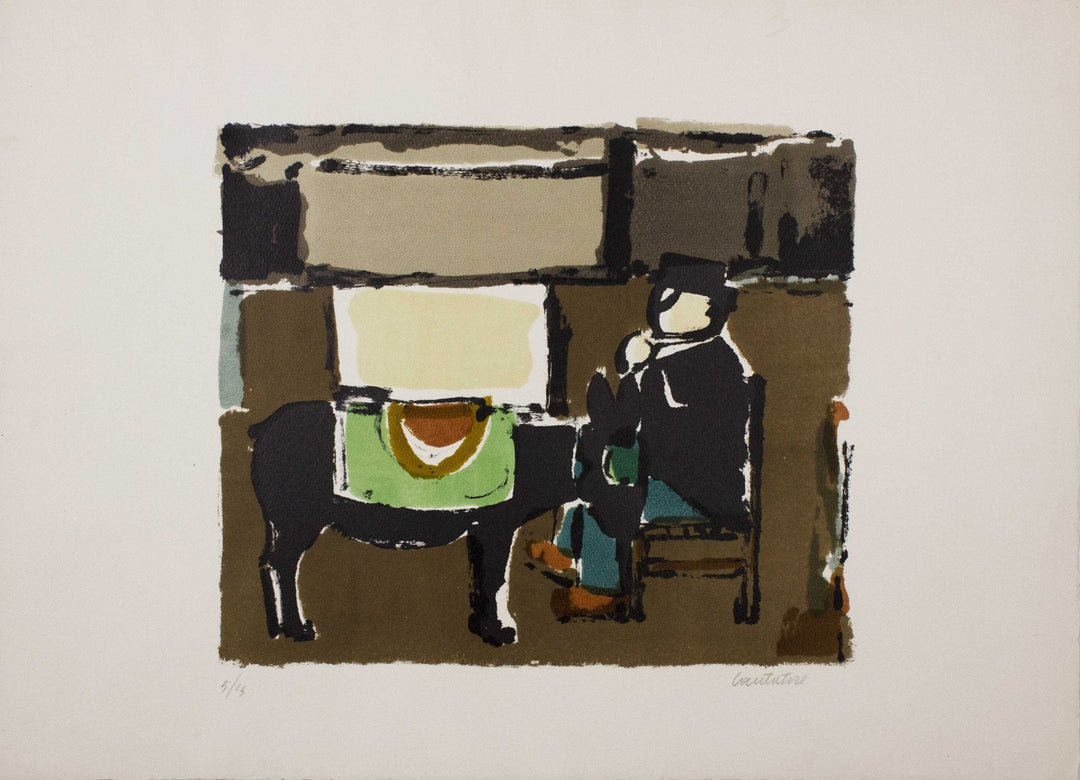
Among the most significant subjects are the men of the South.
The figures are depicted through solid forms and expressive features.
Hands, faces, and postures take on particular importance.
Cantatore observes the dignity of ordinary people.
The depiction does not seek picturesque effects.
It retains a deeply human dimension.
The figures become symbols of a culture and a social condition.
Odalisques
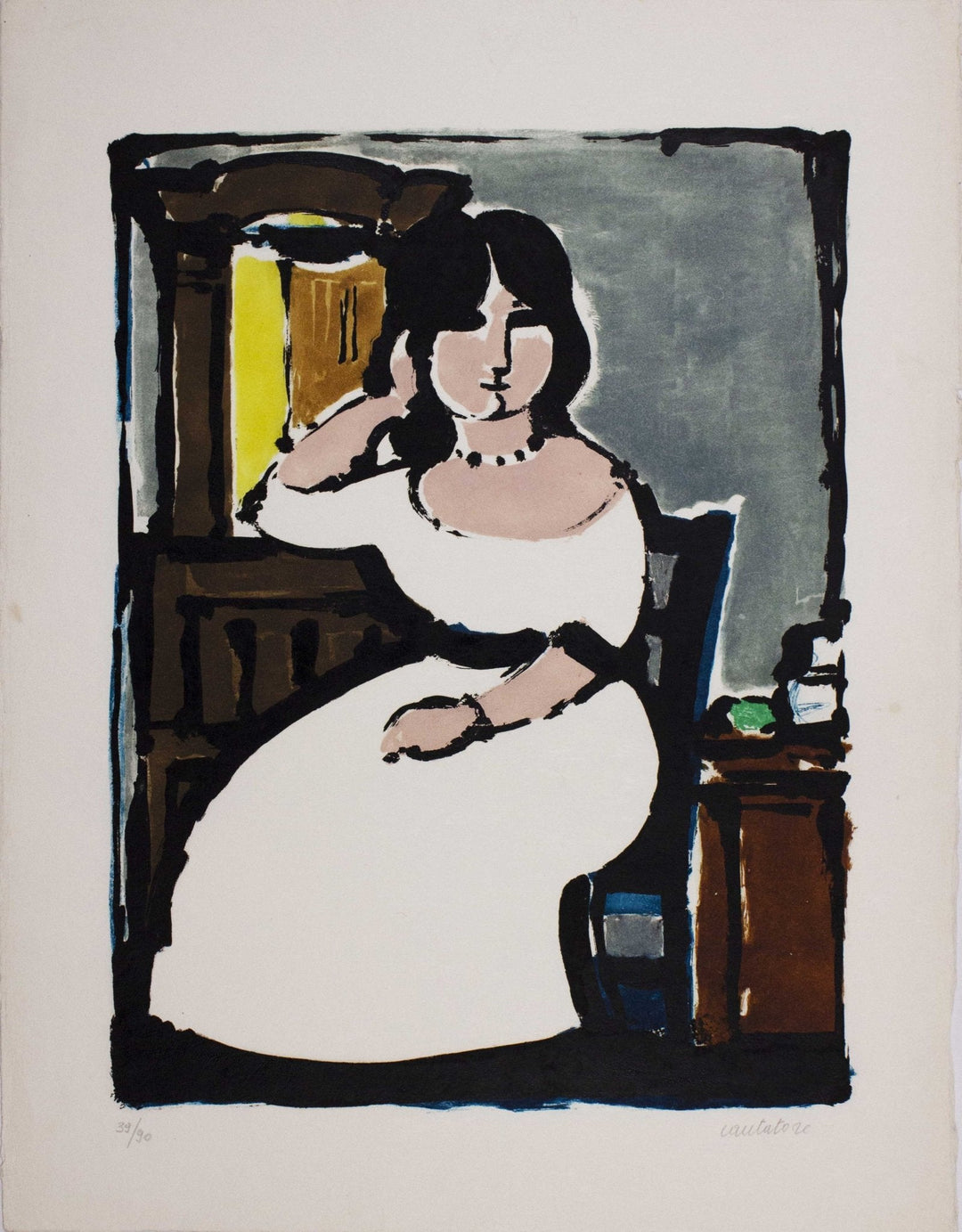
The odalisques are one of the most recognizable themes in his mature work.
The female figures are constructed through broad volumes and intense color relationships.
The pose may evoke the tradition of European painting.
Cantatore nevertheless interprets the subject through a personal visual language.
The figure takes on a monumental presence.
Color helps build the volumes.
The compositions maintain a balance between sensuality, sculptural solidity, and formal synthesis.
Olive trees
Olive trees are another major subject.
The trees are depicted through gnarled trunks and complex structures.
Their form suggests the relationship between nature, time, and memory.
Cantatore observes olive trees as almost human presences.
The twists of the trunks become expressive elements.
Painting transforms the landscape into a reflection on permanence and change.
Still lifes
Cantatore creates numerous still lifes.
Fruits, flowers, and everyday objects are arranged in balanced compositions.
The construction of forms retains a particular solidity.
Color plays a fundamental role.
Surfaces may feature intense hues and contrasting color relationships.
Still life allows the artist to explore formal questions in depth without sacrificing its poetic dimension.
Painting and color
Cantatore's painting is distinguished by its attention to the structure of volumes.
Figures may be simplified, yet retain a strong physical presence.
Color helps define the composition.
His work engages with some Italian artistic movements of the twentieth century while maintaining an independent character.
The relationship between figure and space is shaped through a personal synthesis.
Etching and lithography
Alongside painting, Cantatore pursues a significant body of work in original graphic art.
He creates etchings and lithographs devoted to the main themes of his work.
Figures, olive trees, and still lifes are reinterpreted through line.
Etching makes it possible to explore the relationship between line and volume in greater depth.
Lithography, on the other hand, offers possibilities associated with spontaneous drawing and the use of color.
The graphic works are not merely reproductions of the paintings.
They represent a field in which the artist independently develops his own style.
Literature and writing
Cantatore also cultivates an interest in writing.
His relationship with poets and intellectuals accompanies him throughout his career.
The literary dimension contributes to the narrative sensibility of his painting.
The figures are more than mere visual subjects.
They seem to preserve stories, memories, and connections with places.
This element makes his depiction of the southern world particularly vivid.
Artistic recognition
Throughout his career, Cantatore takes part in major exhibitions.
His work attracts attention in Italy and internationally.
His figurative art is admired for its ability to unite formal solidity and expressive intensity.
His connection with the culture of southern Italy remains one of the most recognizable aspects of his work.
His artistic legacy
Domenico Cantatore dies in Paris on May 22, 1998.
His work represents a significant contribution to twentieth-century Italian figurative art.
Through odalisques, olive trees, men of the South, and still lifes, he created a style deeply connected to memory and cultural identity.
His painting and graphic art reflect a consistent practice, in which solid forms combine with poetic sensitivity.
Ti piace Domenico Cantatore?
Per ricevere gli ultimi aggiornamenti di questo artista, lascia la tua email qui sotto:Il tuo indirizzo email è stato aggiunto alla lista dell'artista.
