
Painter
Carla Badiali
Italy, 1907–1992
Stay up to date with this artist
Leave your email to receive updates on newly available artworks and news about this artist.
Artworks by Carla Badiali
3 artworks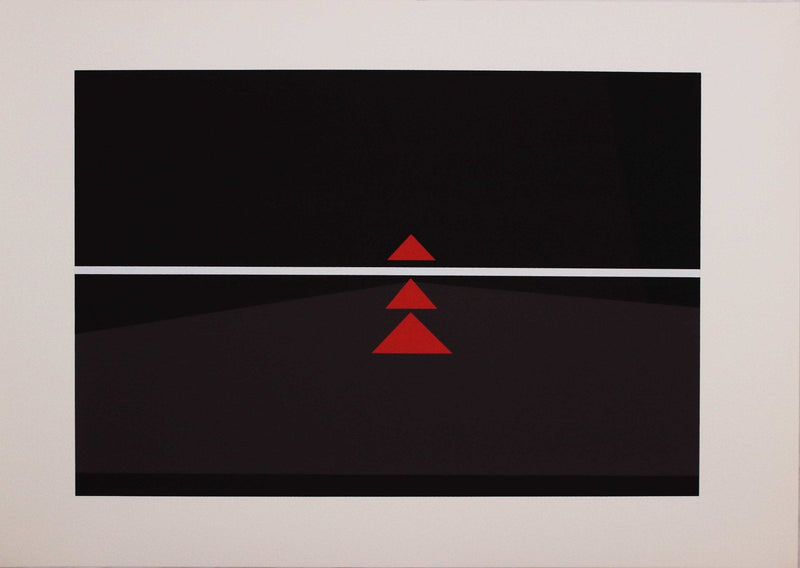

Biography of Carla Badiali
Carla Badiali (Novedrate, 1907 – Como, 1992) was one of the leading figures in Italian geometric abstraction and a key member of the Como abstract artists’ group. A student of Manlio Rho, she developed a style of painting characterized by essential forms, measured color relationships, and compositions in which geometry and poetic sensibility coexist. For decades, her artistic activity was intertwined with textile design, an…
Read the full biographyClose the biography
Carla Badiali (Novedrate, 1907 – Como, 1992) was one of the leading figures in Italian geometric abstraction and a key member of the Como abstract artists’ group. A student of Manlio Rho, she developed a style of painting characterized by essential forms, measured color relationships, and compositions in which geometry and poetic sensibility coexist. For decades, her artistic activity was intertwined with textile design, an experience that contributed to the precision and variety of her pictorial structures. From her early compositions in the 1930s to her postwar explorations, Badiali interpreted abstraction not as a simple geometric exercise, but as a language capable of expressing rhythm, balance, and movement.
Her education between France and Como
Carla Badiali was born on November 9, 1907, in Novedrate, in the province of Como. During her childhood, she moved with her family to Saint-Étienne, France, where she became interested in painting through her father and studied piano. L’Her musical education helped develop a particular attentiveness to rhythm and the arrangement of forms, aspects that would become central to her abstract artwork. After returning to Italy in 1923, she attended the National Institute of Silk in Como, where she met Manlio Rho, her drawing teacher.
Rho, a leading figure in Como abstraction, introduced her to modern art research and to the European art scene. In 1927, Badiali graduated and began working in the textile industry. In 1932, she opened her own textile design studio in Como, collaborating with companies and manufacturers whose products were also destined for international markets. Painting and textile design developed in parallel, influencing one another without fully overlapping.
The Como abstract artists and the birth of a geometric language
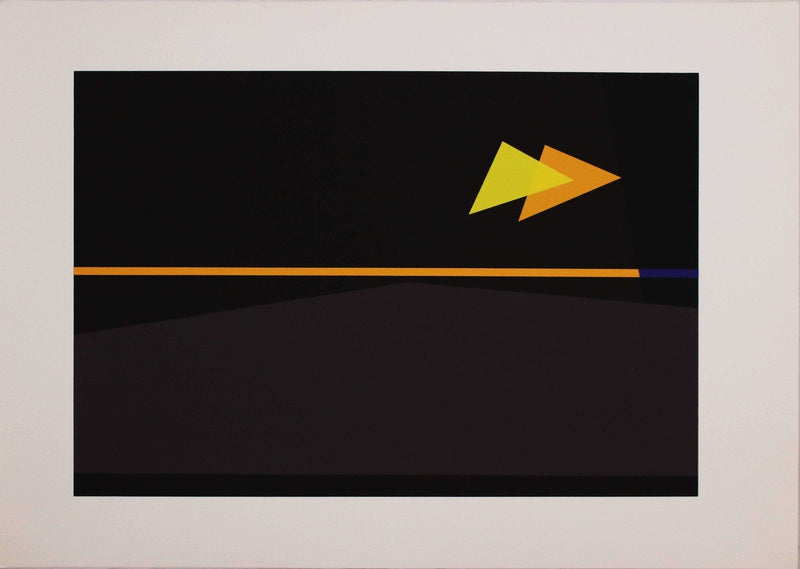
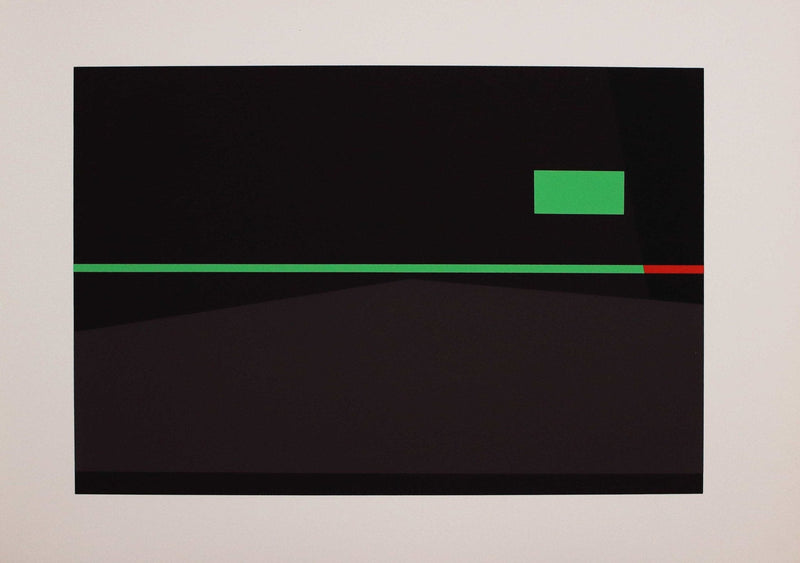
At the beginning of the 1930s, Carla Badiali moved toward geometric abstraction, taking part in a particularly innovative cultural scene. Como was then an important center for dialogue between painting, Rationalist architecture, and applied arts. Alongside Manlio Rho were Mario Radice, Aldo Galli, and other artists interested in moving beyond naturalistic representation. In this context, Badiali developed compositions based on lines, color planes, curves, and geometric shapes. Her painting did not seek to depict recognizable landscapes or objects. The forms took on an independent value and were arranged according to relationships of balance and tension.
In 1936, she takes part in the Exhibition of Modern Italian Painting at Villa Olmo, one of the key events in establishing Como abstractionism.
Composition no. 12 and the artworks of the 1930s
Among the most significant artworks of her early maturity is Composition no. 12 (1935–1936). The painting demonstrates a geometry that is less rigid than the term abstractionism might suggest: straight and curved lines coexist with soft shapes and delicate colors. The surface is organized through precise relationships but retains a sense of movement. L’artist avoids mechanical symmetry and creates a dynamic balance between the elements. The forms seem to engage in dialogue, sometimes drawing closer, sometimes separating through intervals of color.
This ability to combine order and freedom is one of the distinguishing features of Badiali’s painting. The compositions of the 1930s also show a connection with the world of design: the rhythm of the planes and the attention to relationships between colors recall, without coinciding with, certain principles of decorative organization.
Futurism, Primordial Values, and abstract research
In 1938, Carla Badiali joins the Primordial Values group, associated with the cultural discourse promoted by Franco Ciliberti. In 1940, she signs the manifesto of the Sant’Elia Futurist Primordials group. These affiliations testify to her participation in the artistic debate of the time, shaped by different interpretations of modernity. Her painting, however, remains predominantly abstract. L’interest in dynamism is expressed primarily through the arrangement of forms and the construction of visual rhythms.
In 1942, she takes part in the Venice Biennale, presenting artworks related to her abstract research. L’anno following, she is featured at the Rome Quadriennale.
The war and the postwar revival
World War II interrupts the continuity of Badiali’s artistic and professional activity. After the war, the artist resumes her research, once again taking part in exhibitions devoted to Italian abstraction. In 1951, she is featured in the historic exhibition on abstractionism held at the Bompiani Gallery in Milan. Her painting evolves through a gradual simplification of forms. The compositions retain a recognizable geometric structure while developing increasingly personal relationships between color and space.
Lines can become more fluid, and the planes gain greater freedom of arrangement. Badiali does not abandon the fundamental principles of her artistic inquiry, but renews them through continual variations.
Color and rhythm in abstract compositions
Color plays a decisive role in Carla Badiali’s painting. Hues are not used to imitate reality, but to build relationships between forms. A color area can appear closer or farther away depending on its relationship with the surrounding colors. Curves introduce movements that interrupt the rigidity of geometric structures. This arrangement gives the compositions an almost musical character.
This is not about directly translating a melody into painting, but about constructing a sequence of visual relationships through intervals, repetitions, and variations. The result is abstract painting that retains considerable expressive sensitivity.
Textile design and the relationship between art and design
L’s work as a textile designer is an essential aspect of Carla Badiali’s career. For many years, she created designs for fabric production, developing a particular familiarity with patterns, colors, and repetitive structures. Her studio in Como remained active until 1963, with a break during the war years. This experience should not be considered simply a sideline to painting. Daily engagement with applied design helped refine her ability to organize surfaces.
In her abstract artworks, however, Badiali goes beyond the decorative function: each composition is constructed as an autonomous image. The relationship between painting and fabric thus becomes one of the most original aspects of her career.
Exhibitions and historical recognition
In the second half of the twentieth century, Carla Badiali’s oeuvre gradually came to be recognized as a fundamental part of the history of Italian abstraction. In 1966, her artworks were presented at the Venice Biennale in the exhibition dedicated to aspects of early Italian abstraction. In 1989, she took part in the retrospective on the Como abstract artists. In 1990, the Municipality of Como dedicated a retrospective exhibition to her, recognizing the value of a career developed with remarkable consistency. Carla Badiali died in Como on February 7, 1992.
His artworks continue to be studied and featured in exhibitions devoted to geometric abstraction and the relationship between art and design. His legacy lies in his ability to transform geometry into a sensitive language: forms, colors, and rhythms become the tools of a rigorous painting that is never devoid of vitality.
Do you like Carla Badiali?
Leave your email to receive updates on newly available artworks and news about this artist.
Carla Badiali
Art that lives in your spaces
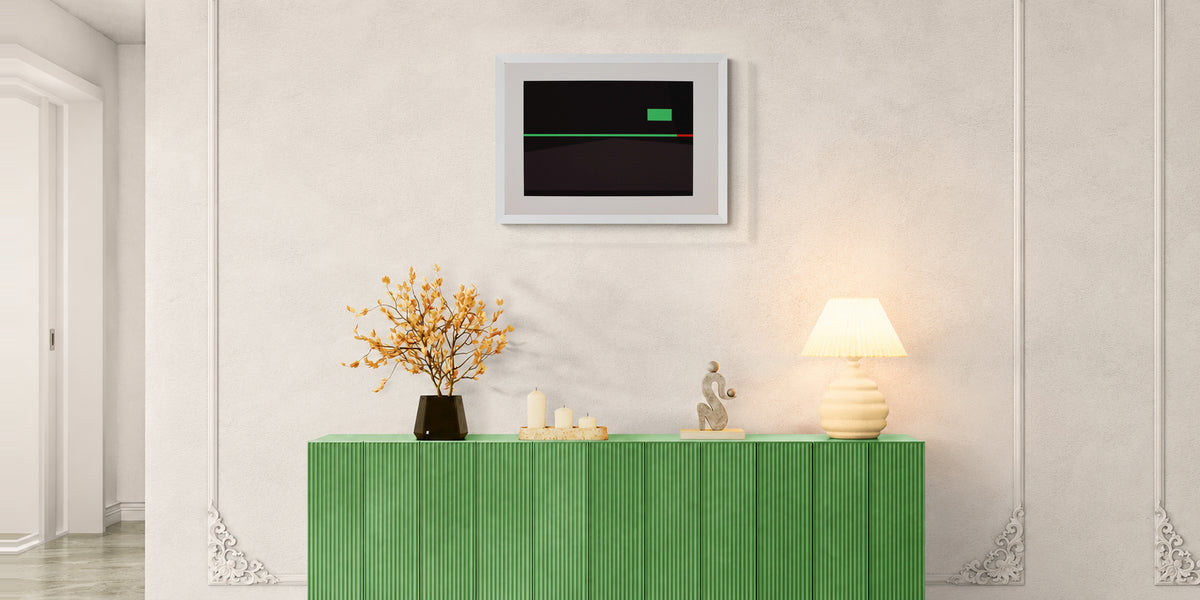
Marks, rhythms and forms: artworks by Carla Badiali bring a new sense of balance to a space. Understated furnishings give the composition room to breathe and invite you to rediscover it every day from a different perspective.
DISCOVER THE ARTIST
Frequently asked questions
Answers to common questions about Carla Badiali, the artist’s life, artworks and value on the art market.
Who was Carla Badiali?
Carla Badiali (1907–1992) was an Italian painter linked to Como abstract art. Active in the twentieth century, she developed a language based on relationships between geometric shapes, lines and colors. Her research is placed in the climate of renewal of Italian abstract art, while maintaining a personal path.
What is the Como abstractionism to which Carla Badiali is linked?
Como abstractionism indicates the experience of artists active in the Como area, especially between the 1930s and 1940s, interested in non-figurative art. In this context the composition does not reproduce recognizable objects, but is constructed through balances of shapes, color and visual rhythm.
How do you recognize an abstract artwork by Carla Badiali?
Geometric organizations and calibrated relationships between colored surfaces recur in Badiali's abstract artworks. To correctly attribute an artwork, however, style is not enough: signature, dating, technique, provenance and documentation count and must be evaluated together.
Did Carla Badiali only make paintings?
Badiali's production mainly includes pictorial research and artworks on paper, with solutions that vary over time. When evaluating an artwork it is important to distinguish an original painting from a drawing or a possible multiple, because technique and uniqueness affect the description and the market.
What does the value of an artwork by Carla Badiali depend on?
The value depends on authenticity, provenance, period, compositional quality, technique, dimensions, state of conservation and comparisons with documented sales. A reliable estimate requires precisely identifying the artwork; it is not correct to attribute an average price to the artist's entire production.