
Artist, designer and theorist
Ugo La Pietra
Italian, 1938 –
Stay up to date with this artist
Leave your email to receive updates on newly available works and news about this artist.
Works by Ugo La Pietra
1 work

Ugo La Pietra
Born in Bussi sul Tirino in 1938, Ugo La Pietra has forged a career that is difficult to contain within a single professional definition. An architect by training, painter, designer, experimental filmmaker, and tireless observer of urban behavior, he has regarded art as a tool for understanding how people live and how they might live differently. His work often begins with a concrete question: who…
Read the full biographyClose the biography
Born in Bussi sul Tirino in 1938, Ugo La Pietra has forged a career that is difficult to contain within a single professional definition. An architect by training, painter, designer, experimental filmmaker, and tireless observer of urban behavior, he has regarded art as a tool for understanding how people live and how they might live differently. His work often begins with a concrete question: who decides how we use streets, homes, objects, and shared spaces? From this emerges a practice that combines the pleasure of visual invention with a critique of the habits and rules governing everyday life.
From painterly mark to the city
After studying architecture at the Polytechnic University of Milan, La Pietra joined the vibrant Milanese art scene of the early 1960s. In 1962, he helped found the Gruppo del Cenobio with Agostino Ferrari, Ettore Sordini, Angelo Verga, and Arturo Vermi. During this period, the painterly mark became a means of interrogating communication: it does not necessarily represent something recognizable, but can function as a trace, code, gesture, and structure. This interest did not disappear when the artist moved away from painting, because the underlying question remained the same: how do we read what surrounds us, and what meanings do we assign to signs?
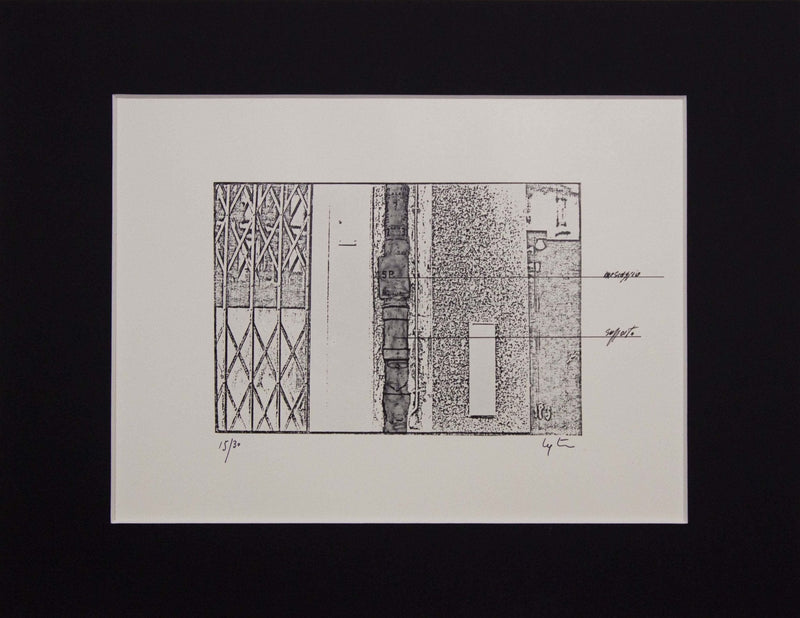
The answer is increasingly sought outside the studio. Through photographs, drawings, maps, interventions, and projects, La Pietra analyzes the organization of urban space and the distance between the planned city and the city as it is actually lived. A sidewalk, a boundary, a bench, or a room can reveal power relations and invisible customs precisely because they seem natural. L'artist then tries to change the point of view, imagine alternative uses, and show that even the most ordinary environment is the result of cultural choices.
The destabilizing system and the idea of inhabiting
The concept of a destabilizing system gives shape to this attitude. To destabilize means to interrupt the usual functioning of a place or an object for a moment, making the rules we normally overlook perceptible. His proposals may take the form of devices, images, situations, or architectural projects; they do not merely ask to be admired, but invite us to reconsider the role of those who inhabit a space. L'observer is no longer a passive recipient: they become someone who can interpret, choose, and even transform their own environment.
In the 1970s, these ideas engaged with radical design and the experience of Global Tools, which challenged the separation between specialist knowledge, creativity, and manual practices. For La Pietra, designing does not simply mean producing new objects: it also means understanding the needs, gestures, and relationships that give objects meaning. His famous phrase “To inhabit is to be at home everywhere” expresses the aspiration to overcome the rigid division between domestic interiors and public space. The street and the piazza should not be alien places, but parts of an environment in which citizens can recognize themselves and take action.
Participation in the exhibition Italy: The New Domestic Landscape, organized by the Museum of Modern Art in New York in 1972, and his relationship with the Milan Triennale place this research within the international debate on architecture and design. Yet its strength does not depend solely on the historical context: many questions raised at the time, from the quality of shared spaces to the possibility of personalizing the environment, remain relevant today.
Materials, Images, and Applied Arts
L's breadth of media is not a sign of scattered exploration. Painting, graphic art, photography, film, ceramics, objects, and installations make it possible to examine the relationship between individuals and their surroundings from different angles. In particular, working with artisans and Italian production traditions restores the importance of skills often considered marginal to industrial design. A ceramic piece or an everyday object can preserve local memory, while also suggesting a different way of understanding the relationship between beauty and function.
This variety also requires attention when examining the artworks intended for collectors. An original drawing, an editioned print, a multiple, a design object, and a ceramic are not interchangeable: they differ in how they are made, their relationship to craftsmanship, and their production conditions. Information about technique, signature, and print run must therefore refer to the individual piece, without automatic attribution. What the different works have in common, rather, is the idea that art should not remain separate from everyday experience. La Pietra invites us to see the built world as something that can be changed: not merely a setting in which to live, but a reality in which to participate.
Do you like Ugo La Pietra?
Leave your email to receive updates on newly available works and news about this artist.
Ugo La Pietra
Art that lives in your spaces
Choosing a work by Ugo La Pietra means making room for an individual artistic language. The works gathered here suggest combinations and perspectives to bring into your own surroundings, letting art guide your gaze.

DISCOVER THE ARTIST
Frequently asked questions
Answers to common questions about Ugo La Pietra, the artist’s life, works and value on the art market.
Who is Ugo La Pietra?
Ugo La Pietra (born 1938) is an Italian artist, architect and designer who investigates the relationship between the individual, urban space and living. His research crosses drawing, photography, installation, ceramics and project, questioning the boundaries between art, design and everyday life.
What does «To live is to be everywhere» mean for Ugo La Pietra?
It is a central formula of his research: living is not just about the house, but about the way in which people appropriate spaces and transform them through behaviors and relationships. La Pietra invites us to critically observe the city and the objects that influence daily life.
What is Ugo La Pietra's Unbalancing System?
The Disbalancing System is a set of experiences and conceptual tools developed by the artist to alter the usual perception of the environment. Through interventions, images and devices, La Pietra shows that built space is not neutral and can be experienced in unexpected ways.
What materials and techniques does Ugo La Pietra use?
His production is interdisciplinary: it includes drawings, collages, photographs, ceramics, objects, installations and design projects. To correctly identify a work it is important to verify technique, support, dating and relationship with any editions or series.
How do you recognize an original work or an edition by Ugo La Pietra?
It is necessary to distinguish unique pieces, drawings, graphic works, design objects and editions. Signature, numbering, documentation of provenance, any certificates and publisher's indications help to identify the work, but their presence must be evaluated together with the technical specification and history of the specimen.