
Painter
Simona Weller
Italy, 1940
Stay up to date with this artist
Leave your email to receive updates on newly available artworks and news about this artist.
Artworks by Simona Weller
2 artworks

Biography of Simona Weller
Simona Weller (Rome, 1940) has built an artistic path in which painting and writing meet to the point of becoming inseparable parts of the same language. Her canvases can recall pages, landscapes, blackboards and surfaces crossed by imaginary alphabets: the sign sometimes begins as a letter, but is progressively transformed into rhythm, texture and colour. The artist has accompanied this visual research with an important…
Read the full biographyClose the biography
Simona Weller (Rome, 1940) has built an artistic path in which painting and writing meet to the point of becoming inseparable parts of the same language. Her canvases can recall pages, landscapes, blackboards and surfaces crossed by imaginary alphabets: the sign sometimes begins as a letter, but is progressively transformed into rhythm, texture and colour. The artist has accompanied this visual research with an important literary activity, dedicated in particular to the reconstruction of the role of women in the history of art.
Training and meeting other cultures
After classical studies, Weller attended the Academy of Fine Arts in Rome, coming into contact with masters such as Ferruccio Ferrazzi and Mario Mafai. However, the training experience is not limited to the Italian environment. Thanks to scholarships and stays in Thailand and Egypt, the artist discovered writing systems and figurative traditions that were very different from Western ones. The interest in characters that she cannot decipher becomes particularly fruitful: even before being read, writing can be observed as a succession of shapes, intervals and movements.
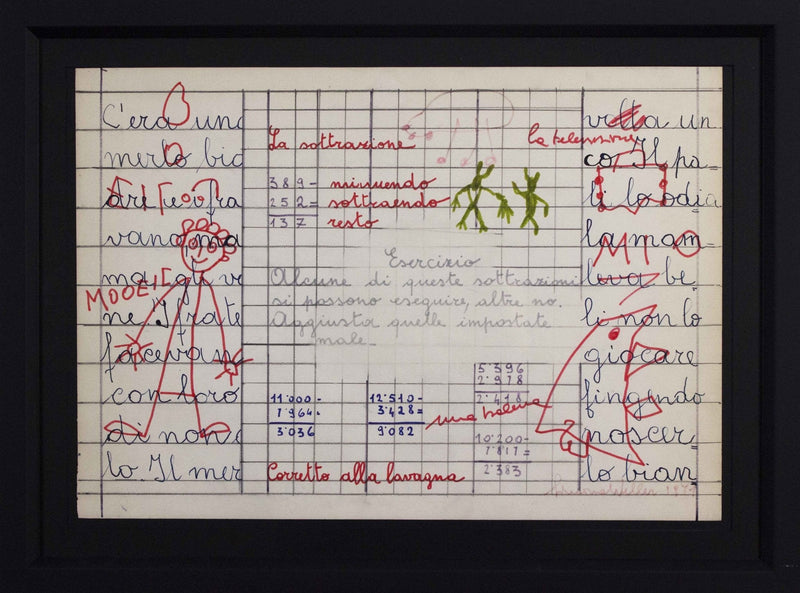
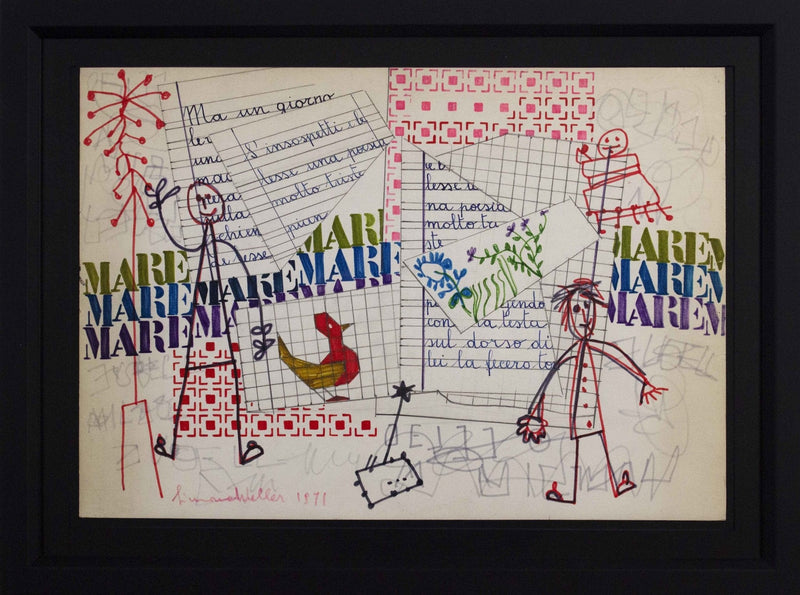
From this intuition comes a painting that is not limited to representing words. The signs can thicken into dense surfaces, interrupt in luminous pauses or widen to become true chromatic backgrounds. The artwork invites us to take a double look: we have the sensation of being in front of a message, but its meaning does not depend on a literal translation. It is the composition as a whole that communicates.
The attention to the alphabets encountered during travels also opens up a question about the relationship between familiarity and difference. An unknown letter is not a valueless sign for the Western observer: it retains a direction, a weight, a cadence. Weller takes up the suggestion without claiming to translate a culture into an exotic ornament. In her painting, the experience of travel is transformed into a reflection on how languages are born and how thin the boundary is between communication and image. The repetition of strokes sometimes produces the impression of a fabric; elsewhere the openings between the signs recall the breath of a manuscript page. In both cases the painting requires a different observation time than that necessary to recognize a figurative subject.
Painting-writing and the Seventies
In 1973, participation in the X Quadrennial of Rome brought to the attention of critics the large canvases in which writing mixes with painting. Weller finds herself in a period of experimentation on language, but retains an autonomous sensitivity, attentive to the physical dimension of the gesture and personal memory. In her artworks the sign can evoke an erasure, a repeated phrase, a note left on a blackboard or a landscape seen from afar.
Participation in the Venice Biennale of 1978, in the Materialization of language section curated by Mirella Bentivoglio, constitutes a significant moment in this journey. The artwork Diary on the wall, created between 1977 and 1978, brings together writing, collage, color and empty intervals, showing how important the artist considers not only the signs, but also the pauses that separate them. The relationship between word and image thus becomes an investigation into time, memory and the construction of identity.
The diary is a useful key to reading this season, as long as it is not understood as a confession to be deciphered word for word. The succession of signs suggests the continuity of the days, while the deletions and superimpositions evoke the selective character of memory. A pictorial surface can hold something and hide it at the same time: this oscillation gives depth to the compositions. The relationship with the verbo-visual research of the period is evident in the attention to the letter as an autonomous element, but Weller maintains a strongly pictorial sensitivity. The color is not used to illustrate the text; it modifies the rhythm, interrupts its regularity, makes a voice perceptible even when there are no legible words. Participation in the great exhibitions of the Seventies allows us to place this research in the debate on the language and presence of female artists, without erasing their individual identity.
Painting, ceramics and literary writing
Over the years Weller also expanded her production to include ceramics, maintaining her interest in the surface as a place of inscription and transformation. The material introduces a further dimension: the sign is no longer just traced on a canvas, but can adhere to an object, follow its volume and dialogue with the light.
In parallel, the artist publishes essays and narrative artworks dedicated to female creativity. With The Michelangelo Complex and other writings she contributes to questioning the historical reasons for the limited visibility of female artists; in the fictional biographies dedicated to Angelica Kauffmann, Suzanne Valadon and Benedetta Cappa she interweaves documentation and story. This activity is not separate from painting: in both cases Weller tries to give voice to often overlooked experiences and languages.
For artworks on paper it is important to distinguish original drawings, collages, any art prints and reproductions, verifying technique, signature, support and print run. The originality of her research lies in the ability to make writing visible and painting legible, in a poetic sense.
Literary writing offers another point of access to her poetics. Reconstructing the life of an artist of the past means dealing with incomplete archives, sedimented judgments and testimonies often filtered by male gazes. Weller's narrative artwork addresses these absences through research and imagination, distinguishing the historical fact from the freedom of the narrative. Something similar happens in the canvases: what is not explicitly written still remains present as a trace or possibility. Also for this reason her production must be observed in the differences between painting, collage and ceramics. A sign drawn with a brush, an applied fragment and a decoration on clay produce different material experiences. In an artwork description, precisely indicating the support and process helps to understand not only the collector's value, but also the way in which the artist constructed her own language.
Do you like Simona Weller?
Leave your email to receive updates on newly available artworks and news about this artist.
Simona Weller
Art that lives in your spaces
Choosing an artwork by Simona Weller means making room for an individual artistic language. The artworks gathered here suggest combinations and perspectives to bring into your own surroundings, letting art guide your gaze.

DISCOVER THE ARTIST
Frequently asked questions
Answers to common questions about Simona Weller, the artist’s life, artworks and value on the art market.
Who is Simona Weller and what role does she have in Italian art?
Simona Weller is an Italian artist whose research crosses painting, signs and writing. In her artworks the surface can become a space in which shapes, letters and visual rhythms intertwine. To understand her oeuvre it is useful to observe both the construction of the image and the relationship between language and pictorial material.
What are the characteristics of Simona Weller's painting?
Simona Weller's painting stands out for its attention to gesture, color and the presence of the sign. Some compositions recall plots and writings, without being reduced to a text to be read. The result is a visual language in which the repetition and variations of the line contribute to the balance of the artwork.
What relationship exists between writing and image in Simona Weller's artworks?
For Simona Weller, writing can become a pictorial element: letters and signs take on a visual, rhythmic and compositional value. These are not always words to be deciphered; often what matters is their presence on the surface, the dialogue with the color and the way in which they guide the gaze.
How to recognize the technique of an artwork by Simona Weller?
It is necessary to consult the description of the artwork and, when possible, examine it live. Painting, drawing and graphics have different supports, materials and methods of execution. Detailed photographs, dimensions, any inscriptions and documentation help to distinguish a unique original from a print or an artwork on paper.
What to check before buying an artwork by Simona Weller?
It is important to verify the title, technique, measurements, state of conservation, signature and documented provenance. For graphic artworks, edition size and numbering, if applicable, must also be checked. The value does not depend only on the name of the artist: the type, period, quality, conditions and comparisons with truly comparable sales have an impact.
Discover more artists
Explore more leading figures in modern and contemporary art


