
Painter, sculptor, printmaker and ceramic artist
Joan Miró
1893 – 1983
Stay up to date with this artist
Leave your email to receive updates on newly available works and news about this artist.
Works by Joan Miró
2 works


Joan Miró
Stars, moons, eyes, birds and suspended figures populate the universe of Joan Miró (Barcelona, 1893 – Palma de Mallorca, 1983), one of the great innovators of twentieth-century art. His images seem to be born from a spontaneous game, but behind the apparent lightness there is rigorous research into signs, color and space. Miró invents a visual alphabet in which recognizable shapes are transformed into symbols,…
Read the full biographyClose the biography
Stars, moons, eyes, birds and suspended figures populate the universe of Joan Miró (Barcelona, 1893 – Palma de Mallorca, 1983), one of the great innovators of twentieth-century art. His images seem to be born from a spontaneous game, but behind the apparent lightness there is rigorous research into signs, color and space. Miró invents a visual alphabet in which recognizable shapes are transformed into symbols, and the symbols return to being living, unpredictable presences. His work crosses painting, drawing, sculpture, ceramics and original graphics, maintaining a constant relationship with poetry and with the idea that art can open a passage towards what ordinary reality is unable to show.
From Catalonia to Paris: the discovery of a new language
Miró's education developed in Barcelona, where he studied drawing and painting, but the connection with the Catalan land remained fundamental even after his entry into the international scene. The landscape, rural life and everyday objects are the protagonists of the first works, in which a meticulous description coexists with a growing compositional freedom. His stay in Paris and his contact with the avant-garde offered him new tools to overcome traditional representation. The encounter with the surrealist environment in the 1920s was decisive, although Miró always retained a personal position, closer to the construction of an autonomous poetic language than to adherence to a group formula.
A work like The Farm (1921–1922) allows us to observe this transformation: the rural world is still recognisable, but the objects take on an almost visionary precision and already seem to be preparing to become signs. In subsequent compositions, the traditional depth dissolves and the figures are distributed across freer chromatic fields. Miró does not completely abandon reality; he dismantles it, recomposes it and preserves essential fragments. An eye, a star or a curved line can suggest a character, a movement or an entire atmosphere without the need to describe them in a naturalistical way.
The relationship with Catalonia continues to emerge even when the vocabulary of images becomes radically different. The land, the animals, the night sky and the rhythms of the landscape are not faithfully reproduced: they survive as memory nuclei. The metamorphosis of these elements makes his language both personal and open, because a sign can recall multiple things without fixating on a single meaning.
The dialogue with poetry also helps to explain its originality. The forms do not simply illustrate a story; rather, they behave like words of an invented language, capable of producing unexpected associations. The composition thus acquires a temporal dimension: the eye encounters a symbol, connects it to another and constructs a path that changes with each observation.
The sign as poetry and the freedom of color
Miró's mature painting is recognizable for a singular balance between apparent simplicity and continuous invention. Primary colors, black, free surfaces and thin lines create images that may seem childish only at a superficial glance. In reality, each sign has a precise weight within the composition: a red spot can balance a black figure, a freshly drawn line can introduce a sense of movement, a large void can become the place where the viewer's imagination goes to work.
European political events and the war also introduce more restless tones into his universe. The Constellations series, created between 1940 and 1941, shows a world full of small signs and cosmic presences, as if the artist was looking for a form of poetic resistance in a period marked by violence. In the following years, his research continues to oscillate between delicate images and more radical interventions on the surface. Miró experiments with different materials, dimensions and gestures, demonstrating that the coherence of a style does not coincide with the repetition of the same formula.
Miró's freedom should not be confused with uncontrolled improvisation. The location of a point, the break of a line, or the distance between two shapes can change the entire image. The artist connects empty and full spaces with a precision that makes even the unpainted surface active. In some works the color explodes in clear backgrounds; in others a few signs seem to float in an almost silent space.
This variety explains why his research can develop on such different scales, from small sheets to monumental interventions. The physical relationship with the observer changes, but the ability to transform simple elements into presences full of poetic energy remains constant.
Lithographs, etchings and artists' books
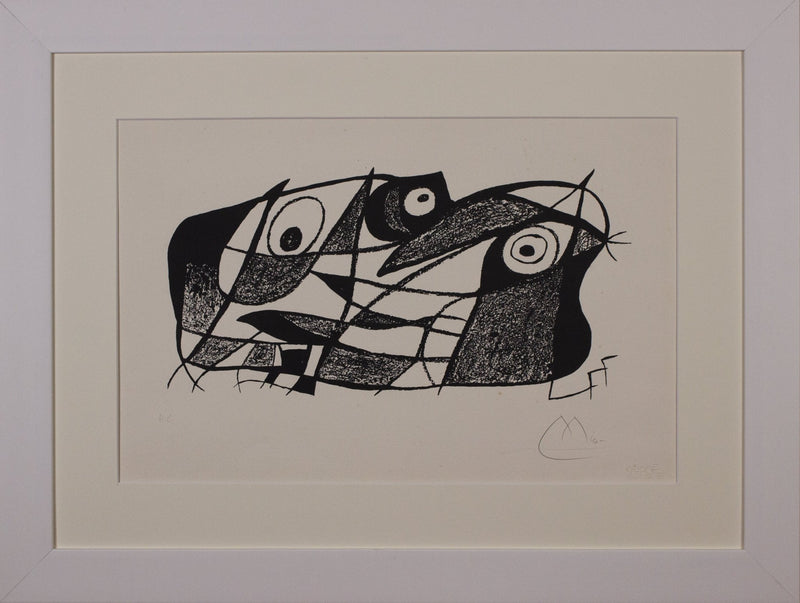
The original graphics occupy a central position in Miró's career. Lithography allows him to work with a freedom close to drawing, creating compositions in which color and sign retain a strong immediacy. In etchings and aquatints, however, the work on the metallic matrix opens up different possibilities: the line can be excavated and modulated, while the aquatint allows backgrounds and tonal transitions. Miró also experiments with combinations of procedures, surveys and interventions that transform the sheet into a true research space. The collaborations with specialized printers and publishers and the creation of artist books demonstrate how printing was an autonomous language for him, not a simple reproduction of paintings.
Working with art prints opens up possibilities for Miró that painting does not offer in the same way. The preparation of the matrices, the succession of colors and the comparison with the printing tests introduce a dialogue between intuition and procedure. The image can be modified through subsequent checks, and the final result is not necessarily the transcription of an already completed drawing.
In artists' books the relationship between text and image adds another dimension: the reader discovers the compositions by following the rhythm of the pages, intervals and changes in format. The work no longer coincides with just a single sheet to be framed, but can be part of a designed whole. This editorial context is essential to correctly identify some loose prints from publications or folders.
This richness makes it essential to distinguish original lithography, engraving, poster and photomechanical reproduction. Two similar images can belong to very different editions in terms of date, technique, paper and printing method. The signature, numbering and bibliographical references are important elements, but must be read together with the documentation of the specimen. Miró's legacy is also in this ability to reinvent his own universe by moving from one support to another: a small engraving can contain the same poetic energy as a large canvas or a monumental ceramic.
For Miró's graphics it is particularly useful to reconstruct the history of the edition: an image may have been conceived for a folder, for an illustrated book or for an independent print. The indication of the procedure, the presence of a signature and the comparison with bibliographical repertoires help to distinguish the different types. A numbered edition does not automatically equate to an original graphic work, just as the absence of numbering does not in itself prove that a sheet is a reproduction.
Observing the relationship between the colours, the quality of the sign and the support also allows us to appreciate the specificity of each impression. The richness of his graphic work lies precisely in having made printing a place of continuous invention, where poetic language is confronted with the concrete possibilities of technique.
Do you like Joan Miró?
Leave your email to receive updates on newly available works and news about this artist.
Joan Miró
Art that lives in your spaces
Works by Joan Miró open a window onto the imagination. In a contemporary interior, their presence invites you to pause and make room for unexpected visual encounters.

DISCOVER THE ARTIST
Frequently asked questions
Answers to common questions about Joan Miró, the artist’s life, works and value on the art market.
Who was Joan Miró?
Joan Miró (1893–1983) was a Catalan painter, sculptor and printmaker, protagonist of twentieth-century art. Close to surrealism but always independent of its programs, he developed a personal language of signs, stars, fantastic figures and intense colors, applying it to painting, ceramics and graphics.
What are the most recurring symbols in Joan Miró's works?
Stars, moons, birds, eyes and female figures recur in his visual vocabulary. Miró transformed them into essential and often ambiguous signs: they do not constitute a code with a fixed meaning, but evoke the cosmos, nature, dreams and imagination.
Was Joan Miró a surrealist artist?
Miró associated with the Surrealists in Paris and shared their interest in dreams and automatism. However, he developed an autonomous path, combining spontaneity, compositional control and references to Catalan culture. Defining him only as a surrealist does not exhaust the variety of his work.
What printing techniques did Joan Miró use?
Miró experimented extensively with lithography, etching, aquatint, and other intaglio techniques, often working with specialized printers. In his original graphics the sign, the color fields and the ink material have a fundamental expressive role.
How do you distinguish an original graphic by Miró from a reproduction?
An original graphic derives from a matrix or a printing process designed and approved by the artist, while a reproduction photographically repeats a pre-existing work. To evaluate an example it is necessary to examine technique, paper, possible signature, numbering, publisher, provenance and references to catalog raisonnés: the mere presence of a printed signature is not enough.