
Painter
Giuseppe Migneco
Italian1997
Stay up to date with this artist
Leave your email to receive updates on newly available works and news about this artist.
Works by Giuseppe Migneco
2 works


Giuseppe Migneco
In the painting of Giuseppe Migneco (Messina, 1908 – Milan, 1997), Sicily is not only the place of childhood, but a presence that continues to re-emerge through the colours, faces and gestures of everyday life. Farmers, fishermen, women at work and popular figures occupy compositions in which reality appears intensified by an energetic design and bright color contrasts. Migneco does not seek the elegance of…
Read the full biographyClose the biography
In the painting of Giuseppe Migneco (Messina, 1908 – Milan, 1997), Sicily is not only the place of childhood, but a presence that continues to re-emerge through the colours, faces and gestures of everyday life. Farmers, fishermen, women at work and popular figures occupy compositions in which reality appears intensified by an energetic design and bright color contrasts. Migneco does not seek the elegance of naturalistic description: his painting aims to restore the human strength of the subjects, their dignity and, often, the harshness of the conditions in which they live. It is a figuration that feeds on personal memory and social participation, without giving up a strong expressive autonomy.
From Sicily to Milan: the birth of an expressive voice
Born in Messina, Migneco grew up in a Mediterranean environment that would leave a deep imprint on his imagination. He moved to Milan in 1931, progressively coming into contact with a different cultural scene, crossed by comparison with European art and the desire to overcome official rhetoric. In the 1930s he became close to the artists and intellectuals who would give life to the Corrente experience, sharing their attention to contemporary reality and their interest in a painting capable of expressing moral as well as formal tensions. The relationship with that climate does not cancel his individuality: while other artists favor urban settings or intellectual subjects, Migneco often returns to the images of the southern popular world, transforming them into a recognizable language.
The comparison with Expressionism helps to free the figure from a rigidly academic design. Anatomies can be simplified, faces accentuated, perspectives compressed; what matters is the intensity of the presence. The brushstroke and the color thus take on a narrative function, but not an illustrative one: they tell of the effort, the pride, the waiting and the movement through the construction of the image itself. The move to Milan is therefore important not because Migneco abandons his roots, but because he finds new tools to reinterpret them.
The proximity to Corrente is also important to understand the ethical value of its figuration. In the cultural climate of the late 1930s, the refusal of celebratory painting translated into the choice to represent ordinary people, concrete existences and situations in which feeling was not separated from history. Migneco participates in this orientation without giving up its Mediterranean memory. The result is a language in which the figure never becomes a simple pretext for style exercises: it retains the weight of a human presence and a social condition.
The work, the characters and the memory of the Mediterranean
A significant part of his production revolves around the crafts and gestures of popular life. Fishermen and farmers are not picturesque figures inserted into a folklore scenario: they become protagonists of a collective experience. The hands, the bodies inclined in the effort, the lined faces and the simple clothes are often more important than the landscape that surrounds them. In many compositions the space is reduced to a few elements, as if to concentrate all the attention on the relationship between the figures and their actions. Sicily then appears as a territory that is both real and mental, preserved by memory and continuously recreated by painting.
Color contributes decisively to this transformation. Reds, yellows, blues and earthy tones are not only chosen to imitate the Mediterranean light, but to create tension and rhythm. The surface can appear bright, sometimes harsh, with marked contours that separate the shapes and reinforce their presence. It is precisely in the balance between simplification of the drawing and chromatic vitality that Migneco's personality is recognised: his images are immediate, but not simplistic, because behind each figure there is a long reflection on the relationship between painting and the human condition.
The arrangement of the characters also contributes to the narrative strength of the images. The figures can occupy almost the entire space, move closer to the edge of the painting or arrange themselves in tight groups; the landscape retreats and the scene takes on the character of a direct encounter. This choice allows us to observe not only the profession represented, but the relationships between people: solidarity, waiting, tiredness, concentration. The daily gesture acquires a monumental dignity without losing its immediacy.
Migneco's Mediterranean is therefore not a repertoire of reassuring views. Intense light and vivid color can coexist with images of fatigue and precariousness. It is precisely this tension between vitality and hardness that distinguishes his work from simply folkloristic painting.
Drawing, graphics and continuity of language
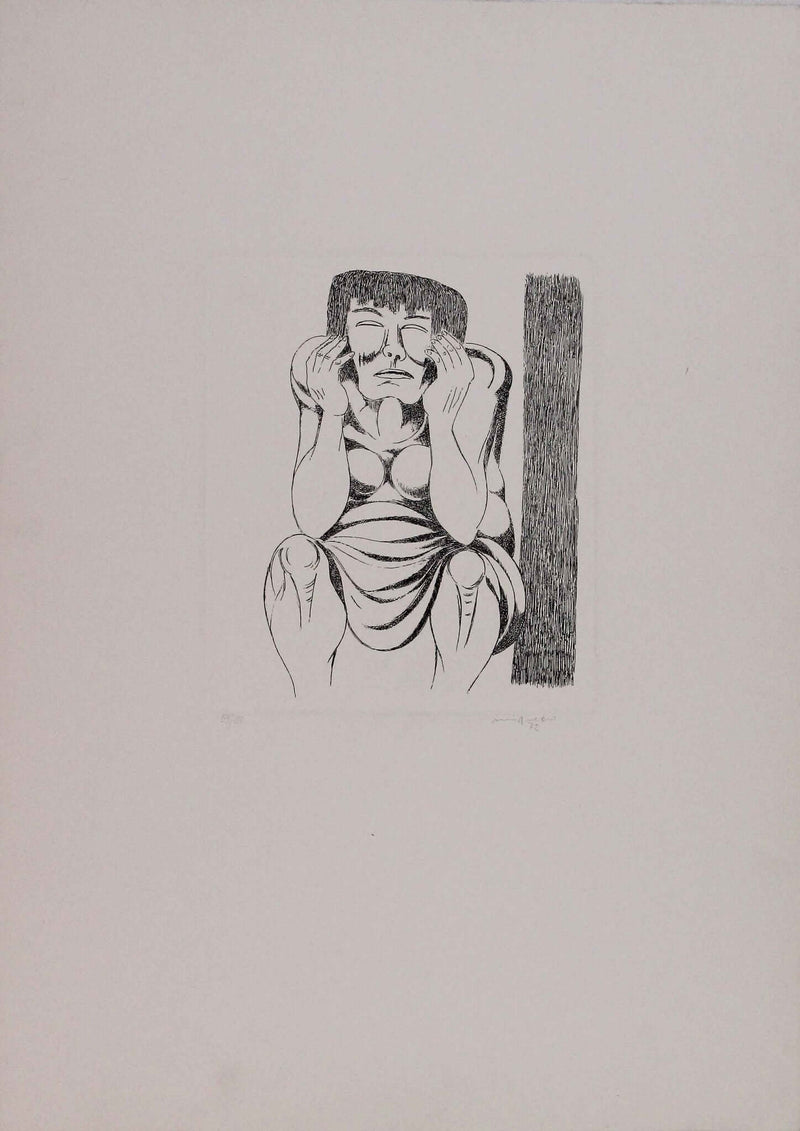
Alongside the paintings, Migneco creates drawings and graphic works, in which the centrality of the sign is particularly evident. The transition to paper does not necessarily entail a reduction in expressive power: a strong line can construct a face, suggest the weight of a body or impart movement to a scene. In color prints, the relationship between backgrounds and outlines can recall that of paintings, although it must be evaluated according to the characteristics of the specific technique used. Lithography, when documented, allows a rendering close to the freedom of the drawing; silkscreen instead organizes the image through passages of color through frame matrices. It is not correct to automatically attribute one of these techniques to every work on paper by the artist.
To understand and catalog one of his works, it is therefore important to distinguish the original drawing from the art print and the editorial reproduction, checking the support, signature, print run and documentation. This material attention is not separated from aesthetic judgment: it allows us to recognize how Migneco constructed a certain image. His legacy lies in the ability to combine deeply personal painting with a collective sensitivity, transforming everyday people and situations into figures of intense human participation.
The drawing deserves independent attention: in many works the speed of the line allows you to grasp the energy of the figure even before the color intervenes. An original print can develop this quality through a matrix designed for the process, while a reproduction of a painting documents a pre-existing image. For a collector the difference is not purely terminological, because it concerns the material history of the work and the role of the artist in its creation.
When reading a sheet of paper it is also useful to observe the relationship between the sign and the white surface. Margins are not necessarily empty space: they can contribute to the balance of the composition and its visual breathing. Title, date, possible edition and conservation finally allow us to place the specimen in the artist's career, avoiding generic attributions based on stylistic similarity alone.
Do you like Giuseppe Migneco?
Leave your email to receive updates on newly available works and news about this artist.
Giuseppe Migneco
Art that lives in your spaces
Choosing a work by Giuseppe Migneco means making room for an individual artistic language. The works gathered here suggest combinations and perspectives to bring into your own surroundings, letting art guide your gaze.

DISCOVER THE ARTIST
Frequently asked questions
Answers to common questions about Giuseppe Migneco, the artist’s life, works and value on the art market.
Who was Giuseppe Migneco?
Giuseppe Migneco (1908–1997) was an Italian painter born in Messina, linked to an intense and socially involved figuration. Popular figures, workers and scenes from everyday life recur in his works, often rendered with strong colors and synthetic forms.
What are the most frequent subjects in Migneco's paintings?
Migneco represented fishermen, farmers, women, workers and popular environments. These subjects reflect the interest in the dignity of daily life and social tensions, without giving up a strong pictorial expressiveness.
What relationship is there between Giuseppe Migneco and the Corrente movement?
Migneco was close to Corrente's environment, who in Milan at the end of the 1930s promoted a painting attentive to human reality and distant from official rhetoric. His language, however, maintained personal characteristics, recognizable in the strength of color and figure.
How can you recognize Giuseppe Migneco's style?
His compositions often feature robust figures, strong contours and intense colours. The simplification of the forms serves to focus attention on the gesture, the work and the expressiveness of the protagonists.
Did Migneco also make lithographs and serigraphs?
In addition to paintings, his production includes graphic works. For each print it is necessary to precisely identify the technique, the print run and any signature, distinguishing the original graphics from editorial reproductions.