

Lucio Ranucci biography
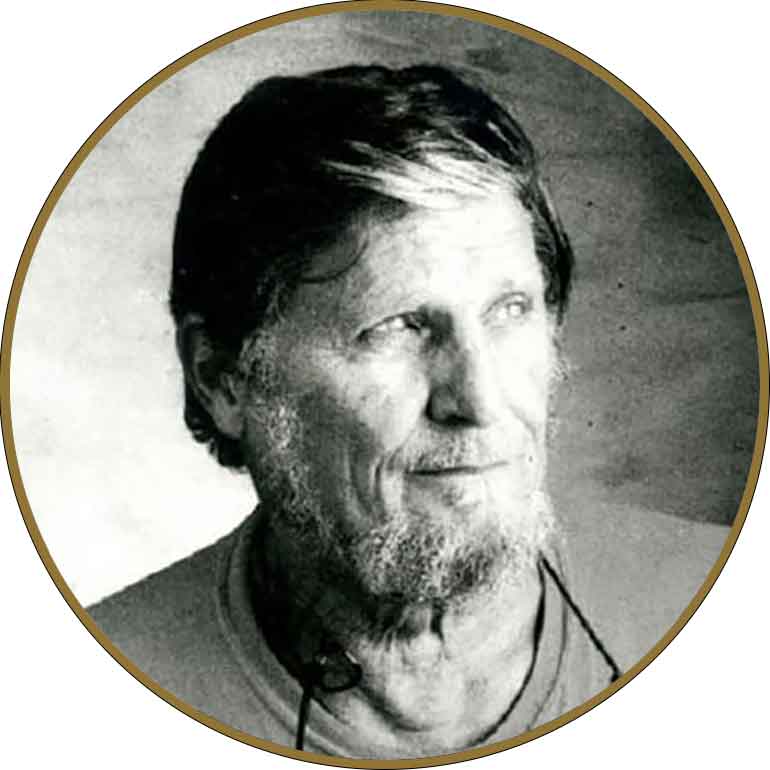
Lucio Ranucci, one of the most significant representatives of the artistic movement known as realist cubism, was born in 1925 in Perledo, in the province of Como. His childhood and adolescence were marked by frequent moves due to his parents' work, both doctors. While his father and little sister Silvia moved between northern and southern Italy, Lucio spent eight years in a boarding school in Perugia. 1933 brought a dramatic turn in his life when his father, Bernardino, died. His mother decided to move to Milan with sister Silvia, leaving Lucio at the boarding school in Perugia. The experience of separation and loneliness would deeply influence his artistic path, inspiring his future works.
At the beginning of 1943, like many young Italians of the time, Lucio Ranucci enlisted as a volunteer in the Italian army and left for North Africa. This adventure was supposed to be a heroic experience, but it soon turned into captivity in Tunisia, where he was captured. In January 1945, he returned to Italy as an interpreter for the Anglo-American troops. After the war, Lucio Ranucci began working as a journalist in Milan, but his thirst for knowledge and desire to explore the world led him, in 1947, to embark on a journey to Latin America, initially to Argentina. His financial means were limited, and to support himself, he took occasional jobs as a sailor, funeral carriage driver, and photographer, moving through Chile, Bolivia, and Peru. Despite frequent moves, he never abandoned his interest in painting and the cultural environment of Latin American countries.
Lucio Ranucci maintained a constant journalistic commitment, using his art as a vehicle to denounce poverty, oppression, and the lack of freedom of South American populations. In 1949, he exhibited for the first time at the Galleria Marini in Lima, Peru, and from that moment on he began to exhibit regularly in various Latin American countries, the United States, Europe, and Italy. During the '50s, he participated in important group exhibitions, such as the Bienal Panamericana de Mexico in 1958 and the Bienal de Sao Paulo as a representative of Costa Rica.
His style, with cubist and expressionist influences, reflects the sublimation of humanity, with solemn and frontal figures, painted with pupil-less eyes that express the inner world of the subjects. In 1951, Lucio Ranucci made Costa Rica his home for ten years, where he served as director of the University Theater and also dedicated himself to painting murals, including a large panel at the San Jose airport. His sensitivity to the people's dramas led him to actively participate in Central American political events, even ending up in prison in Managua, Nicaragua. However, Ranucci did not consider himself just a journalist or a political activist; his true passion remained art.
Over the years, he exhibited in numerous countries, from the Americas to Europe, gaining recognition and appreciation for his ability to capture the soul of suffering humanity through his paintings.
After a period spent in Rome and Ischia, Lucio moved to the United States, to San Francisco, to exhibit his works and connect with his audience of admirers. Later, he lived for a time in Paris and finally settled on the French Riviera, near Vence.
Lucio Ranucci not only devoted himself to painting but also wrote three books, including Alguien camina sobre el sol (1949) and I colonnelli (1965). Throughout his long artistic career, he exhibited in more than fifteen countries and his works ended up in public and private collections worldwide. His indomitable passion for art drove him to fight for the return of art as the cradle of culture and memory and as a voice of protest against human tragedies.
Lucio Ranucci passed away in 2017, but his artistic legacy and his dedication to social denunciation remain a testimony to his heritage in contemporary art. His works continue to live on, carrying with them the power of emotions and the call for social justice.