
Painter
Emilio Scanavino
Italy, 1922–1986
Stay up to date with this artist
Leave your email to receive updates on newly available artworks and news about this artist.
Artworks by Emilio Scanavino
4 artworks



Biography of Emilio Scanavino
Emilio Scanavino (Genoa, 1922 – Milan, 1986) is a central figure of Italian informal art. His research has transformed the sign into an element full of psychological tension, capable of evoking bonds, obstacles and anxieties without resorting to an explicit narrative. The famous knots, the textures and the interweavings that cross its surfaces are not simple decorative motifs: they seem to represent the difficulty and,…
Read the full biographyClose the biography
Emilio Scanavino (Genoa, 1922 – Milan, 1986) is a central figure of Italian informal art. His research has transformed the sign into an element full of psychological tension, capable of evoking bonds, obstacles and anxieties without resorting to an explicit narrative. The famous knots, the textures and the interweavings that cross its surfaces are not simple decorative motifs: they seem to represent the difficulty and, at the same time, the need to establish relationships between things.
From the Genoese training to the international comparison
Trained in Genoa, Scanavino approached painting in a period of profound cultural changes. After the war he came into contact with European artistic experiences and with research that was questioning the traditional distinction between figure and abstraction. His painting is progressively oriented towards a dimension of signs and materials, in which the image does not represent the external world but records an internal condition.
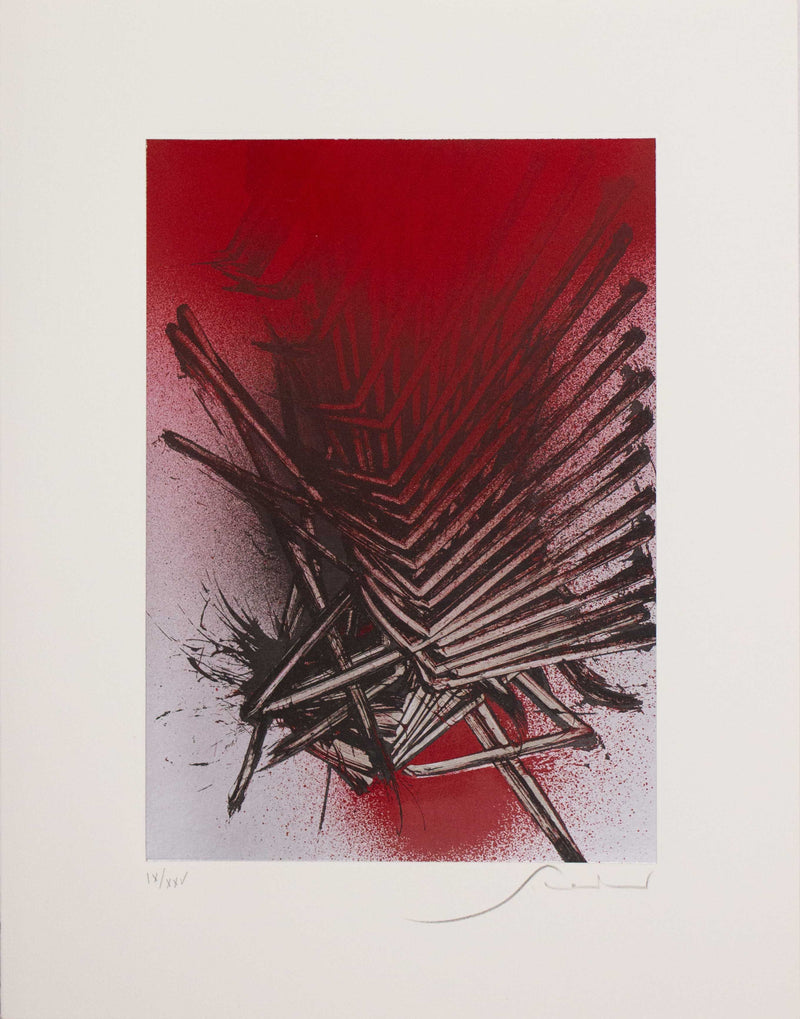
The comparison with the Informal is fundamental, but its language retains a recognizable structure. The surfaces can be crossed by dark lines, mixtures and backgrounds that suggest depth or closure. The sign sometimes appears like a wound, other times like a thread that connects distant points. This ambivalence gives the compositions a dramatic force, without forcing them to a univocal meaning.
His language was formed at a time in which many European artists were looking for a way beyond the traditional opposition between representation and abstraction. Scanavino addresses this question without entirely eliminating the suggestion of a habitable space or physical presence. The lines may look like threads, stitches, or obstacles, but they never settle into a single recognizable object. It is precisely this ambiguity that makes an emotional reading of the artworks possible. The sign does not illustrate an already defined psychological situation: it produces it through the tension between elements. The observation of the surface thus becomes an experience of approach and resistance, in which the eye seeks connections between parts that seem to simultaneously unite and separate. The relationship with the Informal therefore does not coincide with the abandonment of the composition, but with the search for a more restless and unstable order.
The knot as an image of existence
The knot becomes one of the most characteristic nuclei of his oeuvre. It presents itself as a tangle of lines that tighten and overlap, generating tensions between center and periphery, movement and arrest. It can be interpreted as an image of constraint, memory or relationship, but its effectiveness arises above all from the way in which it is constructed on the surface. Painting seems to give shape to something that cannot be expressed directly with words.
The chromatic and material variations broaden this research. In some artworks, dark tones and intimate atmospheres prevail; in others the color opens up to brighter contrasts. Continuity does not depend on a repeated formula, but on the persistence of a question: how to transform an elementary sign into an image capable of containing experience, conflict and duration?
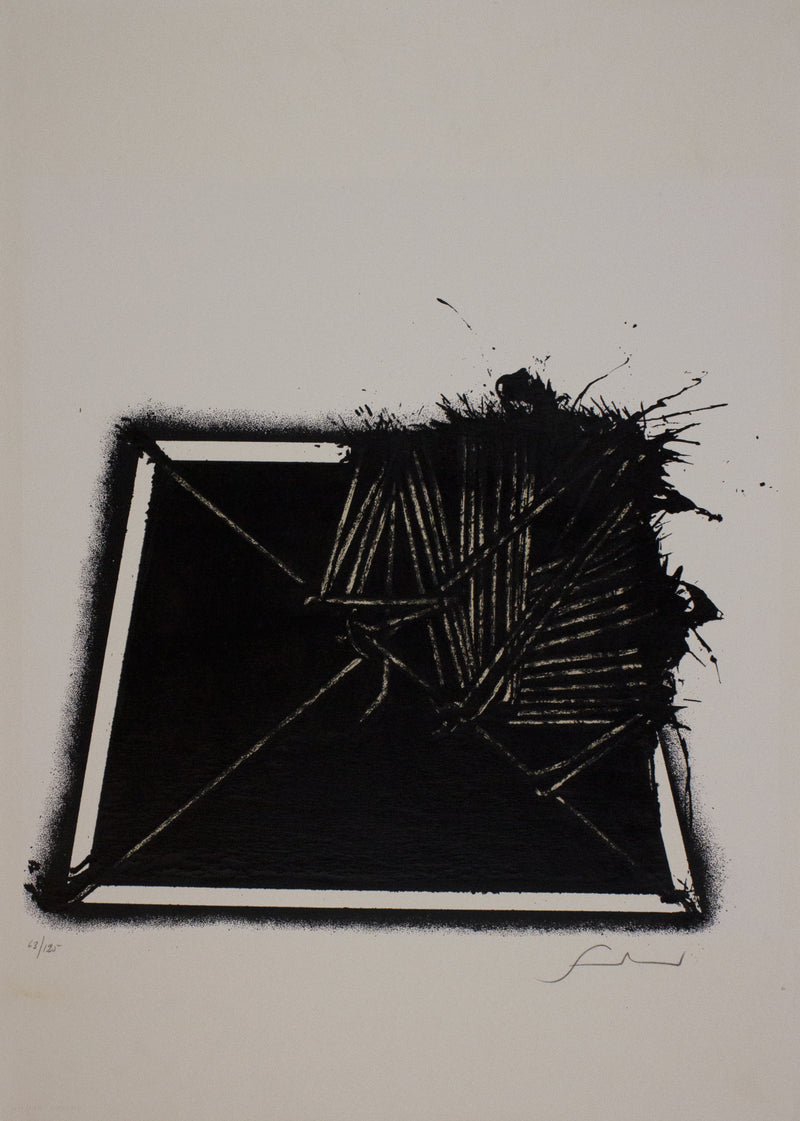
The node can be considered a shape that gathers multiple directions in one point, momentarily interrupting their movement. Its effectiveness depends on the relationship with its surroundings: a plot isolated in a large space produces a different impression from a plot that occupies almost the entire surface. Color also participates in this tension. The light areas can open a passage, while the dark ones seem to retain depth. The material is not a simple covering: mixtures, scratches and overlaps make the artwork of the hand perceptible. For this reason, Scanavino's artworks are not limited to photographic reproduction. The size, thickness and quality of the support affect the reading, transforming an apparently repeated motif into a different experience from painting to painting. The relationship between center and margins is also significant. In some compositions the plot seems to draw all the lines towards a point of maximum tension; in others the plot is distributed and the movement remains open. The same shape of the knot thus takes on different visual meanings, determined by the overall structure of the artwork.
Ceramics, graphics and experimentation with materials
Alongside painting, Scanavino dedicated himself to ceramics, sculpture and graphics, finding in each medium a different possibility of exploring the relationship between gesture and matter. Ceramic, in particular, allows the sign to acquire physical thickness and to become relief, a modeled surface, an object. In artworks on paper the same tension can be entrusted to the line, the tonal contrast and the overlapping of the strokes.
To distinguish a lithograph, an etching, a silk-screen print or a reproduction it is essential to consult the documentation of the individual specimen. Signature and numbering are important elements, but they are not sufficient in themselves to identify the procedure. Scanavino left a language of extraordinary coherence, in which the repetition of the sign does not eliminate the variety: each plot seems to be a new reflection on the complexity of the human experience.
The transition to ceramics allows us to observe the sign in a new condition. What appears in painting as a tangle of lines can become a relief, an engraving in the material or a structure that physically occupies the space. The surface is no longer just a plane to be looked at frontally: the light modifies its appearance according to the angle of observation. In graphic artworks, on the contrary, the research must deal with the possibilities of the matrix and with the repetition of the impression. A lithograph can preserve the fluid character of the drawing, while an etching highlights the relationship between groove and ink. It is not correct to assign a technique just because the sign appears engraved or printed. The description should document the process, paper, measurements, signature, numbering and provenance, keeping the artistic identity of the motif distinct from the characteristics of the specimen.
Do you like Emilio Scanavino?
Leave your email to receive updates on newly available artworks and news about this artist.
Emilio Scanavino
Art that lives in your spaces
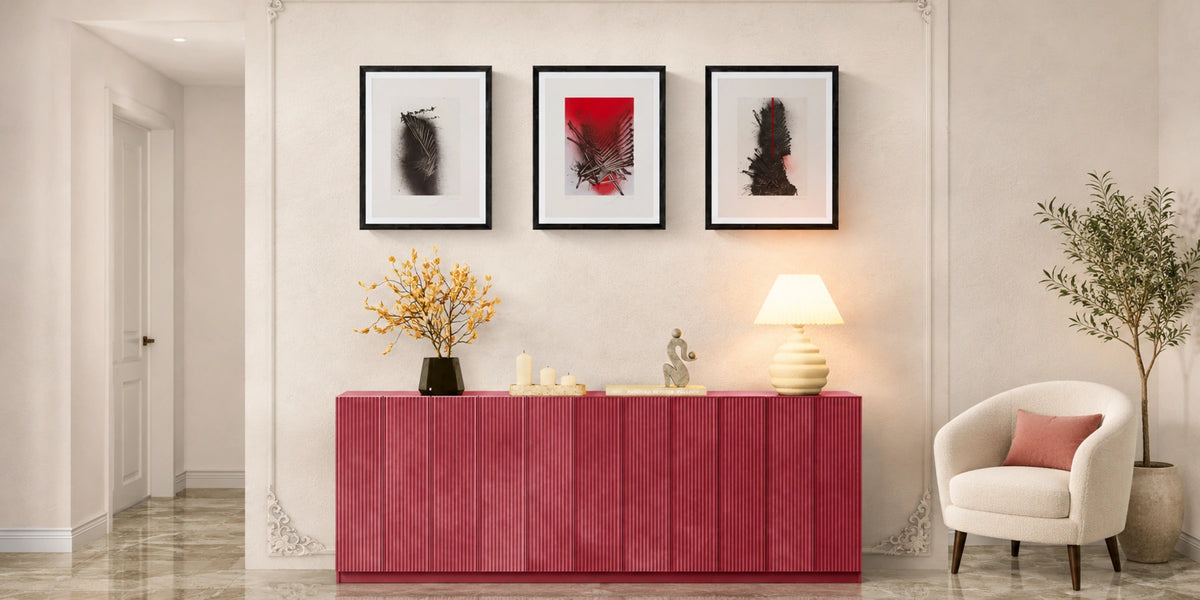
Choosing an artwork by Emilio Scanavino means making room for an individual artistic language. The artworks gathered here suggest combinations and perspectives to bring into your own surroundings, letting art guide your gaze.
DISCOVER THE ARTIST
Frequently asked questions
Answers to common questions about Emilio Scanavino, the artist’s life, artworks and value on the art market.
Who was Emilio Scanavino and what style did he develop?
Emilio Scanavino (1922–1986) was an Italian artist associated with the informal research of the second half of the twentieth century. His language is recognizable by textures, weaves, dark signs and knot-like shapes that cross the surface. He also worked in sculpture and ceramics.
What do the knots represent in Emilio Scanavino's artworks?
The knot is a recurring element of his visual research: it can evoke tension, bond, constriction or movement without necessarily corresponding to a real object. Rather than attributing a single symbolic meaning, it is worth observing how the signs are arranged and interact in the space of the artwork.
Did Emilio Scanavino belong to informal art?
Scanavino is commonly compared to the Informal for the importance attributed to the gesture, the material and the sign. His research, however, retains a very personal identity, built on linear structures and recognizable plots. The stylistic classification helps to contextualise, but does not replace the examination of the individual artwork.
Did Scanavino create etchings and lithographs?
Scanavino's graphic production includes original prints made with different processes. For each example it is necessary to read the technique reported in the sheet and distinguish engraving, lithography and reproduction. Signature, numbering and editorial information, when present, contribute to identification.
How to verify an original graphic by Emilio Scanavino?
You need to check the technique, possible print run, dimensions, paper, state of conservation and origin. It is useful to request photographs of the signature, numbering and details of the sheet and compare the artwork with catalogs or documentary references. No single element, considered in isolation, certifies authenticity.