

Giorgio De Chirico biography
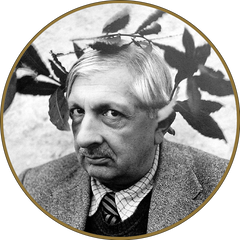
Giorgio De Chirico was an Italian painter, engraver, and sculptor among the main exponents of Metaphysical Painting. He was born in Volos, Greece in 1888 to Italian parents of noble origins. In 1891 his brother Andrea Alberto was born, who from 1914 would take the stage name Alberto Savinio for his activity as a musician, writer, and painter. In 1900 Giorgio De Chirico enrolled at the Polytechnic of Athens where he began studying painting. In 1906 he returned to Italy with his mother and brother, settling first in Milan and then Florence where he enrolled at the Academy of Fine Arts. In 1907 he enrolled at the Academy of Fine Arts of Munich where he attended the lessons of Franz von Stuck and took an interest in the art of Arnold Böcklin and Max Klinger.
In 1909 he returned to Milan where he reunited with his mother and brother. In 1910, during a stay in Florence with his mother, he painted The Enigma of an Autumn Afternoon, inaugurating the cycle of Metaphysical Squares. From 1911 to 1915 he lived in Paris with his brother Alberto and came into contact with artists such as Guillaume Apollinaire, Max Jacob, and Pablo Picasso. Between 1912 and 1913 he began painting his first Mannequins present in the works The Disquieting Muses and The Troubadour. The figure of the mannequin representing the contemporary man-automaton was inspired by a character from a drama by his brother Alberto Savinio, the faceless man.
At the outbreak of the First World War, the two brothers enlisted and were sent to Ferrara in the 27th Infantry Regiment. During this period the De Chiricos befriended Carlo Carrà, Filippo de Pisis, and Giorgio Rea. In particular, Filippo de Pisis often hosted friends in his apartment in Palazzo Calcagnini, via Montebello, influencing Giorgio De Chirico's metaphysical sensitivity, who during the Ferrara period began the cycle of Metaphysical Interiors.
In 1924 he met and married the actress and dancer Raissa Calza and together they settled in Paris. In the French capital Raissa abandoned dance and resumed archaeology studies at the Sorbonne. Inspired by his partner's studies, Giorgio De Chirico began painting archaeological subjects, a tribute to classicism but presented in a disturbing way. Among the works of this period are Hector and Andromache and Roman Villas. The marriage did not last long; in fact, at the end of 1930 the painter fell in love with Isabella Far, who became his second wife and remained by his side until his death.
From 1925 to 1935 Giorgio De Chirico deepened the study of the Metaphysics of light and the Mediterranean myth, giving rise to the cycles of the Archaeologists, the Horses by the Sea, the Trophies, the Landscapes in the Room, the Furniture in the Valley, and the Gladiators.
In 1924 and 1932 he participated in the Venice Biennale and in 1935 in the Rome Quadriennale. Between 1936 and 1937 he settled in New York where he exhibited his works at the Julien Levy Gallery.
In 1970 at the Royal Palace of Milan, an important retrospective of the artist was held. Giorgio De Chirico died in Rome on November 20, 1978, after a long illness.