

ART TECHNIQUES
Charcoal Drawing
Line, light and depth.
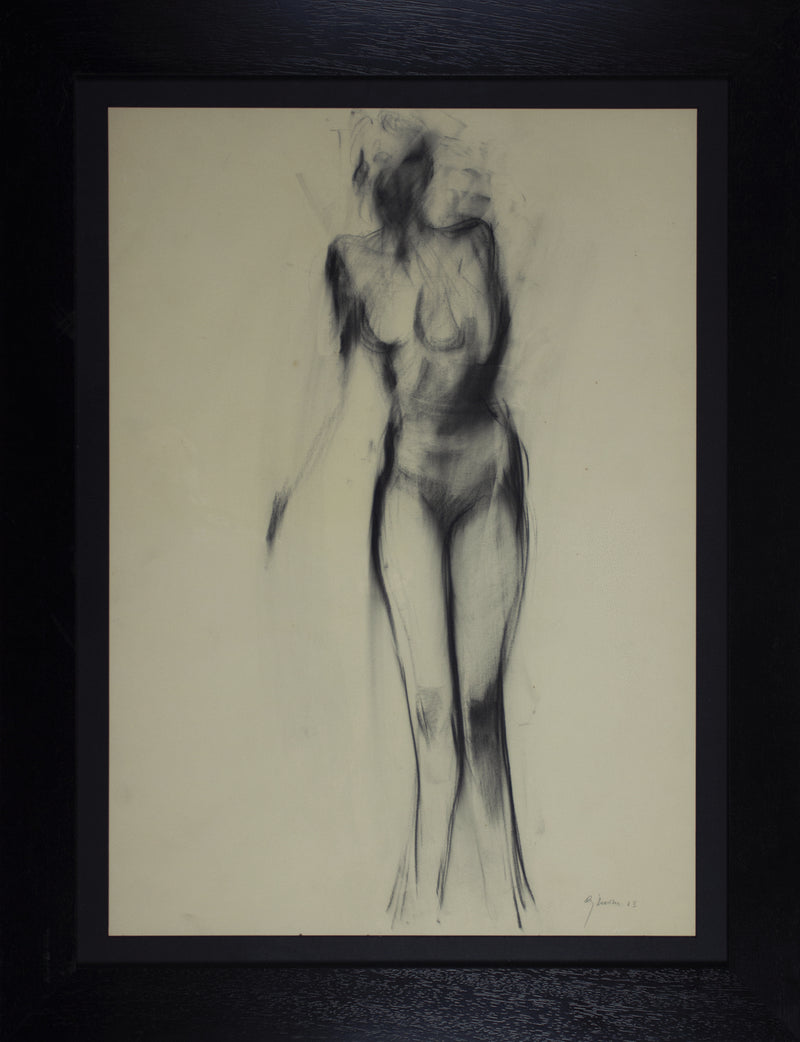
A drawing technique that combines spontaneous marks with a rich tonal range, from delicate lines to deep blacks.
OUR CHARCOAL DRAWINGS
Artworks to discover, choose and live with every day.

UNDERSTANDING THE ART TECHNIQUE
What is charcoal drawing?
Charcoal drawing uses a carbon-based material traditionally made by heating slender wooden branches with little oxygen. Natural sticks, compressed charcoal and pencils produce marks of varying intensity, broad dark passages and delicate tonal transitions.
By blending and lifting charcoal, artists build an image through light and shadow, combining precise lines with spontaneous gestures.
Origins — From early art to contemporary drawing
Charcoal has been used to make images since prehistoric times, as many cave paintings and drawings show. Over the centuries it became an important drawing material for preparatory studies, compositions and the human figure.
From the Renaissance to nineteenth-century academic training, it was widely used to study proportion, chiaroscuro and volume. Modern and contemporary artists also use it as a medium in its own right for finished artworks, portraits, landscapes and abstractions.
How it is made — Materials, supports and methods
Charcoal is usually applied to paper with enough texture to hold its particles. Natural charcoal produces soft marks that are easily adjusted. Compressed charcoal contains powdered charcoal and binders and often gives darker tones.
The tip makes outlines and details, while the side of the stick covers broad areas. Blending stumps or other tools soften transitions, and a kneaded eraser lifts dark passages to restore highlights. A suitable fixative can reduce shedding, though it may alter the tones.
Characteristics — Strength of mark, chiaroscuro and expressive freedom
Charcoal offers a rich tonal range, deep blacks and a contrast between sharp lines and soft, atmospheric passages. Its powdery nature encourages direct, gestural work and leaves a delicate surface.
It suits figurative and abstract work alike, bringing out movement, texture, contrasts of light and the expressive force of the mark.
Art in your spaces
The elegance of the drawn line.
From portraits to abstract compositions, charcoal drawings bring the expressive force of chiaroscuro and subtle monochrome tones into interiors. Deep blacks and gentle transitions complement a range of materials, furnishings and colours in classic and contemporary spaces.

EXPLORE THE TECHNIQUE
Frequently asked questions
Clear, simple answers to common questions.
What is the difference between charcoal and graphite pencil?
Charcoal generally gives deeper, more matte blacks and blends easily. Graphite produces precise lines and controlled gradations, but can shine in darker areas. Each offers different effects and they can be used together.
What supports work with charcoal?
Paper is the most common support, especially if it has enough tooth to hold the particles. Card and other properly prepared supports also work. Surface texture and colour affect the lines and chiaroscuro.
Is a charcoal drawing an original artwork?
Yes, if the artist made it directly and it is not a reproduction. A charcoal drawing can be a preparatory study or a finished, independent artwork. Assess originality through attribution, provenance and available documentation.
How can you recognise a quality charcoal drawing?
Look at the expressive quality of the marks, the tonal structure, the relationship to the artist’s practice, condition and provenance. Consider signatures and documentation alongside other evidence. Neither alone guarantees authenticity.
How should a charcoal drawing be preserved?
Use a glazed frame with a mat or spacer to keep the surface away from the glass. Choose conservation-grade materials and avoid direct sunlight, humidity and temperature fluctuations. Do not rub the surface or apply fixative to a finished work without consulting a conservator.
EXPLORE OTHER ART TECHNIQUES
Techniques, materials, endless forms of expression.
 Etching
The appeal of the etched line
 Aquatint
The nuances of intaglio
 Lithography
Freedom of line
 Screenprint
Colour takes shape
 Linocut
The strength of shapes
 Woodcut
The line cut into wood