
Visual artist
André Verlon
Austrian, 1917 – 1993
Stay up to date with this artist
Leave your email to receive updates on newly available works and news about this artist.
Works by André Verlon
1 work

André Verlon
André Verlon, the pseudonym of Willy Verkauf, was born in Zurich on 6 March 1917 and died in Vienna on 12 February 1994. A painter, collage artist, writer and publisher, he was a distinctive figure in the European avant-garde of the second half of the twentieth century. His artistic exploration arose from the meeting of formal experimentation, literary culture and political commitment, developing through a…
Read the full biographyClose the biography
Between the avant-garde, political commitment and artistic experimentation
André Verlon, the pseudonym of Willy Verkauf, was born in Zurich on 6 March 1917 and died in Vienna on 12 February 1994. A painter, collage artist, writer and publisher, he was a distinctive figure in the European avant-garde of the second half of the twentieth century. His artistic exploration arose from the meeting of formal experimentation, literary culture and political commitment, developing through a language that combines painting, image fragments, printed materials and montage techniques.
His life encompassed some of the most dramatic moments in European history. Having grown up in Vienna, he emigrated with his family in 1933 to Palestine, then under British mandate, as antisemitism intensified. During his years in exile, he worked in various professions and became involved in journalism, publishing and opposition to Nazism. This experience helped shape a sensibility deeply attentive to the relationships between the individual, power and society.
Returning to Vienna in 1946, he continued his cultural activities and published the magazine Erbe und Zukunft, devoted to literature, music, history and philosophy. His publishing experience reveals an interest in dialogue between disciplines that would also become an essential characteristic of his artistic work.
In the 1950s, he deepened his study of the historical avant-gardes, focusing particularly on Dadaism, to which he devoted the volume Dada. Monographie einer Bewegung in 1957. With its rejection of aesthetic conventions and its use of irony, chance and assemblage, the Dada movement provided Verkauf with an important cultural reference point.
In 1958, he adopted the artistic name André Verlon and devoted himself with growing intensity to the visual arts. The choice of a new name accompanied the development of a personal artistic vision, bringing together his experience of exile, knowledge of the avant-gardes and interest in the language of contemporary imagery.
Between 1961 and the early 1970s, he lived mainly in Paris, maintaining contacts with the international art world. In 1963, together with the Argentine artist Antonio Berni, he founded the ?–IMAGO group, an initiative exploring new expressive possibilities through images and montage.
Montage-Painting and dialogue with the avant-gardes
André Verlon’s most distinctive contribution was the development of Montage-Painting, a process combining painting and collage within a single composition. In this technique, cut-out images, papers, painted marks and other visual elements are organised into a unified whole, overcoming the traditional distinction between painting and assemblage.
Collage, introduced into modern art through the Cubist experiments of Pablo Picasso and Georges Braque, involves incorporating materials foreign to traditional painting into the surface of a work. Verlon took up this principle but developed it through a language in which montage has not only aesthetic value, but also narrative and critical significance.
The reference points of his work include Cubism, Futurism, Suprematism and, above all, Dadaism. The tradition of political photomontage also played an important role, particularly the works of John Heartfield, in which the combination of images becomes a tool for denunciation and social reflection.
In Verlon’s compositions, figurative fragments and abstract structures can coexist in a dynamic space. Images are superimposed, juxtaposed and transformed, creating unexpected associations. The result is not a simple sum of different materials, but a new visual construction in which each element acquires meaning through its relationship with the others.
The work Âge atomique, made in 1962 and held at the Centre Pompidou in Paris, is a significant example of this exploration. Executed in oil, ink and pasted papers on canvas, it demonstrates the artist’s ability to integrate different languages into a composition that reflects the tensions of the contemporary era. The title evokes the cultural and political climate of the atomic age, marked by technological transformations and the anxieties of the post-war period.
Verlon’s experimentation also involved the relationship between image and word. His literary activity developed alongside his visual work and shared its interest in fragments, quotation and recomposition. In autobiographical works such as Situationen, published in 1983, the principle of collage is transferred to writing, demonstrating the continuity between the different forms of his production.
This multidisciplinary exploration helps clarify the artist’s position in twentieth-century art. Verlon did not adhere rigidly to a single movement, but used tools from different traditions to construct a personal language in which compositional freedom coexists with a precise attention to history.
Exhibitions, museums and international recognition
André Verlon’s artistic career developed through exhibitions in Europe and the United States. In 1961, he took part in the landmark exhibition The Art of Assemblage, organised by the Museum of Modern Art in New York, one of the fundamental surveys in the recognition of artistic practices based on assembling heterogeneous objects and materials.
His participation placed his work in the international context of experiments that were redefining the very concept of the artwork. Collage and assemblage, initially associated with the historical avant-gardes, became central tools for interpreting contemporary society.
During the 1960s, his activity intensified, also thanks to his stays in Paris and relationships with artists from different backgrounds. His collaboration with Antonio Berni and the ?–IMAGO project testify to the international dimension of his career.
His works entered important museum collections. The Museum of Modern Art in New York holds works and documents relating to his production, including No Escape? from 1958 and materials connected with the ?–IMAGO project. The Centre Pompidou holds Âge atomique, while the Musée d’Art Moderne de Paris documents works such as Confusion and Reges et imperato.
After returning to live mainly in Vienna, Verlon continued to work in both art and literature. His activity remained connected with cultural freedom and historical memory. In 1991, together with his wife Helga, he established a prize devoted to Austrian antifascist journalism and writing, confirming the continuity between his personal experience and civic commitment.
Today, his work offers significant evidence of the expressive possibilities of collage in the second half of the twentieth century, particularly through its ability to unite formal exploration with reflection on the contemporary world.
Works by André Verlon: collage, mixed media and printmaking
André Verlon’s works stand out for the variety of their materials and the originality of their compositional methods. Collages, paintings, mixed-media pieces and works on paper constitute the main areas of his practice.
In his original collages, the artist uses paper fragments and pre-existing images, integrating them through painted and drawn interventions. Each composition results from the direct arrangement of materials and has particular characteristics linked to their placement, texture and overlap.
The mixed-media techniques may include oil painting, ink, watercolour and pasted papers. Identifying the materials is particularly important for understanding the nature of a work, because the generic term collage does not necessarily describe all the processes used.
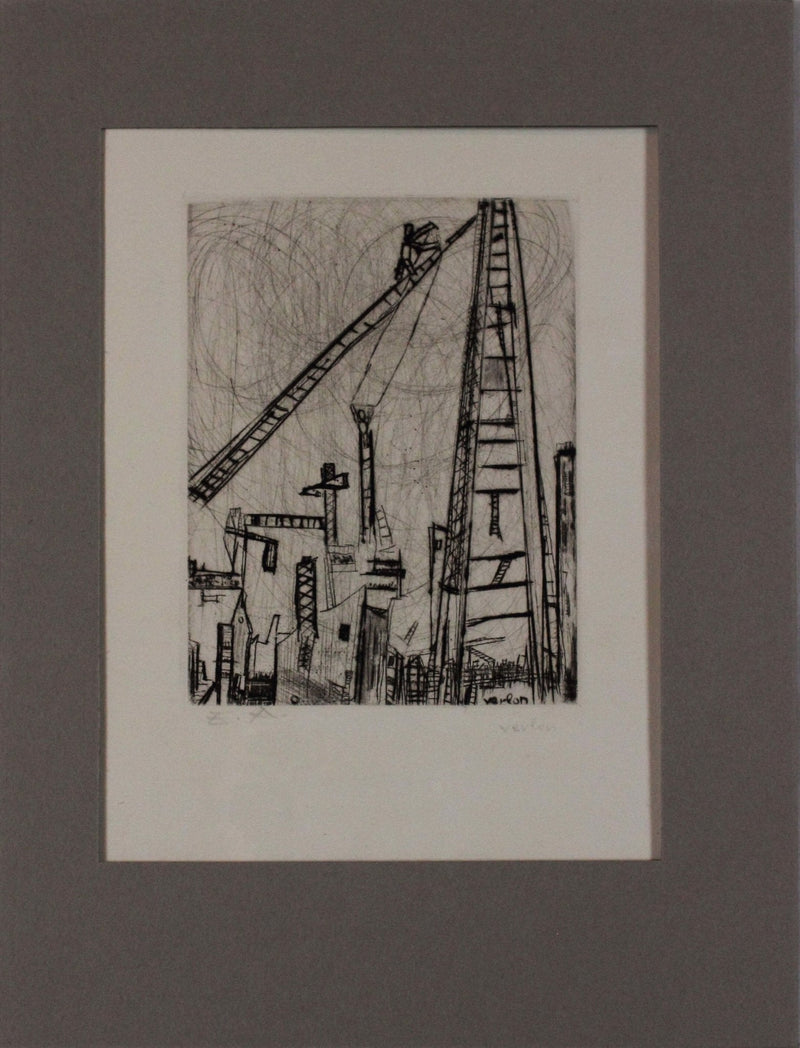
His printmaking and publishing work also document the artist’s relationship with printing and the dissemination of images. His presence in avant-garde publications testifies to an interest in artistic forms capable of crossing the boundaries between autonomous artwork, book and collective project.
For collectors, it is essential to distinguish an original collage, made directly with materials applied by the artist, from an original print produced using a specific printmaking technique, and from a simple reproduction. Signature, dating, any numbering, provenance and documentation are useful elements for correctly assessing each work.
The interest of André Verlon’s works lies above all in their position at the meeting point of the historical avant-garde and post-war experimentation. His language retains the critical energy of Dadaism but reworks it in the light of the political and cultural experiences of the second half of the twentieth century.
Discovering works by André Verlon means approaching an artist who made montage a tool of expressive freedom, transforming materials, images and fragments of reality into compositions capable of questioning history and the human condition.
Do you like André Verlon?
Leave your email to receive updates on newly available works and news about this artist.
André Verlon
Art that lives in your spaces
Choosing a work by André Verlon means making room for an individual artistic language. The works gathered here suggest combinations and perspectives to bring into your own surroundings, letting art guide your gaze.

DISCOVER THE ARTIST
Frequently asked questions
Answers to common questions about André Verlon, the artist’s life, works and value on the art market.
Who was André Verlon?
André Verlon (1917–1994) was an Austrian artist active in painting and graphics. His production includes figurative images and compositional experiments. To understand a specific work it is useful to consider the period of creation and the technique, avoiding automatically attributing all of his production to a single style.
What subjects recur in André Verlon's works?
In his production figures and compositions appear that rework the relationship between reality and imagination. The subjects and the degree of abstraction vary over time: for an accurate reading it is best to start from the image of the work and the documented information on its dating.
Did André Verlon create paintings or graphic works?
Verlon worked in multiple fields, including painting and graphics. The distinction is important for the collector: a painting is generally a one-of-a-kind piece, while an original print may belong to a print run. The work sheet must indicate the process and support actually used.
How to recognize an original print by André Verlon?
An original print arises from an artistic graphic process, not from the photographic reproduction of an image. To evaluate it, it is necessary to verify the declared technique, possible numbering, signature, characteristics of the paper and origin. The absence of one of these elements does not alone determine authenticity or non-authenticity.
What information should you look for in an André Verlon profile?
A reliable card should report title, technique, medium, dimensions, signature and, if relevant, print run and numbering. Conservation conditions and provenance are also useful. For artists less frequently documented online, it is especially important to distinguish verified data from attributions yet to be explored.