
Painter
Lorenzo Viani
Italy, 1882–1936
Stay up to date with this artist
Leave your email to receive updates on newly available artworks and news about this artist.
Artworks by Lorenzo Viani
1 artwork

Biography of Lorenzo Viani
Lorenzo Viani (Viareggio, 1882 – Ostia, 1936) was a painter, engraver and writer, among the most intense voices of Italian Expressionism. His art arises from the participatory observation of a humanity often excluded from official accounts: sailors, poor people, prisoners, vagabonds, women and men marked by fatigue. The deformed figures and dramatic contrasts do not have a caricatural function; they serve to restore the weight…
Read the full biographyClose the biography
Lorenzo Viani (Viareggio, 1882 – Ostia, 1936) was a painter, engraver and writer, among the most intense voices of Italian Expressionism. His art arises from the participatory observation of a humanity often excluded from official accounts: sailors, poor people, prisoners, vagabonds, women and men marked by fatigue. The deformed figures and dramatic contrasts do not have a caricatural function; they serve to restore the weight of existences that the artist knew closely.
Viareggio, apprenticeship and social restlessness
Growing up between the popular world of the dock and the environment of servitude linked to the Bourbon family, Viani soon developed a sensitivity to social inequalities. His apprenticeship in barber shops and his frequenting of anarchist environments offered him opportunities to meet characters and stories that would become central to his production. The artistic training is irregular, fueled by direct observation and an intense curiosity for literature.
The reception of Viani also requires avoiding an exclusively biographical reading. The proximity to the world of the excluded helps to understand his subjects, but is not enough to explain the quality of the images. The choice of cuts, the construction of contrasts and the deformation of the figures reveal a conscious formal research. The civil force of his oeuvre derives precisely from the encounter between lived experience and artistic invention. Looking at his woodcuts and his paintings therefore means recognizing both the testimony of an era and the autonomy of a personal language.
The Viareggio environment provides Viani with a human repertoire far from the celebratory images of society. Proximity to port workers, sailors and people on the margins fosters a sensitivity in which observation and solidarity are inseparable. His interest in anarchist culture also helps to explain the attention towards social hierarchies and forms of exclusion. However, his painting is not limited to formulating a complaint: it seeks a language capable of restoring the physical and moral strength of the subjects represented.
The comparison with Tuscan art and the stays in Paris broaden his language. The encounter with European painting of the early twentieth century, from Expressionism to post-impressionist experiences, contributes to freeing the form from any obligation of naturalistic fidelity. Viani does not renounce the subject: instead he accentuates his features to make his interior condition visible.
The face of the excluded and the drama of the sea
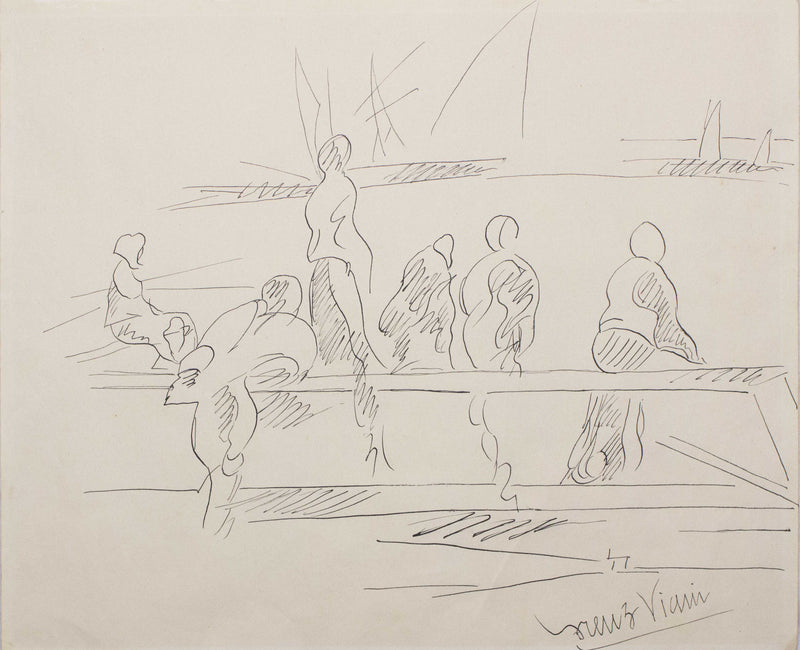
Viani's characters possess an often harsh physical presence. The faces are hollow, the eyes deep, the bodies contracted; the surrounding space can appear essential, almost crushed on the figure. Deformation becomes a language of participation and denunciation, not an exercise in style. The sea, a central element of Viareggio's identity, is both a place of artwork, promise and threat.
The expressive deformation thus takes on a precise value. A face marked by deep lines or a figure gathered in a painful posture are not treated as caricatures. They are images in which the form makes an existential condition visible. Color can accentuate drama or leave room for more sober contrasts; the drawing tends to isolate the essential features. This research places Viani in dialogue with European Expressionism, while maintaining a personal root in the Tuscan landscape and society.
In Blessing of the Dead of the Sea, one of his best-known paintings, the theme of loss takes on a collective dimension. The artist looks at the fishing community and its tragedies with an intensity that surpasses the local anecdote. Religious sentiment, popular memory and suffering meet in a scene with strong expressive tension.
Woodcut and writing
The xylography occupies a fundamental place in his production. In this technique the artist engraves a wooden matrix, eliminating the parts that should not receive the ink. The areas that remain in relief are printed on the paper, producing images in which the contrast between solids and voids can take on an extraordinary force. The procedure adapts to Viani's energetic synthesis, which constructs faces and figures with clear cuts and deep shadows.
The sea is a complex presence in his oeuvre. It not only represents a natural horizon, but the place of artwork and risk, departure and mourning. The events of the maritime community thus become the subject of a painting that combines individual memory and collective rituals. In this context, even religious scenes acquire a concrete human dimension: pain is not an abstract symbol, but a shared reality. The strength of these images depends on the ability to combine the local character of the subjects with a comprehensible feeling beyond their original context.
His activity also includes books and literary texts, in which the same human environments as painting occur. Writing and image share a radical attention to the lives of the marginal. For artworks on paper it is important to distinguish an original woodcut from a subsequent reproduction, checking the matrix, edition, paper, signature and catalog references. Viani's legacy consists in having given art a language that is both personal and civil, capable of transforming the observation of suffering into a form of testimony.
Literary writing further expands the portrait of his world. Words allow us to give voice to characters and situations that painting concentrates in an image, while drawing translates into a few signs a condition that the story can develop over time. Considering these practices together allows us to better understand the coherence of his research: not the repetition of a style, but a persistent attention to the existence of those left on the margins.
The woodcut makes the relationship between technique and language particularly evident. The wood engraving imposes clear choices: each cut modifies the relationship between light and shadow, while the non-engraved areas maintain the strength of the printed black. This economy of means favors a synthesis that accords with the tension of Viani's figures. The images may be harsh, but their intensity comes from a conscious construction. To evaluate a sheet it is necessary to check whether it is an original print from the matrix or a subsequent reproduction.
Do you like Lorenzo Viani?
Leave your email to receive updates on newly available artworks and news about this artist.
Lorenzo Viani
Art that lives in your spaces
Choosing an artwork by Lorenzo Viani means making room for an individual artistic language. The artworks gathered here suggest combinations and perspectives to bring into your own surroundings, letting art guide your gaze.

DISCOVER THE ARTIST
Frequently asked questions
Answers to common questions about Lorenzo Viani, the artist’s life, artworks and value on the art market.
Who was Lorenzo Viani and what style did he have?
Lorenzo Viani (1882–1936) was an Italian painter, engraver and writer linked to Versilia. His art has a strong expressive character, with intense and often dramatic figures. He paid great attention to the marginalized, the workers and the protagonists of popular life, represented with human participation.
What subjects did Lorenzo Viani paint?
Viani depicted sailors, fishermen, poor people, people on the margins of society and scenes of Versilia life. His interest was not only descriptive: through expressive deformations and contrasts he accentuated the emotional character of the characters. The social dimension is an important element of his oeuvre.
Was Lorenzo Viani an expressionist artist?
His painting is often similar to Expressionism due to the emotional intensity, the marked sign and the deformation of the figures. However, it is also important to consider its rooting in Italian culture and in the social reality of Versilia. His language arises from the encounter between artistic experiences and direct observation.
Did Lorenzo Viani make woodcuts and engravings?
Yes. Graphic production, and in particular woodcuts, occupies an important place in his career. The incisive style and clear contrasts lent themselves to the representation of the subjects that were dear to him. For a single artwork it is however necessary to verify the declared technique and distinguish an original print from a reproduction.
How to evaluate a woodcut by Lorenzo Viani?
It is necessary to check the origin, quality of the impression, condition of the paper, any signatures or inscriptions and bibliographical evidence. The dating and editorial characteristics may vary between copies. A serious evaluation requires examination of the specific artwork and, when necessary, discussion with specialists.
Discover more artists
Explore more leading figures in modern and contemporary art


