

Visual artist and performance artist
Marina Abramović
Serbia, 1946
Stay up to date with this artist
Leave your email to receive updates on newly available artworks and news about this artist.
Artworks by Marina Abramović
1 artwork

Biography of Marina Abramović
Marina Abramović (Belgrade, 1946) is one of the most important figures in contemporary performance art. Since the 1970s, she has used her own body as a means of artistic expression, exploring the limits of physical endurance, the relationship between artist and audience, and the meaning of presence. Her artworks may consist of simple gestures, such as remaining still or looking someone in the eye, but…
Read the full biographyClose the biography
Marina Abramović (Belgrade, 1946) is one of the most important figures in contemporary performance art. Since the 1970s, she has used her own body as a means of artistic expression, exploring the limits of physical endurance, the relationship between artist and audience, and the meaning of presence. Her artworks may consist of simple gestures, such as remaining still or looking someone in the eye, but they become experiences that challenge traditional ways of viewing art. Through performances, photographs, videos, and installations, Abramović has shown that an artwork does not necessarily have to be an object: it can also be an action, an encounter, or an experience.
Life and artistic training
Born on November 30, 1946, in Belgrade, in what was then Yugoslavia, Marina Abramović grows up in a family shaped by the political history of the postwar period. Her parents had taken part in the partisan resistance during the Second World War, while her maternal grandmother, who was deeply religious, instills in her a sensitivity to ritual and spirituality. These experiences contribute to the development of a personality drawn to discipline, endurance, and the symbolic dimension of human experience.
She studies painting at the Academy of Fine Arts in Belgrade and continues her training in Zagreb. Initially, she focuses on drawing and painting, but gradually realizes that the surface of the canvas is not enough to express her ideas. So, in the early 1970s, she begins to use the body as an artistic material, choosing to live out the experiences she intends to represent directly in front of spectators. Her first performances are born, in which time, exertion, concentration, and risk become fundamental elements of the artwork.
Performance art and its relationship with the audience
In performance art, the artist uses gestures, movements, words, or their own presence to create an experience that unfolds in a specific place and time. Unlike a painting or a sculpture, a performance does not necessarily take the form of a physical object: it can last a few minutes or many hours and directly involve the audience.
Abramović developed this language through an exploration in which the body becomes both the subject of the artwork and the tool for exploring fatigue, fear, and vulnerability. The viewer's role also changes: their reactions and sometimes their decisions help determine what happens, transforming the artwork into a relationship between human beings.
The early performances: Rhythm 0
Between 1973 and 1974, Marina Abramović created the Rhythm series, devoted to control, endurance, and collective behavior. L's best-known artwork is Rhythm 0, presented in 1974 at the Studio Morra in Naples.
For six hours, the artist remains at the public's disposal beside a table holding 72 objects, some harmless and others potentially dangerous. Visitors can use them on her, taking responsibility for their actions. L's initial interaction gradually becomes an unsettling situation, showing how much individual behavior can change when the usual social rules no longer apply.
With Rhythm 0, Abramović explores the relationship between freedom and responsibility, demonstrating how a performance can become a tool for psychological and social inquiry.
The collaboration with Ulay
In 1975, Marina Abramović met German artist Ulay, the pseudonym of Frank Uwe Laysiepen. Their romantic and artistic relationship gave rise to a collaboration that lasted until 1988, characterized by performances exploring trust, mutual dependence, and the balance between two individuals.
In Imponderabilia (1977), the two artists stand naked on either side of a narrow entrance, forcing visitors to pass through the space between their bodies. In Rest Energy (1980), they hold a bow under tension, with an arrow aimed at Abramović's heart, entrusting the artist's safety to their mutual trust.
These artworks make the tensions in human relationships visible, showing how relying on someone also means accepting a state of vulnerability. The collaboration ended in 1988 with The Lovers: The Great Wall Walk, during which the two walked along the Great Wall of China from opposite ends until they met after a long journey. L's action symbolically marked the end of their shared journey.
Dragon Heads: controlling fear
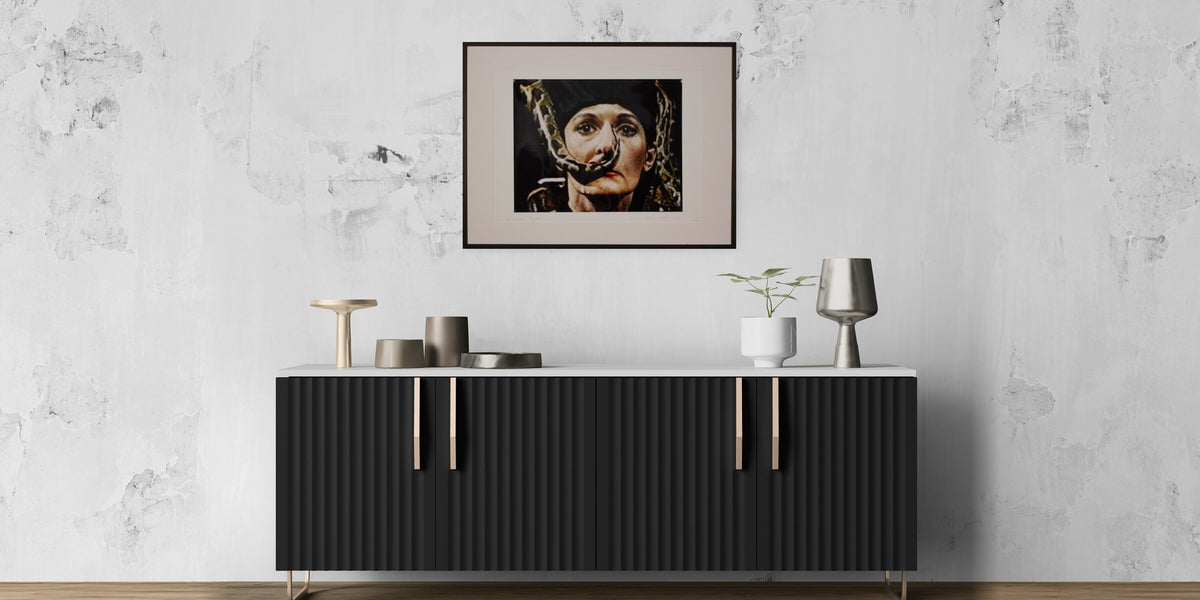
In 1990, Marina Abramović created Dragon Heads, a performance in which her body interacts with live snakes and blocks of ice. Lthe artist remains motionless as the pythons move around and over her body, creating a situation that brings human vulnerability into relation with an animal presence capable of inspiring both attraction and fear.
Lstillness becomes a fundamental element: Abramović gives up movement and focuses attention on her ability to control her own reactions. The snake, rich in symbolic meanings in many cultures, contributes to a reflection on energy, fear, and transformation.
The photographs associated with Dragon Heads preserve the visual record of an otherwise unrepeatable action, allowing those who did not witness it firsthand to learn about it.
Balkan Baroque: the memory of war
In 1997, Marina Abramović presented Balkan Baroque at the Venice Biennale, winning the Golden Lion for best artist. L'opera emerged from a reckoning with the wars that had swept through the former Yugoslavia and addresses the theme of memory through a physical action repeated over several days.
Seated on a pile of animal bones, Abramović attempts to clean them as she sings and recalls personal and collective memories. The repetitive, arduous gesture becomes a metaphor for the impossibility of completely erasing the consequences of violence.
The performance thus addresses a historical and moral question through the body, exertion, and a ritual action, transforming the memory of war into a direct artistic experience.
The Artist Is Present: the value of presence
In 2010, the Museum of Modern Art in New York dedicated a major retrospective to Marina Abramović, accompanied by the performance The Artist Is Present. For more than 700 hours in total, spread over the course of the exhibition, the artist sat in silence, welcoming one by one the visitors who wished to sit across from her.
L'opera consists solely of an encounter between two people. There are no dialogues or complex movements, but the simplicity of the action produces profound reactions: some visitors smile, others cry, while others remain still, holding the artist's gaze.
With The Artist Is Present, Abramović brings her exploration of duration, presence, and connection with the audience to an essential form, demonstrating how giving another person one’s undivided attention can become a meaningful artistic experience.
Photographs, videos, and graphic artworks
In Marina Abramović’s artwork, photographs and videos play a fundamental role because they make it possible to document performances that are destined to end and preserve significant moments from them. In some cases, the images also constitute autonomous artworks, conceived and presented according to specific artistic choices.
A photograph related to a performance is therefore not necessarily simple documentation. It may be an original photographic artwork, produced in an edition and intended for collectors. It is important to distinguish between historical documentation, a reproduction, and an artwork authorized by the artist.
To assess an item, consider its provenance, edition size, any signature or certification, printing technique, and condition. The subject is also important: photographs related to performances such as Dragon Heads offer a way to connect with significant moments in Abramović’s practice through images that can be viewed and preserved over time.
L’s importance in contemporary art
Marina Abramović has helped transform the relationship between artwork, artist, and viewer, demonstrating that the body can become a tool for exploring time, memory, fear, trust, and presence.
From her early actions in the 1970s to major museum performances, she has developed a language in which even a simple gesture can take on complex meaning. Photographs and artworks related to the performances offer a way to engage with this exploration through physical forms that preserve its images and meanings.
Knowing the context in which these artworks were created is essential to understanding their historical, cultural, and artistic value.
Do you like Marina Abramović?
Leave your email to receive updates on newly available artworks and news about this artist.
Marina Abramović
Art that lives in your spaces
Choosing an artwork by Marina Abramović means making room for an individual artistic language. The artworks gathered here suggest combinations and perspectives to bring into your own surroundings, letting art guide your gaze.
DISCOVER THE ARTIST
Frequently asked questions
Answers to common questions about Marina Abramović, the artist’s life, artworks and value on the art market.
Who is Marina Abramović?
Marina Abramović, born in Belgrade in 1946, is a Serbian artist among the most important figures of performance art. Since the Seventies she has used her body, duration and relationship with the public to explore resistance, vulnerability and presence.
Why is Marina Abramović famous?
She is known for performances that test physical and psychological limits and directly engage viewers. Among the most famous are Rhythm 0 (1974), Balkan Baroque (1997) and The Artist Is Present, presented at MoMA in 2010.
What does performance art mean in Abramović's artwork?
Performance is an artwork that is realized through actions, time and presence, not necessarily through a traditional object. Abramović often uses immobility, repetition and confrontation with the audience to make the experience itself the center of the artwork.
What is the relationship between Marina Abramović and Ulay?
Abramović and the artist Ulay collaborated from the mid-1970s until 1988. They created performances based on the relationship between two bodies and two identities; their collaboration ended symbolically with The Lovers, the route on the Great Wall of China.
Can artworks by Marina Abramović be collected?
Yes, but it is necessary to distinguish performances, photographic documentation, videos, editions and other material artworks. For each proposal it is essential to verify technique, authenticity, edition size, provenance and related rights. Any artworks present on Emporium Art are described in the respective product sheets.
Discover more artists
Explore more leading figures in modern and contemporary art

