
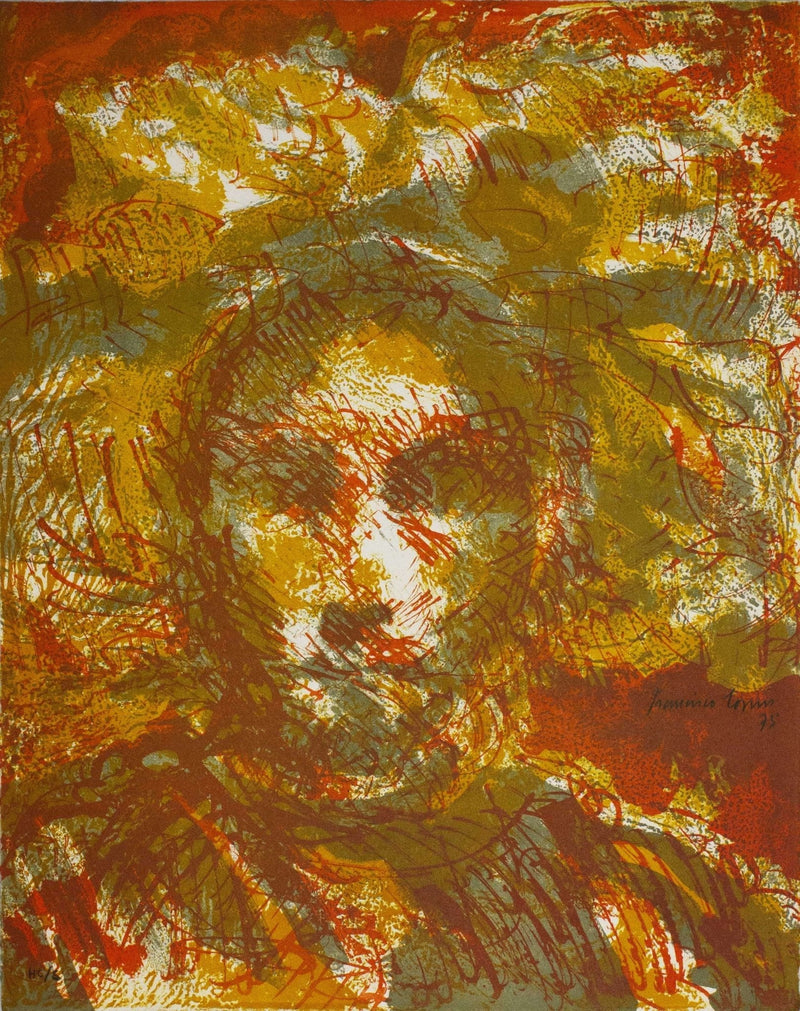
Painter and printmaker
Francisco Corzas
Mexico, 1936–1983
Stay up to date with this artist
Leave your email to receive updates on newly available artworks and news about this artist.
Artworks by Francisco Corzas
1 artwork

Biography of Francisco Corzas
Francisco Corzas (Mexico City, 1936–1983) was a Mexican painter and printmaker, and one of the leading figures of the so-called Generación de la Ruptura. His oeuvre is distinguished by intense figuration, featuring enigmatic figures, suspended atmospheres, and references to the European painting tradition. After training at the La Esmeralda school in Mexico City, he spent time in Italy, where he deepened his study of Renaissance…
Read the full biographyClose the biography
Francisco Corzas (Mexico City, 1936–1983) was a Mexican painter and printmaker, and one of the leading figures of the so-called Generación de la Ruptura. His oeuvre is distinguished by intense figuration, featuring enigmatic figures, suspended atmospheres, and references to the European painting tradition. After training at the La Esmeralda school in Mexico City, he spent time in Italy, where he deepened his study of Renaissance and Baroque masters. His painting developed a personal language in which the human body, memory, and the psychological dimension play a central role. Alongside his paintings, he created prints and graphic artworks, contributing to the renewal of Mexican figurative art in the second half of the 20th century.
LChildhood in Mexico City
Francisco Corzas was born in Mexico City on October 4, 1936. He came from a large family with limited financial means. From a young age, he showed a particular interest in drawing. His ability to depict figures and forms was recognized early on. LThe artist developed a sensibility that would lead him to devote himself to painting and printmaking.
Training at La Esmeralda
Between 1951 and 1955, Corzas studied at the Escuela Nacional de Pintura, Escultura y Grabado La Esmeralda. The school was one of the leading centers for artistic training in Mexico. His teachers included Carlos Orozco Romero, Manuel Rodríguez Lozano, and Agustín Lazo. Corzas developed his life-drawing skills and studied the construction of the figure. His training helped him build a solid technical foundation.
The Generación de la Ruptura
Corzas belonged to the so-called Generación de la Ruptura. The term refers to a generation of Mexican artists who, from the 1950s onward, sought new forms of expression beyond the muralist tradition. Their oeuvre did not constitute a stylistically unified movement. It encompassed both figurative and abstract approaches. Corzas developed a personal style of painting, characterized by a strong interest in the human figure.
The trip to Italy
In 1957, Corzas arrived in Rome. His stay marked a decisive moment in his artistic development. He studied painting and deepened his knowledge of the European masters. His engagement with the Renaissance and Baroque helped shape his artistic language. LThe artist was especially interested in depicting the body and in the use of light.
The relationship with European tradition
Corzas’s painting draws on the European tradition. Among the most significant influences is Francisco Goya. L’s artist looks to the Spanish master’s ability to portray the fragility and contradictions of the human condition. His engagement with old master painting does not result in an imitative style. Corzas developed a modern figurative style characterized by enigmatic atmospheres.
Human figures
The human figure is the central subject of his oeuvre. The figures may appear isolated. Their poses are often still. The portrayal retains a strong psychological dimension. The figures seem to belong to a suspended reality. The body becomes a means of exploring themes related to memory and identity.
Enigmatic atmospheres
One of the most distinctive aspects of his painting is the presence of mysterious atmospheres. Settings may seem undefined. Figures are placed in spaces characterized by a particular stillness. Light contributes to the construction of meaning. L’image does not necessarily present an explicit narrative. It invites the viewer to interpret the relationships between the figures.
Color
Corzas used a palette often characterized by restrained tones. Color relationships contribute to the psychological dimension. His painting retains a particular attention to material. The surface may feature complex tonal transitions. Color becomes an integral part of the construction of figures.
Drawing
Drawing occupies a fundamental place. His academic training enabled Corzas to develop remarkable mastery of the figure. Line contributes to the construction of volume. The prints testify to the importance of working from life.
L’s printmaking
Alongside painting, Corzas produced prints and artworks in graphic media. Printmaking allowed him to explore the relationship between line and light in greater depth. He interpreted figures through different techniques. L’s printmaking constitutes a significant part of his output. When cataloging individual artworks, it is important to verify the specific technique and distinguish original prints from reproductions.
Recognition in Rome
In 1958, Corzas received recognition at the International Exhibition of Via Margutta in Rome. Around the same time, he held a solo exhibition in the capital. L’s experience in Italy helped spread his oeuvre. His career also began to develop internationally.
The return to Mexico
During the 1960s, Corzas returned to work in Mexico. However, he maintained ties with the European art scene. His oeuvre attracted attention for its ability to develop a distinctive figurative style independent of the main trends in muralism.
International exhibitions
Corzas took part in numerous exhibitions in Europe and the Americas. In 1965, he received recognition at the Salón 65 of the Instituto Nacional de Bellas Artes. In 1972, the Palacio de Bellas Artes in Mexico City dedicated a retrospective exhibition to him. In 1976, he exhibited at the Museo de Arte Moderno. These honors confirmed his standing in contemporary Mexican painting.
Psychological dimension
Corzas’s painting frequently addresses themes related to loneliness and human fragility. The figures are not represented merely as recognizable individuals. They take on a symbolic dimension. L’artista uses the body to express inner states. The representation retains a particular emotional intensity.
L’s artistic legacy
Francisco Corzas died in Mexico City on September 15, 1983. His oeuvre represents a significant contribution to Mexican figurative art in the second half of the 20th century. Through painting and printmaking, he developed a style in which European tradition and contemporary sensibility coexist. His oeuvre demonstrates how the human figure can become a means of reflecting on memory and the human condition.
Do you like Francisco Corzas?
Leave your email to receive updates on newly available artworks and news about this artist.
Francisco Corzas
Art that lives in your spaces
Choosing an artwork by Francisco Corzas means making room for an individual artistic language. The artworks gathered here suggest combinations and perspectives to bring into your own surroundings, letting art guide your gaze.
DISCOVER THE ARTIST
Frequently asked questions
Answers to common questions about Francisco Corzas, the artist’s life, artworks and value on the art market.
Who was Francisco Corzas?
Francisco Corzas (1936–1983) was a Mexican painter and printmaker. His oeuvre is known for intense figuration, often characterized by enigmatic atmospheres, isolated characters and a dramatic use of light.
What are the recurring themes in Francisco Corzas' paintings?
Human figures, solitude, theatricality and dreamlike suggestions recur in many of his compositions. Images can evoke stories or psychological states without offering a univocal narrative: interpretation requires attention to the specific artwork.
Did Francisco Corzas also make engravings?
Yes, in addition to painting Corzas practiced graphics. To identify a print it is necessary to check the precise technique, the possible print run, the signature and the provenance, because the generic term "engraving" can include different processes.
How to distinguish an original artwork by Corzas from a reproduction?
A painting, a drawing and an original print have different material characteristics. It is necessary to check the support, technique, printing marks, possible numbering and documentation; a signature reproduced in the image is not equivalent to a handwritten signature.
What does the value of an artwork by Francisco Corzas depend on?
Authenticity, period, technique, subject, dimensions, state of conservation and provenance count. Paintings and graphics in edition size must be compared separately; it is not correct to obtain a quote from just one price displayed online.