
Sculptor
Ettore Colla
Italy, 1896–1968
Stay up to date with this artist
Leave your email to receive updates on newly available artworks and news about this artist.
Artworks by Ettore Colla
1 artwork

Biography of Ettore Colla
Ettore Colla (Parma, 1896 – Rome, 1968) was one of the leading figures in postwar Italian abstract sculpture. After training rooted in the figurative tradition and an important stay in Paris, he developed a personal language based on the use of reclaimed industrial materials. Wheels, gears, sheet metal, and metal fragments were transformed into sculptures in which the material retains traces of time and its…
Read the full biographyClose the biography
Ettore Colla (Parma, 1896 – Rome, 1968) was one of the leading figures in postwar Italian abstract sculpture. After training rooted in the figurative tradition and an important stay in Paris, he developed a personal language based on the use of reclaimed industrial materials. Wheels, gears, sheet metal, and metal fragments were transformed into sculptures in which the material retains traces of time and its own history. As founder of the Origine group, together with Alberto Burri, Giuseppe Capogrossi, and Mario Ballocco, Colla contributed to the renewal of Italian art through exhibition and publishing activities as well. His artworks represent an original meeting of abstraction, assemblage, and reflection on industrial society.
His training in Parma
Ettore Colla was born in Parma on April 13, 1896. He grew up in a cultural environment in which the Italian figurative tradition remained significant. From a young age, he showed an interest in sculpture and attended the Academy of Fine Arts of Parma. During his studies, he came into contact with Attanasio Soldati and Bruno Barilli, figures who would play a significant role in twentieth-century culture. World War I temporarily interrupted his education. After his military service, he resumed his studies, focusing mainly on sculpture.
During this period, he deepened his understanding of modeling and the representation of the human figure, developing a solid knowledge of traditional techniques.
His stay in Paris
In 1922, Colla left Parma and embarked on a period of travel and study abroad. In Paris, he became part of the circles of leading European sculptors. He worked in Émile-Antoine Bourdelle's studio and became familiar with the artwork of Aristide Maillol, Charles Despiau, and Constantin Brâncuși. Engaging with these artists broadened his conception of sculpture. Figurative tradition was complemented by an interest in simplifying forms and in the autonomy of volumes. LThe Parisian experience marked a decisive turning point, although the abstract language that would make Colla famous developed only many years later.
Moving to Rome
In 1926, Colla settled in Rome, the city where he would spend much of his life. He initially worked as a sketch artist for the sculptor Angelo Zanelli. His oeuvre during this period remained predominantly figurative. The artworks show references to the language of Italian Novecento, with solid forms and archaizing influences. In 1930, he participated in the Venice Biennale, gaining significant public recognition. During the 1930s, he also produced artworks for monumental and decorative commissions.
The Crisis of Figuration
During the 1940s, Colla went through a period of deep reflection. His engagement with the historical and cultural transformations of the period gradually led him to question figurative language. He also devoted himself to painting and organizing artistic initiatives. LHis experience of Roman galleries, including the Zodiaco and the Secolo, contributed to his involvement in contemporary debate. His research moved toward a progressive reduction of forms. Sculpture no longer necessarily had to represent a recognizable body or object.
It can become an autonomous structure.
The Origine Group
In 1950, Colla founded the Origine group together with Alberto Burri, Giuseppe Capogrossi, and Mario Ballocco. L'initiative emerged amid the debates between figuration and abstraction taking place in postwar Italy. The artists shared a desire to develop a language capable of moving beyond traditional conventions. Their approaches remained distinct, but were united by an interest in essential elements of form and material. In 1951, the group held an exhibition in Rome. L'experience helped spread new non-figurative approaches.
The journal Arti Visive
In 1952, Colla helped found the journal Arti Visive, together with Emilio Villa and Piero Dorazio. The publication became an important forum for exchange between artists and critics. Articles, images, and theoretical contributions documented the transformations taking place in contemporary art. Colla took an active part in producing the journal, also working on its graphic design and editorial aspects. L'activity attests to his interest in promoting artistic culture, as well as in his own artwork.
The return to sculpture
During the early 1950s, Colla gradually returned to sculpture. His oeuvre turned toward abstract forms constructed from different materials. His early experiments included geometric structures and reliefs. Later, the artist developed an increasingly keen interest in discarded metal objects. Industrial materials became the focus of a new visual language.
Reclaimed materials
Colla's mature oeuvre is distinguished by the use of scrap iron. Wheels, pipes, gears, and mechanical fragments are salvaged and assembled. The objects lose their original function. They become elements of a new sculptural construction. L'artist does not seek to completely erase the characteristics of the material. Rust, deformations, and traces of use contribute to the meaning of the artwork. The industrial fragment is transformed into an autonomous sculptural presence.
L'assemblage
L'Assemblage represents the fundamental process of his mature oeuvre. Colla selects different elements and arranges them through balanced relationships. The composition emerges from the relationship between pre-existing forms. The result is not a simple accumulation of objects. It is a carefully constructed structure. The parts may suggest figures, architectures, or organisms without necessarily taking on a single, unequivocal meaning.
The relationship with Dadaism
L'use of reclaimed objects recalls some of the practices of Dadaism and the objet trouvé. The main difference, however, lies in the role of sculptural construction. Colla does not simply present the industrial object as an artwork. He transforms it through assemblage. The material retains its history, but is placed in a new formal relationship. Sculpture thus becomes a space where memory and invention meet.
Matter and time
One of the most original aspects of his oeuvre is the relationship between matter and time. The metal fragments bear the marks of wear. Rust bears witness to processes of transformation. L'artist gives these characteristics expressive value. Matter is not considered a neutral medium. It becomes an integral part of the artwork's meaning.
The Great Spiral
Among Colla's monumental artworks is The Great Spiral, from 1962. The sculpture is located at the National Gallery of Modern and Contemporary Art in Rome. L's oeuvre demonstrates the artist's ability to develop large-scale structures using metal elements. The form takes on an independent presence in space. The interplay between solids and voids contributes to the perception of the composition.
International recognition
In 1959, Colla presented an exhibition at the Institute of Contemporary Arts in London. In 1960, he exhibited at the Stedelijk Museum in Amsterdam. In 1964, he took part in the Venice Biennale with a solo gallery. These exhibitions contributed to the international recognition of his oeuvre. In 1970, after his death, the National Gallery of Modern Art in Rome dedicated an important retrospective to him.
Drawings and projects
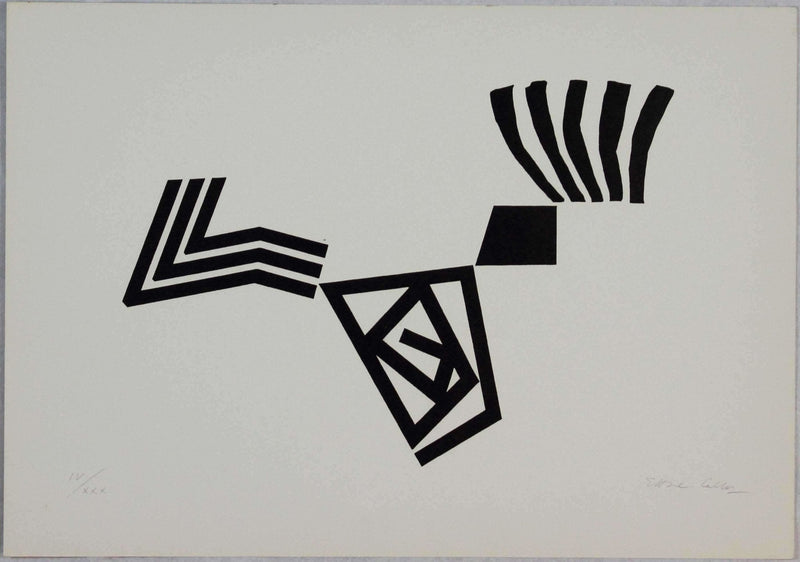
Alongside his sculptures, Colla created drawings, studies, and projects. The prints offer insight into the relationship between structure and form. In some cases, a drawing anticipates solutions intended for three-dimensional construction. In others, it constitutes an independent field of research. His documented graphic artwork attests to the continuity of his interest in composition.
L's artistic legacy
Ettore Colla died in Rome on December 28, 1968. His oeuvre represents one of the most original contributions to Italian sculpture in the second half of the twentieth century. Through reclaimed industrial materials, he transformed discarded objects into structures of intense expressive power. His research demonstrates how matter can preserve the memory of its past and acquire new meaning through art.
Do you like Ettore Colla?
Leave your email to receive updates on newly available artworks and news about this artist.
Ettore Colla
Art that lives in your spaces
Choosing an artwork by Ettore Colla means making room for an individual artistic language. The artworks gathered here suggest combinations and perspectives to bring into your own surroundings, letting art guide your gaze.
DISCOVER THE ARTIST
Frequently asked questions
Answers to common questions about Ettore Colla, the artist’s life, artworks and value on the art market.
Who was Ettore Colla?
Ettore Colla (1896–1968) was an Italian sculptor who, after a figurative training, developed an abstract and experimental language. He is remembered above all for the sculptures assembled with recovered metal elements, transformed into compositions with a strong plastic presence.
Why did Ettore Colla use scrap metal in his sculptures?
Colla recovered already existing industrial materials, such as mechanical parts and iron fragments, and recomposed them into new structures. The object thus lost its original function and acquired a formal and poetic value; they are not simply found objects left unchanged.
What is the relationship between Ettore Colla and the Forma 1 group?
Colla was not one of the signatories of the Forma 1 manifesto of 1947. His path, however, is part of the broader renewal of post-war Italian abstraction: it is useful to distinguish cultural proximity from formal belonging to a group.
How do you recognize a sculpture by Ettore Colla?
Many mature artworks feature vertical assemblies or open structures constructed of metal components. Style alone does not demonstrate authenticity: it is necessary to verify provenance, documentation, any archives and comparisons with published artworks.
What does the value of Ettore Colla's artworks depend on?
Authenticity, dating, dimensions, materials, importance of the artwork in the artist's career and provenance are decisive. A historical sculpture and an artwork on paper require different markets for comparison; a reliable evaluation considers documented results of comparable artworks.
Discover more artists
Explore more leading figures in modern and contemporary art


