
Painter
Bruno Saetti
Italy, 1902–1984
Stay up to date with this artist
Leave your email to receive updates on newly available artworks and news about this artist.
Artworks by Bruno Saetti
2 artworks

Biography of Bruno Saetti
Bruno Saetti (Bologna, 1902–1984) occupied a singular place in twentieth-century Italian painting, recovering the ancient wisdom of the fresco to make it a contemporary language. In his paintings, murals and mosaics, the human figure, the sun and motherhood become essential presences, immersed in a chromatic material that seems to preserve the memory of time. His painting does not seek spectacular effects: it relies on the…
Read the full biographyClose the biography
Bruno Saetti (Bologna, 1902–1984) occupied a singular place in twentieth-century Italian painting, recovering the ancient wisdom of the fresco to make it a contemporary language. In his paintings, murals and mosaics, the human figure, the sun and motherhood become essential presences, immersed in a chromatic material that seems to preserve the memory of time. His painting does not seek spectacular effects: it relies on the density of the surfaces, the measure of the composition and a light capable of transforming familiar images into symbols of universal significance.
From Bolognese training to the Venetian experience
Trained at the Academy of Fine Arts in Bologna, where he studied painting, sculpture and architecture, Saetti approached the tradition of wall decoration at an early age. He made his debut in the exhibitions of the 1920s and participated in the Venice Biennale as early as 1928. In 1930 he moved to the lagoon city to teach and there consolidated a career that would lead him to the chair of painting and the direction of the Academy. The comparison with the Venetian tradition, rich in luminous vibrations and great decorative cycles, was intertwined with his attention to the fourteenth-century masters and to ancient surfaces.
The visit to Pompeii in the 1930s contributed to making the fresco central to his research. Saetti understood that the mural technique could offer something different from oil painting: a light absorbed into the material, a color intimately linked to the support, a surface that does not simply receive the image but becomes part of it. This discovery did not push him to imitate the past. On the contrary, it allowed him to simplify the forms and build a personal lexicon, in which the echo of ancient art coexists with the anxieties and research of the twentieth century.
The choice of fresco also involves a different way of thinking about artwork time. The painter must foresee the parts to be executed while the plaster is wet, organize the composition and accept that some decisions cannot be corrected with the freedom allowed by other techniques. In Saetti this discipline is reflected in the clarity of the volumes and the reduction of superfluous details. The relationship with the ancient therefore does not only concern the appearance of the images, but the very process of their creation. The surface retains a mineral, almost archaeological quality, which makes the figures both present and distant. Even when working on non-architectural supports, the artist seems to think of the painting as a fragment of a wall, endowed with a material weight and its own duration.
Motherhood, suns and painting as memory
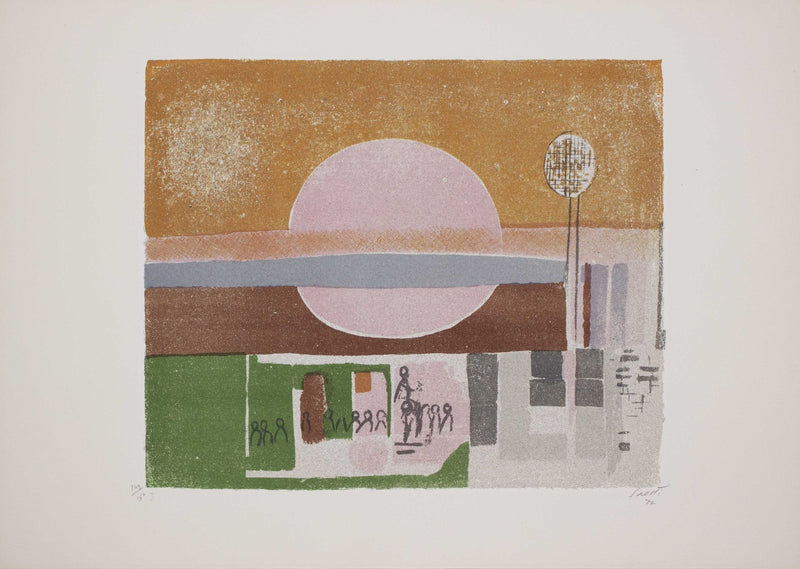
Among the most recurring themes are motherhood, female figures, angels and suns. In mothers with child, the monumentality of the shapes does not erase the tenderness of the gesture: the relationship between the bodies is entrusted to a balance of volumes, silences and warm colours. The sun, on the other hand, can become an almost abstract disc, suspended on backgrounds that evoke landscapes and walls without describing them in detail. The artist thus moves from figuration to increasingly synthetic images, maintaining a strong emotional continuity.
His religious sensitivity emerges above all in artworks of sacred art, where spirituality is not entrusted to a conventional decorative repertoire but to the quality of human presence. Saetti created important mural and mosaic interventions, including artworks for the University of Padua and for religious buildings. The recognition obtained in the Biennials and Quadrennials testifies to the importance of a path that was able to dialogue with the post-war artistic system without giving up its own identity.
Motherhood, read along the entire path, is not simply a sentimental subject. The closeness between adult and child allows us to represent protection, fragility and continuity of life with a few essential gestures. The figures tend to lose individual details and take on the value of collective presences. Similarly, suns and cosmic elements should not be interpreted as symbols with a fixed meaning: they are forms that allow the artist to organize light and color, creating a balance between concreteness and allusion. In this sense, figurative simplification is not an impoverishment, but a way of focusing attention on fundamental relationships. The warm tones, the opaque surfaces and the variations in chromatic intensity contribute to a feeling of concentration that permeates even the most monumental compositions.
Fresco, mosaic and art graphics
The fresco is created by applying pigments to still damp plaster: during the carbonation of the lime, the color binds to the wall. It is a technique that requires preparation, speed and knowledge of the materials. Saetti also used it in solutions adapted to mobile supports, preserving the opaque and compact character of wall painting. The mosaic offered him another possibility to construct light through units of matter and color. Alongside these practices he produced drawings, engravings and lithographs, which allow us to grasp his interest in the sign and in composition.
To understand an artwork on paper it is necessary to distinguish an original lithograph from a reproduction and verify the technique, support, edition and signature. Saetti's graphics should not be considered a simple minor version of painting: it is another place where the artist explores the relationship between form, surface and light. His legacy remains linked to this ability to make an ancient technique contemporary, transforming the wall into a space of contemplation and poetic intensity.
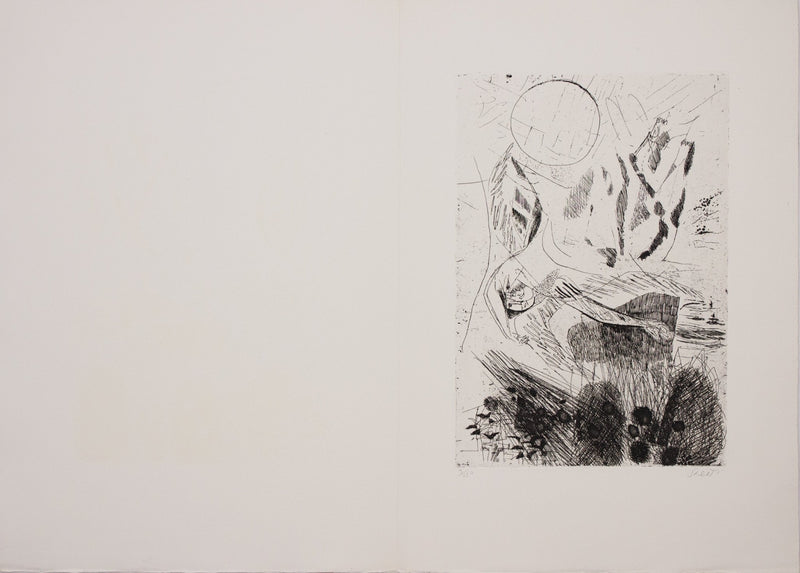
For graphic artworks, the distinction between technique and subject is particularly useful. An original lithograph arises from a planographic process in which the image is prepared on the matrix and printed; an intaglio engraving, on the other hand, transfers the ink retained in the grooves of a plate. Both can be original artworks in multiple copies, but should not be confused with a photomechanical reproduction of a fresco or painting. Even the term fresco requires precision: not every opaque or mural-looking surface was painted on fresh plaster. In the catalog cards it is therefore appropriate to describe what can be documented, distinguishing the actual technique from the visual effect. Interest in Saetti grows precisely when the coherence between his thinking about form and the concrete possibilities of such different materials is recognized.
Do you like Bruno Saetti?
Leave your email to receive updates on newly available artworks and news about this artist.
ART IN YOUR SPACES
The art of Bruno Saetti in your spaces
Choosing an artwork by Bruno Saetti means making room for an individual artistic language. The artworks gathered here suggest combinations and perspectives to bring into your own surroundings, letting art guide your gaze.
DISCOVER THE ARTIST
Frequently asked questions
Answers to common questions about Bruno Saetti, the artist’s life, artworks and value on the art market.
Who was Bruno Saetti and why is he important in Italian painting?
Bruno Saetti (1902–1984) was an Italian painter known for essential figures, motherhood, sacred images and compositions in which color and surface play a central role. His research spans the twentieth century maintaining a personal language, often characterized by intimate atmospheres and an expressive use of pictorial material.
What are the most recurring subjects in Bruno Saetti's artworks?
Recurring themes include motherhood, female figures, angels and images of religious inspiration. Saetti tends to simplify the contours and enhance the chromatic relationships, giving the figures a symbolic rather than narrative presence. Subject, technique and dating must be verified on the individual artwork.
Did Bruno Saetti also create frescoes?
Yes. Fresco is an important part of his activity, alongside painting on other supports and graphic production. The interest in the wall and in the quality of the surface also helps to understand his pictorial language. A print that reproduces a fresco, however, is not an original fresco.
How to distinguish a unique artwork from an original graphic by Bruno Saetti?
An original painting or drawing is a unique example; a lithograph or other original print may exist in multiple copies belonging to a print run. Before purchasing it is useful to check the technique, support, dimensions, possible numbering, signature and documentation. The signature alone does not prove authenticity.
What should you check before purchasing an artwork by Bruno Saetti?
It is necessary to examine the technical description, the state of conservation, the provenance and any available documents. For graphics it is important to distinguish an original print from a reproduction and verify the print run, when indicated. The value depends on specific characteristics of the specimen and cannot be deduced from the artist's name alone.
Discover more artists
Explore more leading figures in modern and contemporary art

