
Sculptor
Sol LeWitt
American, 1928 – 2007
Stay up to date with this artist
Leave your email to receive updates on newly available works and news about this artist.
Works by Sol LeWitt
1 work

Sol LeWitt
What makes a work of art what it is: the object we see, or the idea that determined its form? Sol LeWitt (Hartford, Connecticut, 1928 – New York, 2007) placed this question at the center of an inquiry that profoundly changed contemporary art. Associated with Minimalism and, above all, Conceptual Art, he created drawings, three-dimensional structures, prints, and wall works based on systems of rules.…
Read the full biographyClose the biography
What makes a work of art what it is: the object we see, or the idea that determined its form? Sol LeWitt (Hartford, Connecticut, 1928 – New York, 2007) placed this question at the center of an inquiry that profoundly changed contemporary art. Associated with Minimalism and, above all, Conceptual Art, he created drawings, three-dimensional structures, prints, and wall works based on systems of rules. The rigor of his works does not eliminate visual surprise; on the contrary, it shows how many possibilities can arise from an apparently simple premise.
From Geometric Forms to the Idea
After studying at Syracuse University and serving in the military during the Korean War, LeWitt settled in New York. He worked in graphic design and at the studio of architect I. M. Pei, experiences that contributed to his familiarity with modules, systems, and the organization of space. In the 1960s, while some American art continued to value individual gesture and the expressive force of painting, LeWitt focused on elementary forms and processes that could be described precisely. The cube became a favored starting point: precisely because it is simple, it makes it possible to observe how a structure changes when repeated, opened up, rotated, or subjected to a sequence of transformations.
In 1967, he publishes Paragraphs on Conceptual Art, a text in which he clarifies the central importance of the concept over its material execution. L'artist can establish a rule and let that rule determine the development of the work. This does not mean giving up visual sensitivity, but shifting attention from the artist's unrepeatable gesture to the process that generates the form. From this perspective, repetition is not a lack of inventiveness: it makes subtle differences and unexpected consequences perceptible.
Wall Drawings and Structures
The wall drawings, initiated in 1968, make this conception particularly clear. The artworks are made directly on walls according to instructions formulated by LeWitt; they can be executed by other people and recreated in different places. Lines, arcs, grids, and bands of color are organized according to principles ranging from simple combinations to very complex systems. The wall is no longer a neutral support on which to hang a picture, but an integral part of the work. The relationship with the person executing the work also changes: its realization requires precision and interpretation while remaining faithful to a preexisting plan.
At the same time, the structures explore three-dimensionality through modules, progressions, and geometric variations. Observing them means mentally following a sequence: understanding what remains constant and what changes. This is a form of intellectual participation that does not preclude an immediate aesthetic experience. L Order can produce rhythm, seriality can generate complexity, and an impersonal structure can become surprisingly expressive.
Original Prints and Artist’s Books
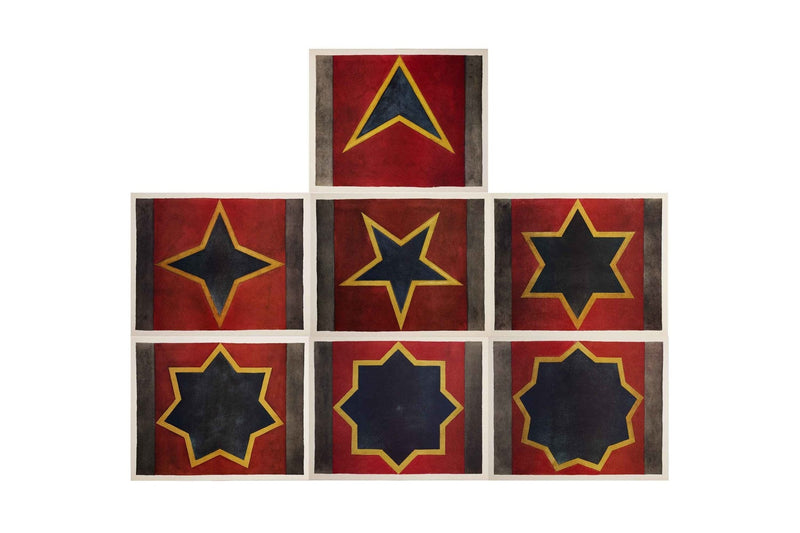
The production of screenprints, lithographs, etchings, and artist’s books plays an important role in this process. Paper is a particularly suitable space for presenting sequences and permutations, comparing color variations, and making a system legible. A print is not necessarily a reproduction of a preexisting work: it can be the medium in which an idea is developed specifically through the possibilities of the technique. The book, too, with its sequence of pages, offers an ideal structure for showing the transition from one combination to the next.
When examining a LeWitt print, it is important to distinguish the original print, the drawing, the book page, and the reproduction, referring, whenever possible, to the catalogue raisonné of prints. The characteristics of an edition cannot be inferred from its image alone. L The artist’s legacy also lies in this new conception of authorship: the work can be conceived before it is physically made and can take different forms without losing its identity. The result is an art that invites us to look and, at the same time, mentally reconstruct the process that made it possible.
Do you like Sol LeWitt?
Leave your email to receive updates on newly available works and news about this artist.
Sol LeWitt
Art that lives in your spaces
Choosing a work by Sol LeWitt means making room for an individual artistic language. The works gathered here suggest combinations and perspectives to bring into your own surroundings, letting art guide your gaze.

DISCOVER THE ARTIST
Frequently asked questions
Answers to common questions about Sol LeWitt, the artist’s life, works and value on the art market.
Who was Sol LeWitt?
Sol LeWitt (1928–2007) was an American artist among the protagonists of conceptual art and minimalism. His research focuses on the idea, the system of rules and the process of creating the work, rather than the individual expression of the gesture.
What are Sol LeWitt's Wall Drawings?
They are wall drawings created following instructions defined by the artist. The execution can be entrusted to other authorized persons: the identity of the work lies in the project and in the indications that allow its creation, not only in the single painted wall.
Why did Sol LeWitt consider the idea more important than the execution?
For LeWitt, the conception of the work could constitute the decisive part of the artistic work. Establishing a sequence of instructions or a system of variations meant creating a structure capable of producing visual forms even without direct manual intervention at each stage.
What are Sol LeWitt's Structures?
The «Structures» are three-dimensional works often built starting from geometric modules, grids and systematic variations. The term underlines the design nature of the research, avoiding reducing it to traditional sculpture.
Has Sol LeWitt created silk-screen prints and graphic works?
Yes. Graphics are an important part of his production and include works based on lines, colors, geometric shapes and serial combinations. For a print it is necessary to check the technique, print run, signature when required, publisher and conservation conditions.