
Painter
Antonio Corpora
Tunisia, 1909–2004
Stay up to date with this artist
Leave your email to receive updates on newly available artworks and news about this artist.
Artworks by Antonio Corpora
1 artwork

Biography of Antonio Corpora
Antonio Corpora (Tunis, 1909 – Rome, 2004) was one of the leading figures in Italian abstract painting in the second half of the 20th century. After training rooted in the French tradition and a long stay in Paris, he developed a style founded on the centrality of color. A member of the Fronte Nuovo delle Arti and later the Gruppo degli Otto, he helped define…
Read the full biographyClose the biography
Antonio Corpora (Tunis, 1909 – Rome, 2004) was one of the leading figures in Italian abstract painting in the second half of the 20th century. After training rooted in the French tradition and a long stay in Paris, he developed a style founded on the centrality of color. A member of the Fronte Nuovo delle Arti and later the Gruppo degli Otto, he helped define an abstract-concrete style of painting in which references to reality are transformed through autonomous chromatic relationships. His output includes paintings, watercolors, drawings, and graphic artworks. Landscape, light, and the memory of places are fundamental elements in an artistic practice spanning much of the 20th century.
Training in Tunis
Antonio Corpora was born in Tunis on August 15, 1909, to parents of Italian descent. From an early age, he showed an interest in painting. In 1928, he enrolled at the École des Beaux-Arts de Tunis. He studied with Armand Vergeaud, an artist trained in the French art world. His training helped foster a particular sensitivity to color.
The move to Florence
In 1929, Corpora moved to Florence. He attended classes taught by Felice Carena. He studied the artworks of the Italian masters firsthand in museums. His engagement with Giotto, Paolo Uccello, and Piero della Francesca contributed to his understanding of pictorial structure. In 1930, he held a solo exhibition at Palazzo Bardi.
His stay in Paris
In 1930, Corpora moved to Paris. The city was a crucial environment for his artistic development. He encountered post-Impressionist and Cubist explorations. L’interest in color deepened through engagement with modern French painting. His stay helped shape a language increasingly oriented toward abstraction.
LEuropean abstraction
During the 1930s, Corpora came into contact with the circles of Cercle et Carré and Abstraction-Création. These experiences marked important moments in the history of European abstraction. Painting was considered through autonomous relationships between forms and colors. Corpora developed a particular interest in the possibility of moving beyond naturalistic representation.
The Galleria del Milione
In 1939, Corpora held a solo exhibition at the Galleria del Milione in Milan. The gallery was one of the leading centers of Italian abstraction. L’artista came into contact with figures such as Lucio Fontana, Mauro Reggiani, and Attanasio Soldati. L’experience contributed to the spread of European abstract research in Italy.
The return to Rome
In 1945, Corpora settled in Rome. He came into contact with Renato Guttuso. The cultural context was shaped by the debate between figuration and abstraction. Corpora actively took part in this debate. His painting developed a style characterized by a gradual transformation of recognizable forms.
Neocubism
During the postwar period, Corpora moved toward Neocubism. Forms were broken down through geometric relationships. Color contributed to the composition's construction. The representation retained a reference to reality, but was transformed into an autonomous structure. This phase paved the way for his later abstract-concrete explorations.
The New Arts Front
Corpora took part in the New Arts Front, an initiative that brought together artists committed to renewing Italian painting. The group emerged in the cultural climate of the postwar period. The artists shared the need to develop modern forms of expression, though their approaches remained distinct. Corpora contributed with a style of painting in which color played a fundamental role.
The Group of Eight
In 1952, Corpora took part in the founding of the Group of Eight, promoted by the critic Lionello Venturi. Its artists included Afro, Birolli, Corpora, Moreni, Morlotti, Santomaso, Turcato, and Vedova. The group proposed a style of painting defined as abstract-concrete. This approach did not completely abandon its connection with reality. However, forms were transformed through the language of painting.
L'abstract-concrete
The term abstract-concrete is fundamental to understanding Corpora's oeuvre. The starting point may be a landscape or a visual experience. L's image is gradually transformed through chromatic relationships. Color takes on autonomy. The composition no longer depends on a detailed depiction of the subject.
Color
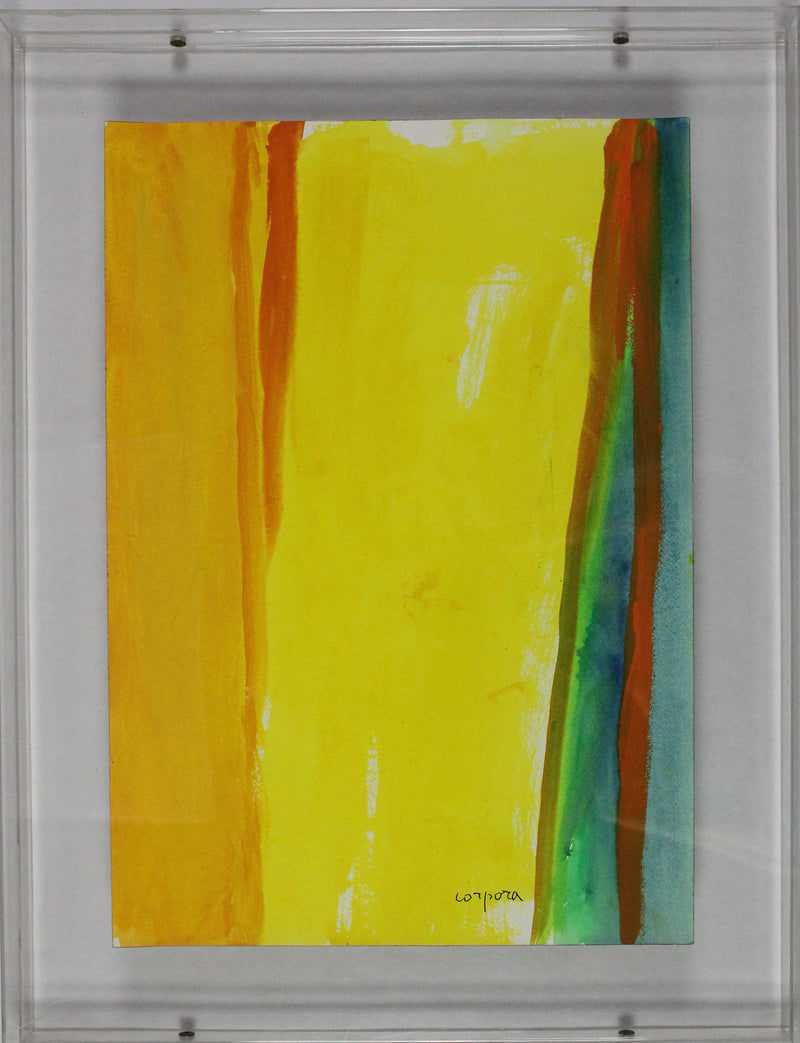
Color is the main expressive element in Corpora's painting. The tones can be intense and luminous. Surfaces are organized through different fields of color. The relationship between colors creates depth and movement. Light seems to emerge from the very structure of the composition.
The landscape
The landscape is an important source of inspiration. Views are gradually transformed into chromatic structures. The reference to nature may remain recognizable or become extremely concise. L's artist seeks to preserve the perception of the place through color.
Watercolors
Corpora produced numerous watercolors. The technique makes it possible to achieve transparency and delicate gradations of color. Later contributes to the spread of pigment across the paper. Lhe artist used these possibilities to develop compositions of great luminosity. Latercolor represents an important area of his research.
Original graphics
Alongside painting, Corpora produced lithographs, screen prints, and other graphic artworks. Printmaking techniques made it possible to develop independent color relationships. The surface became a space for organizing forms and colors. Graphic art helped disseminate his oeuvre.
The Venice Biennale
Corpora participated repeatedly in the Venice Biennale. In 1952, he exhibited with the Group of Eight and received recognition for young Italian painting. In 1956, 1960, and 1966, he presented solo exhibitions. His participation confirmed his standing in contemporary Italian painting.
International recognition
Corpora exhibited at major European and American events. He also took part in Documenta in Kassel. In 1987, the National Gallery of Modern Art in Rome dedicated an important retrospective to him. His oeuvre was recognized as one of the fundamental contributions to Italian abstract painting.
Legacy in art
Antonio Corpora died in Rome on September 6, 2004. His output represents a consistent journey through the transformations of twentieth-century painting. Color is the primary means through which to interpret reality. His oeuvre demonstrates how light and the memory of the landscape can be transformed into highly evocative abstract compositions.
Do you like Antonio Corpora?
Leave your email to receive updates on newly available artworks and news about this artist.
Antonio Corpora
Art that lives in your spaces
Choosing an artwork by Antonio Corpora means making room for an individual artistic language. The artworks gathered here suggest combinations and perspectives to bring into your own surroundings, letting art guide your gaze.
DISCOVER THE ARTIST
Frequently asked questions
Answers to common questions about Antonio Corpora, the artist’s life, artworks and value on the art market.
Who was Antonio Corpora?
Antonio Corpora (1909–2004) was an Italian painter whose research crossed figuration and abstraction. Color and light play a central role in his compositions, often characterized by dynamic chromatic relationships.
Was Antonio Corpora an abstract painter?
His oeuvre developed in an abstract direction, but was not identical in all phases. Some artworks maintain references to recognizable landscapes or structures, while others entrust the construction of the image above all to the color and rhythm of the composition.
What relationship did Corpora have with the Group of Eight?
Corpora was part of the Group of Eight, presented by Lionello Venturi in the early 1950s. The group brought together artists with different languages, united by overcoming the rigid opposition between figuration and abstraction.
How to recognize the artworks of Antonio Corpora?
In mature artworks we often encounter backgrounds and chromatic signs that construct space through contrasts and transparencies. Since the style changes over time, signature, documentation and comparisons with recognized artworks are required for attribution and dating.
What factors influence Corpora's stock prices?
Technique, period, size, quality of execution, conservation and provenance impact the market. A unique painting, a watercolor and an edition graphic do not necessarily have the same positioning: it is necessary to compare examples of the same type.
Discover more artists
Explore more leading figures in modern and contemporary art


