
Painter
Sergio Vacchi
Italy, 1925–2016
Stay up to date with this artist
Leave your email to receive updates on newly available artworks and news about this artist.
Artworks by Sergio Vacchi
1 artwork

Biography of Sergio Vacchi
Born in Castenaso, near Bologna, in 1925 and passed away in Siena in 2016, Sergio Vacchi crossed the Italian painting of the second half of the twentieth century with a language that changes profoundly without losing its narrative tension. In his paintings the matter can become tormented and almost geological, while in other seasons the human figure re-emerges as the protagonist of enigmatic tales. The…
Read the full biographyClose the biography
Born in Castenaso, near Bologna, in 1925 and passed away in Siena in 2016, Sergio Vacchi crossed the Italian painting of the second half of the twentieth century with a language that changes profoundly without losing its narrative tension. In his paintings the matter can become tormented and almost geological, while in other seasons the human figure re-emerges as the protagonist of enigmatic tales. The artist does not seek a neutral description of the world: he transforms historical events, literary suggestions and personal memories into images suspended between reality, theater and imagination.
From post-war Bologna to informal matter
After a classical education, Vacchi approached painting in the post-war cultural climate of Bologna. The meeting with the critic Francesco Arcangeli helps to direct attention towards an intense relationship with nature and matter. His first solo exhibition in Milan, in 1951, marked the start of a path which, from the initial neorealist and naturalist references, moved towards an increasingly freer painting. The surface is loaded with mixtures, signs and chromatic tensions; the subject does not disappear completely, but seems to struggle to emerge from the colour.
The relationship between vision and story also emerges in the way in which details are distributed. A seemingly marginal object can guide the interpretation of an entire scene, while a look or posture can create a contrast with the general atmosphere. Painting therefore proceeds through clues rather than explanations. This open character allows the images to be read from different perspectives, without losing the connection with the cultural and historical climate in which they were born. The complexity of its path therefore requires always considering the date of the artwork and the research phase to which it belongs.
The Bolognese context is also decisive for understanding his distance from a painting of pure news. The experience of war and reconstruction made the comparison with reality urgent, but Vacchi soon sought a language in which the material itself expressed instability. The relationship with Arcangeli can be read in the light of the so-called ultimate naturalism, understood not as faithful reproduction of the landscape but as emotional participation in its processes. The brushstroke thus becomes a trace of energy and transformation, and the densest areas of the painting seem to contain images still in formation.
This transition to Informal does not represent a simple adherence to an international fashion. In Vacchi's painting the material retains a restless, almost psychological quality. The shapes thicken and fall apart, suggesting a world crossed by conflicts. Even when the image approaches abstraction, the viewer feels the presence of a possible story, as if behind the mixtures still indistinct figures and events remained.
The return of the figure and the great narrative cycles
Since the 1960s his research has opened up to a visionary figuration, in which the characters seem to move on mental stages. Vacchi looks at history, science, literature and cinema, bringing together recognizable elements and impossible situations. His pictorial cycles do not function as linear illustrations: they proceed through associations, apparitions and symbols, asking the viewer to reconstruct the relationships between the protagonists.
In the transition to the figure, the historical dimension does not coincide with a documentary reconstruction. Public figures, fantastic figures and references to mass culture can meet in the same scene, according to a logic close to dreams and satire. The observer recognizes clues, but does not have a plot resolved in advance. It is precisely the friction between recognizability and mystery that gives depth to these compositions: Vacchi transforms history into a theater of memory, in which the imagination puts to the test what we believe we know.
Color contributes decisively to the atmosphere. Metallic shades, artificial lights and enamelled surfaces can make the scenes alienating, while the human figure sometimes appears monumental, sometimes fragile. Irony and a sense of the grotesque coexist with melancholy. Precisely this oscillation prevents us from reading Vacchi as a simple narrative painter: narration becomes a means of questioning memory and the contemporary condition.
Drawing, artworks on paper and graphic language
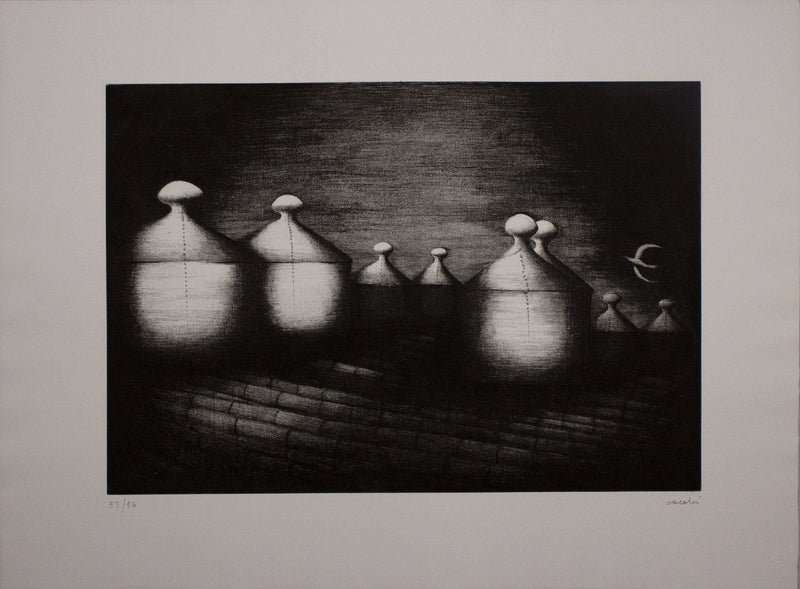
Alongside paintings, Vacchi practiced drawing and created artworks on paper that allow us to closely follow the construction of his images. The feature can define a face, suggest a gesture or transform into an independent sign. In graphic editions, when documented, the relationship between drawing, color and matrix requires different attention compared to the original painting: a lithograph, a silk-screen and a photomechanical reproduction are not technically equivalent.
An element to consider is the relationship between scale and presence. In larger compositions, the accumulation of figures and details can create a feeling of immersion, while more collected artworks focus attention on a single gesture or on a relationship between characters. The artist thus alternates narrative density and visual pauses. His interest in cinema and literature helps to understand the construction of scenes that seem to belong to a broader story, but which retain their own pictorial autonomy.
To correctly identify an example it is necessary to verify the declared technique, the signature, any numbering, the publisher and the provenance. The variety of his production makes it particularly important not to automatically attribute a specific printing technique to each artwork on paper. The artist's strength lies in his ability to construct images that seem to narrate an era and, at the same time, escape any definitive explanation.
In the sheets it is useful to observe not only the subject but the function of the line. Some signs serve to define a face, others construct an atmosphere, still others deliberately interrupt the continuity of the image. For an original print, in addition to the signature, it is important to check whether the artist participated in the creation of the matrix and whether there are indications of the printer, publisher and print run. This data allows us to describe the object without confusing an art edition with the reproduction of an already existing painting.
Do you like Sergio Vacchi?
Leave your email to receive updates on newly available artworks and news about this artist.
Sergio Vacchi
Art that lives in your spaces
Choosing an artwork by Sergio Vacchi means making room for an individual artistic language. The artworks gathered here suggest combinations and perspectives to bring into your own surroundings, letting art guide your gaze.
DISCOVER THE ARTIST
Frequently asked questions
Answers to common questions about Sergio Vacchi, the artist’s life, artworks and value on the art market.
Who was Sergio Vacchi and which painting characterizes him?
Sergio Vacchi (1925–2016) was an Italian painter known for a visionary, theatrical and often enigmatic figuration. After an initial phase close to post-cubism, he developed a personal language made up of characters, allegories and settings full of psychological tension. His artworks stand out for their narrative intensity and expressive use of color.
What are the recurring themes in Sergio Vacchi's artworks?
Vacchi addresses the relationship between individual, power, history and imagination. Human figures, symbols and apparently surreal situations build stories open to multiple interpretations. To read one of his paintings it is useful to observe not only the subjects, but also the relationships between the characters and the atmosphere of the scene.
Does Sergio Vacchi belong to Surrealism?
His painting presents visionary and sometimes surreal aspects, but is not limited to belonging to historical Surrealism. Vacchi developed an independent path in the field of Italian figuration of the second half of the twentieth century, combining cultural references, imagination and commentary on his own time.
What artistic techniques did Sergio Vacchi use?
Vacchi worked mainly in painting, also creating drawings and graphic artworks. The technique of a single artwork must be identified by the relevant sheet: oil, mixed technique, drawing and original print are not interchangeable categories. Support, size, signature and provenance help to describe it correctly.
How to evaluate an artwork by Sergio Vacchi before purchasing?
It is important to distinguish a unique painting from an artwork on paper or an original print. Authenticity, provenance, state of conservation, technique, size and relevant bibliography matter. A signature alone does not replace documentation: it is preferable to examine detailed photographs and all available information on the specimen.