
Artist, designer and graphic designer
Bruno Munari
Italy, 1907–1998
Stay up to date with this artist
Leave your email to receive updates on newly available artworks and news about this artist.
Artworks by Bruno Munari
2 artworks

Biography of Bruno Munari
For Bruno Munari (Milan, 1907–1998), creating means above all questioning the things we usually consider obvious. A book can be made of pages without words, a sculpture can move in the air, a machine can function only to entertain and an everyday object can reveal unexpected possibilities. Artist, designer, graphic designer, author and experimenter, Munari lived through almost the entire twentieth century with an attitude…
Read the full biographyClose the biography
For Bruno Munari (Milan, 1907–1998), creating means above all questioning the things we usually consider obvious. A book can be made of pages without words, a sculpture can move in the air, a machine can function only to entertain and an everyday object can reveal unexpected possibilities. Artist, designer, graphic designer, author and experimenter, Munari lived through almost the entire twentieth century with an attitude that is difficult to enclose in a single current. The underlying theme of his oeuvre is curiosity: observing materials, shapes and behaviors to understand how images are created and how the experience of those who encounter them can be made freer.
From the avant-gardes to research on movement
Munari approached Futurism at a very young age, participating in the climate of experimentation that questioned traditional painting and attributed value to movement, the machine and the transformation of space. However, he does not remain imprisoned in that language. Already in the 1930s he developed the famous Useless Machines, light suspended structures that move thanks to the air and changes in the environment. Their name is deliberately paradoxical: they do not serve to produce a practical result, but to make movement, chance and the relationship between equilibrium and instability visible.
These artworks anticipate a principle that will accompany all of his activity: art does not necessarily have to present itself as a solemn and immobile object. It can be an experience to observe over time, a system of relationships, an invitation to participate. Munari's lightness is not superficiality; it is the result of a remarkable ability to simplify complex problems to the point of making them understandable through an essential gesture or form.
The Useless Machines also calls into question the idea that the artwork must always appear identical. A current of air changes the position of the elements, the light draws different shadows and time becomes part of the experience. Movement is not represented on a surface: it actually happens, in relation to environmental conditions. In this sense, Munari's research anticipates a sensitivity that will become important in kinetic and programmed art.
The irony of the title helps to understand his conception of creativity. A machine can be rigorously constructed and have no productive purpose. Its usefulness then consists in making us observe the world differently, showing that a mechanism can generate wonder without turning into an industrial device.
Concrete art, design and experimentation with materials
After the war, Munari participated in the research of Concrete Art, becoming interested in compositions based on autonomous forms and relationships, not derived from the imitation of nature. But his research is not limited to abstract painting: it extends to graphic design, everyday objects, visual communication and industrial production. The distinction between art and design, in his oeuvre, becomes an open question. An object can be functional and at the same time stimulate the imagination; an apparently playful experiment can teach something precise about perception.
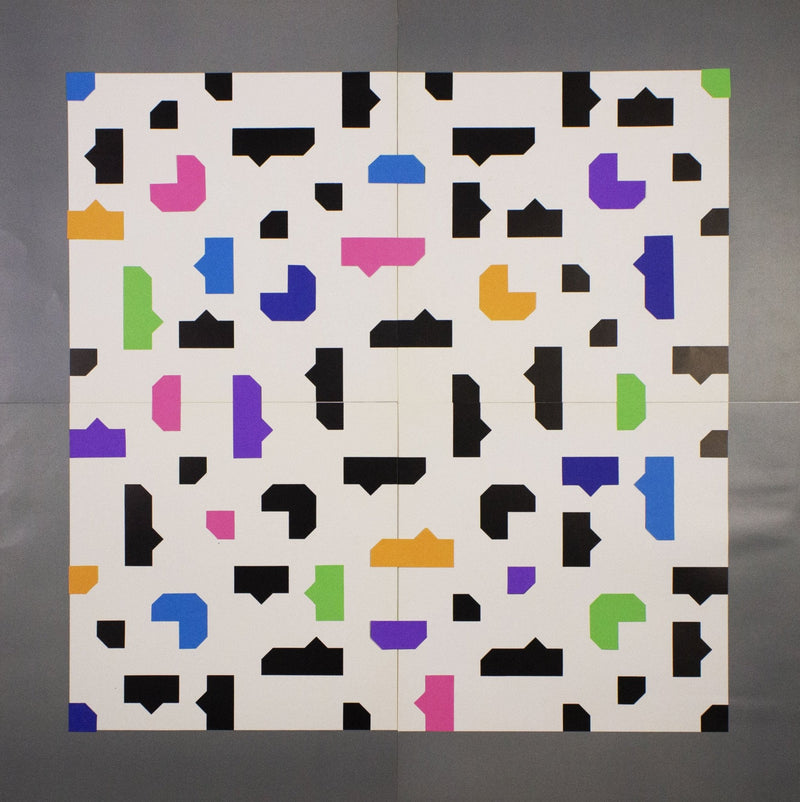
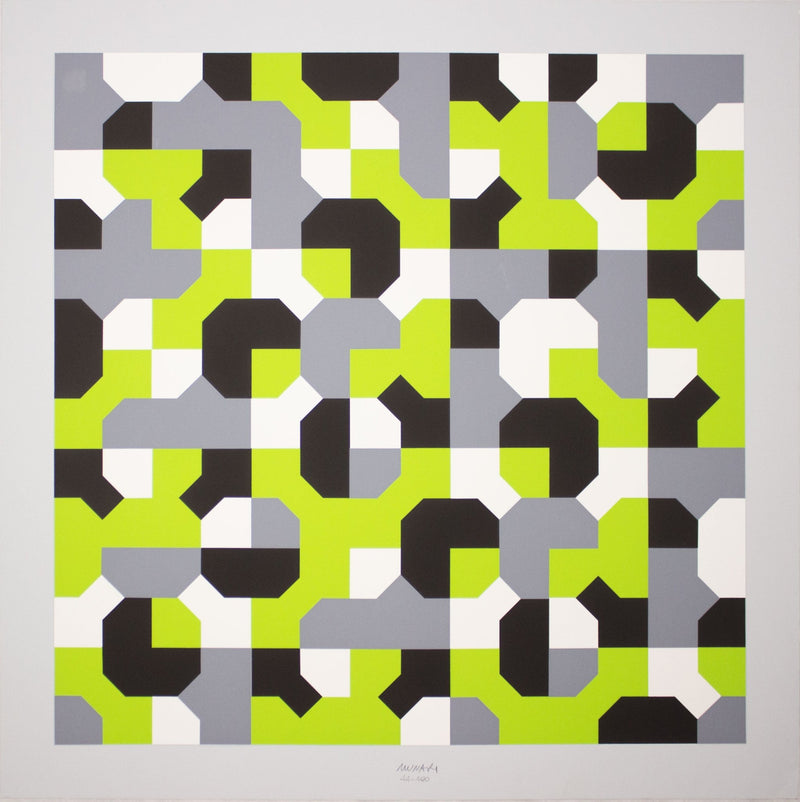
Among the most significant experiences are the Direct projections, in which transparent or colored materials are used to construct luminous images, and the research on Negative-positive, compositions that undermine the stable distinction between figure and background. Munari also explores the relationship between rule and variation, showing that a simple system can generate very different results. Experimentation concerns both the image and the way in which it is produced and observed.
In Negative-Positives the eye can oscillate between what it considers a figure and what it interprets as a background. Neither reading is definitive: it is enough to change the point of attention for the composition to reorganize itself. Munari thus demonstrates that perception is not a passive act, but a process in which the spectator continuously builds relationships.
Direct projections instead move the image from the material surface to the light. Colors and transparencies can transform through the device that projects them, making the process visible. In both experiences the artist avoids relying on mysterious effects: he shows how a simple technical solution can open up complex poetic and perceptive possibilities.
Books, graphics and workshops: learning through doing
The illegible books and the prebooks are among the most original examples of his ability to rethink a familiar object. In the former, the book can give up the text to become a sequence of colours, cuts, materials and rhythms; in the latter, designed for the little ones, the relationship with the pages passes through touch, dimensions and manipulation. Munari thus demonstrates that reading does not just mean deciphering words, but also exploring a structure and discovering relationships.
Munari's editorial research also involves the rhythm of experience. A cut page, a difference in format or a transparent surface can produce anticipation and surprise even before a word is spoken. The book is no longer just a container of contents, but an object to be traversed with the eyes and hands. This way of designing has had a lasting influence on children's graphics and publishing.
The educational activity continues the same reflection. In laboratories you are not asked to copy a pre-established result: you explore materials and rules to discover what they can generate. Creativity is not presented as a privilege of the few, but as a capacity that can be cultivated through observation and experiment.
His activity includes serigraphs, graphic artworks, multiples and editorial projects, in which technical repeatability is not necessarily a limit. On the contrary, the possibility of producing an image in multiple copies can become part of his idea of accessible and shareable art. However, for the collector it remains essential to distinguish an artist's multiple, an original print, a design object and an editorial reproduction, verifying the edition, materials, print run and documentation. Munari's educational commitment, also developed through workshops dedicated to children, completes this vision: not to transmit a model to imitate, but to offer tools to discover for themselves. His legacy is an invitation to look at the world as a set of possibilities yet to be explored.
When collecting Munari's oeuvre it is particularly important to distinguish the different categories of objects. A multiple designed by the artist can be conceived from the beginning to exist in multiple copies; an artist's book may need to be viewed as a sequence; an original screenprint belongs to the history of printing; a design object has its own production context. Repeatability does not necessarily eliminate the invention, but it changes the way the artwork is described.
Materials, any assembly instructions, publisher or manufacturer and storage conditions are essential information. Even the presence of a signature must be read in the context of the specific edition, without assuming that all artworks have the same method of identification. It is precisely this variety that makes Munari's production particularly rich and requires accurate records.
Do you like Bruno Munari?
Leave your email to receive updates on newly available artworks and news about this artist.
Bruno Munari
Art that lives in your spaces
Choosing an artwork by Bruno Munari means making room for an individual artistic language. The artworks gathered here suggest combinations and perspectives to bring into your own surroundings, letting art guide your gaze.
DISCOVER THE ARTIST
Frequently asked questions
Answers to common questions about Bruno Munari, the artist’s life, artworks and value on the art market.
Who was Bruno Munari?
Bruno Munari (1907–1998) was an Italian artist, designer, author and experimenter. His activity has combined art, visual communication, publishing and teaching, exploring the relationship between creativity, play, materials and design processes.
What are Bruno Munari's Useless Machines?
The Useless Machines are light mobile structures, started in the 1930s, composed of suspended elements that move with the air. They do not produce a practical result: they invite us to observe balance, movement, light and unpredictable variations in space.
What are Bruno Munari's Negative-Positives?
They are abstract compositions in which figure and background can exchange roles. Munari eliminates a stable visual hierarchy, ensuring that shapes are alternately perceived as positive or negative based on the gaze.
What is the difference between an original screenprint and a Munari reproduction?
The original screenprint belongs to a graphic project conceived as an art print, often with editorial and edition size indications. A reproduction, on the other hand, reprints the image of an artwork. To distinguish them, data on edition, technique, signature, paper and origin are needed.
Why is Bruno Munari also important in design and teaching?
Munari applied artistic experimentation to objects, books and workshops, enhancing learning through direct experience. His approach has influenced Italian design and creativity education, showing how design and play can integrate.
Discover more artists
Explore more leading figures in modern and contemporary art


