
Painter, printmaker and ceramic artist
Guillaume Corneille
Belgium, 1922–2010
Stay up to date with this artist
Leave your email to receive updates on newly available artworks and news about this artist.
Artworks by Guillaume Corneille
1 artwork

Biography of Guillaume Corneille
Guillaume Corneille, the pseudonym of Guillaume Cornelis van Beverloo (Liège, 1922 – Auvers-sur-Oise, 2010), was a Dutch-born painter, printmaker, and ceramicist, and one of the founders of the CoBrA movement. His oeuvre is distinguished by its use of vivid colors, fantastical figures, and recurring symbols, including birds, women, cats, and suns. After an initial Expressionist phase, he developed a personal style characterized by luminous compositions…
Read the full biographyClose the biography
Guillaume Corneille, the pseudonym of Guillaume Cornelis van Beverloo (Liège, 1922 – Auvers-sur-Oise, 2010), was a Dutch-born painter, printmaker, and ceramicist, and one of the founders of the CoBrA movement. His oeuvre is distinguished by its use of vivid colors, fantastical figures, and recurring symbols, including birds, women, cats, and suns. After an initial Expressionist phase, he developed a personal style characterized by luminous compositions and images inspired by nature and travel. L'experience in Africa and Latin America helped expand his visual repertoire. Alongside painting, Corneille produced numerous lithographs, etchings, and ceramics, helping bring his oeuvre to an international audience.
Education
Guillaume Cornelis van Beverloo is born to Dutch parents in Liège, Belgium, on July 3, 1922. During his youth, he shows an interest in drawing. Between 1940 and 1943, he attends the Rijksakademie van Beeldende Kunsten in Amsterdam. His training takes place during the years of the Second World War. L'artist begins to seek a language capable of transcending academic conventions.
The First Exhibitions
In 1946, Corneille held his first solo exhibition in Groningen. L'experience marked an important moment in the development of his career. His early paintings showed influences of Expressionism and Surrealism. L'artist was interested in the possibility of constructing images through free associations.
The Dutch Experimental Group
In 1948, Corneille helped found the Nederlandse Experimentele Groep. Other key figures included Karel Appel and Constant. The group published the magazine Reflex. L'objective was to develop a style of painting free from traditional conventions. Spontaneity of gesture became a fundamental element.
The Birth of CoBrA
That same year, Corneille helped found the CoBrA movement. The name derives from the initials of Copenhagen, Brussels, and Amsterdam. The movement brought together artists and writers interested in freedom of expression. Children's painting, folk art, and spontaneous forms were important influences. Corneille developed a style characterized by a distinctive sensitivity to color.
CoBrA Painting
During the CoBrA period, Corneille created artworks characterized by energetic marks and intense colors. The figures could take on fantastical forms. The composition retained a narrative dimension. L'artist did not seek naturalistic representation. He favored the freedom of the imagination.
Move to Paris
In 1950, Corneille settled in Paris. The French capital was a major center of contemporary art. L'artist came into contact with new cultural circles. His painting gradually developed into a more personal language.
Journeys to Africa
From 1949 onward, Corneille embarked on journeys to North Africa. His encounters with different landscapes and cultures helped transform his artistic language. His compositions developed a greater focus on natural structures. Color took on an increasingly important role.
Imaginary Landscapes
One of the fundamental themes in his oeuvre is imaginary landscapes. The images do not necessarily correspond to recognizable places. Nature is transformed through marks and colors. The forms may bring to mind rocks, deserts, and organic structures. The painting creates a poetic space.
The Birds
Birds became one of his most recognizable symbols. The figures may be depicted using essential forms. Flight suggests freedom and movement. Birds are often incorporated into luminous compositions. The subject takes on a symbolic dimension.
Female figures
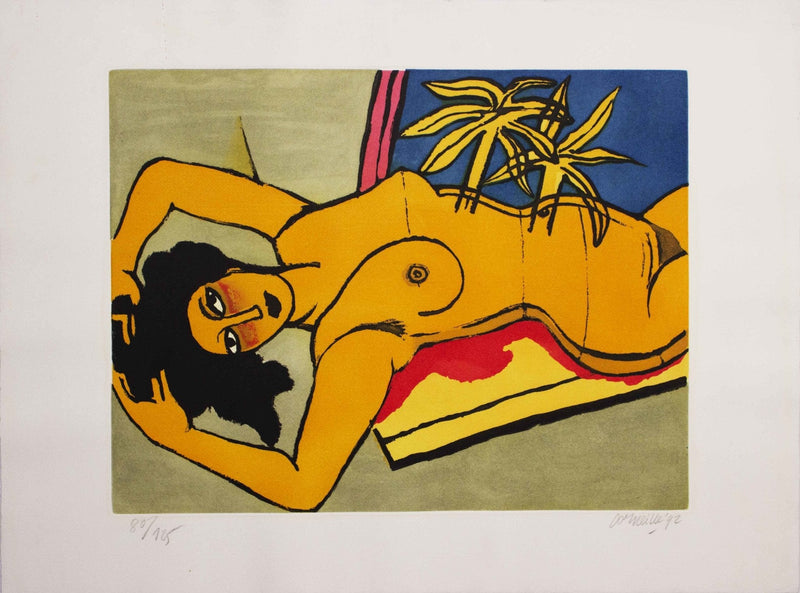
Women are another recurring theme. The figures are depicted with simplified lines and intense colors. The compositions can take on a fantastical character. The human body is transformed into an element of a symbolic universe.
Cats
Cats also appear frequently in his oeuvre. The figures are interpreted through a free-flowing style. Animals may be associated with women, birds, and other symbols. The compositions often take on a playful character.
The sun and color
The sun is one of the fundamental symbols of his mature oeuvre. His compositions often feature shades of yellow, red, and blue. Color helps create images of great intensity. His painting retains a luminous, fantastical quality.
L'engraving
In 1953, Corneille studied engraving with Stanley William Hayter in Paris. L' experience allowed him to explore intaglio techniques in greater depth. The engraved mark became a tool for developing independent compositions. Printmaking gradually took on an important role in his oeuvre.
Lithography
Corneille created numerous original lithographs, often characterized by vivid colors. The technique makes it possible to translate drawing and color into printed images. Birds, women, and cats became frequent subjects. Printmaking helped spread his artistic language internationally.
Ceramics in Albisola
During the summers of 1954 and 1955, Corneille worked in Albisola, in Liguria. He studied ceramics with Tullio Mazzotti. L' experience allowed him to transfer his pictorial language to three-dimensional surfaces. Ceramics became another field of experimentation.
International recognition
In 1956, Corneille presented important exhibitions at museums in Brussels and Amsterdam. That same year, he received the Guggenheim Award. In 1966, the Stedelijk Museum in Amsterdam dedicated a retrospective to him. His oeuvre earned lasting international recognition.
L's artistic legacy
Corneille died in Auvers-sur-Oise in 2010. His oeuvre represents one of the most recognizable contributions of the CoBrA movement. Through painting, printmaking, and ceramics, he created a visual universe characterized by color and imagination. His oeuvre shows how simple forms and recurring symbols can generate images of great expressive freedom.
Do you like Guillaume Corneille?
Leave your email to receive updates on newly available artworks and news about this artist.
Guillaume Corneille
Art that lives in your spaces
Choosing an artwork by Guillaume Corneille means making room for an individual artistic language. The artworks gathered here suggest combinations and perspectives to bring into your own surroundings, letting art guide your gaze.

DISCOVER THE ARTIST
Frequently asked questions
Answers to common questions about Guillaume Corneille, the artist’s life, artworks and value on the art market.
Who was Guillaume Corneille?
Guillaume Cornelis van Beverloo (1922–2010), known as Corneille, was a Dutch artist linked to the CoBrA movement. He is known for a lively and imaginative language, populated by birds, figures, fantastic landscapes and intense colors.
Why do birds and women often appear in Corneille's artworks?
Birds and female figures are recurring motifs in his iconography, often associated with freedom, travel, desire and vitality. However, there is no single meaning valid for each artwork: the composition, the period and the specific context matter.
What is the connection between Corneille and the CoBrA movement?
Corneille participated in the founding of CoBrA in 1948. In that environment, spontaneous painting established itself, free from academic conventions and open to popular and childish suggestions. His subsequent production developed an easily recognizable personal signature.
What graphic techniques did Corneille use?
Alongside paintings and drawings, Corneille created numerous graphic artworks, including lithographs and serigraphs. It is important to verify the declared technique, the print run and any signature for each example, without confusing an original print with a poster.
How are Corneille's lithographs evaluated?
Authenticity, edition, numbering, signature, subject, dimensions, conservation and provenance have an impact. The presence of bright colors or an iconic subject alone is not enough to establish the price: comparisons with sales of equivalent artworks are needed.
Discover more artists
Explore more leading figures in modern and contemporary art
