
Painter and ceramic artist
Giuliano Della Casa
Italy, 1942–2026
Stay up to date with this artist
Leave your email to receive updates on newly available artworks and news about this artist.
Artworks by Giuliano Della Casa
3 artworks

Biography of Giuliano Della Casa
In the artwork of Giuliano Della Casa, painting is not confined to the canvas, and the image does not merely illustrate a word. Watercolors, artists' books, drawings, and ceramics make up a universe in which the lightness of the mark coexists with an inexhaustible curiosity about poetry, material, and the possibilities of storytelling. His figures, at times resembling symbols from an imaginary alphabet, arise from…
Read the full biographyClose the biography
In the artwork of Giuliano Della Casa, painting is not confined to the canvas, and the image does not merely illustrate a word. Watercolors, artists' books, drawings, and ceramics make up a universe in which the lightness of the mark coexists with an inexhaustible curiosity about poetry, material, and the possibilities of storytelling. His figures, at times resembling symbols from an imaginary alphabet, arise from an immediately recognizable language, yet cannot be reduced to a single meaning: instead, they invite us to follow personal associations, rhythms, and suggestions.
Early Years in Modena and the Encounter with Experimental Poetry
Born in Modena in 1942, Della Casa studied at the Adolfo Venturi Art Institute, where he trained with Pompeo Vecchiati, and continued his studies at the Academy of Fine Arts in Bologna, in Umberto Mastroianni's sculpture class. This education, which embraced both drawing and sculptural construction, soon intertwined with the lively cultural scene of Emilia in the 1960s. In 1966, he held his first solo exhibition at the Galleria della Sala di Cultura in Modena, introduced by Renzo Margonari, and took part in the exhibition Nuove Presenze at the Casa del Mantegna in Mantua. LThe following year, he frequented the Galleria Alpha, a meeting place for artists with diverse approaches, including Claudio Parmiggiani and Franco Vaccari.
It is above all his relationship with Adriano Spatola that gives his oeuvre a particular direction. In the atmosphere of the neo-avant-garde, Della Casa discovers in poetry not a text to be faithfully translated into images, but a counterpart capable of inspiring independent inventions. His participation in Parole sui Muri in Fiumalbo in 1967, together with Spatola and Parmiggiani, clearly expresses this aspiration to overcome the traditional divisions between visual arts and writing. In his compositions, a mark can take on the rhythm of a sentence, and a word can become a visual element, without either having to explain the other.
Watercolors, marks, and spaces of imagination
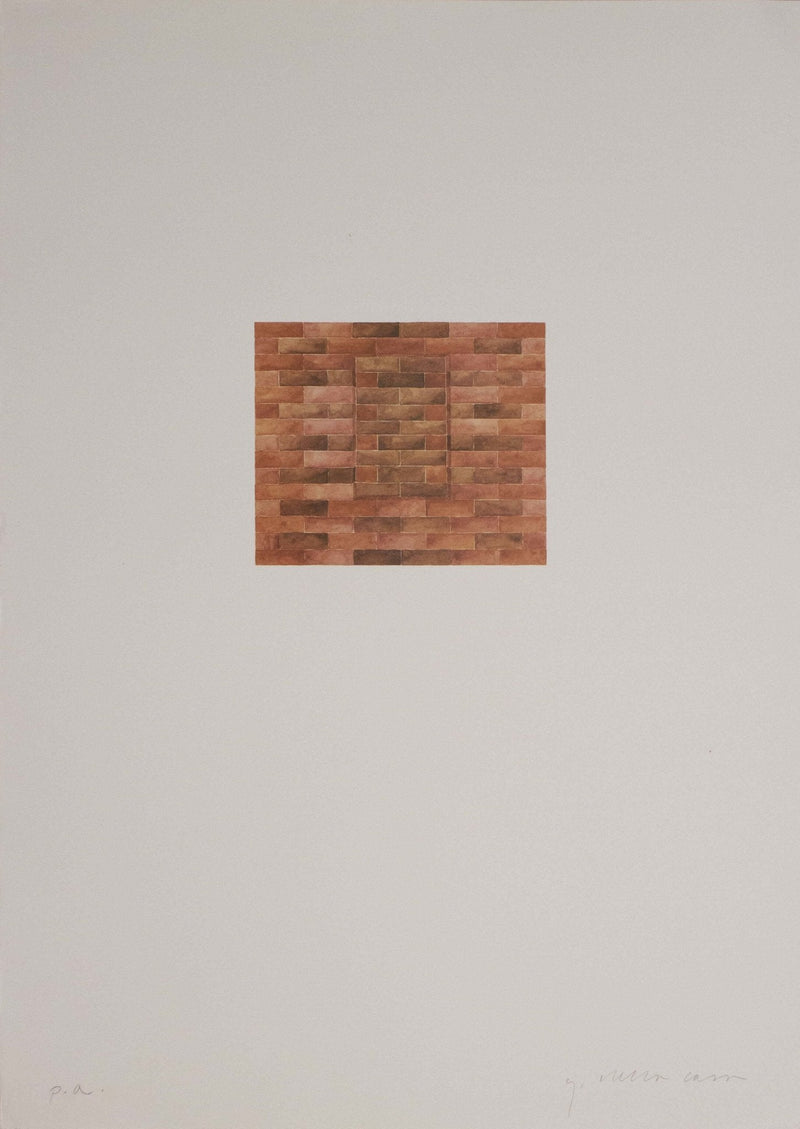
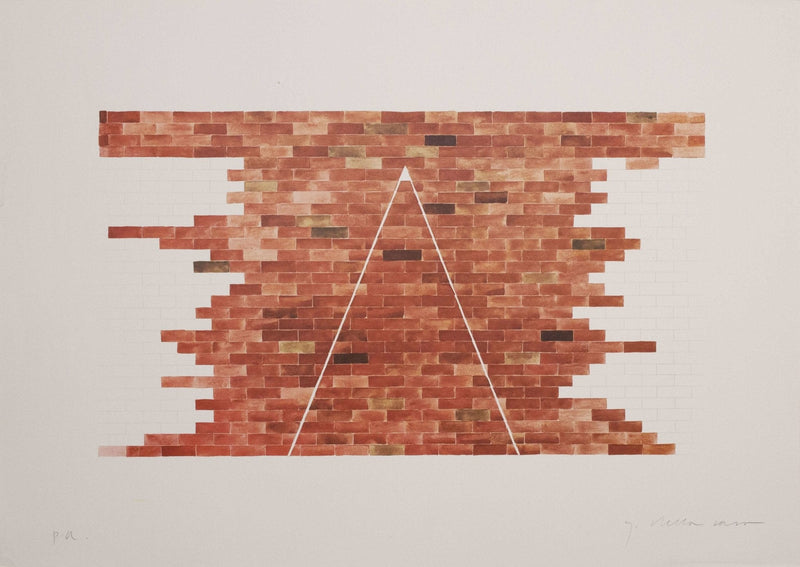
LWatercolor is one of Della Casa's preferred mediums precisely because it allows him to combine immediacy and control. The transparency of the washes, the intensity of a small patch of color, and the presence of the white paper all help define images that seem simple, but are actually built on delicate balances. The empty space is not an area to be filled: it allows forms to breathe, take on an almost theatrical presence, and establish unexpected relationships with one another. From this comes a lightness that is not superficial, but rather the ability to concentrate many associations in just a few elements.
The same freedom can be found when the artist engages with literature. The illustrations inspired by diverse narrative worlds, from Pellegrino Artusi to François Rabelais, do not seek a descriptive correspondence with every passage of the text. Della Casa prefers to capture its tone, its taste for invention, or its fantastical energy, allowing the image to live beyond the page that gave rise to it.
The book as artwork and ceramic experimentation
The artist’s book occupies a central place in his career. Collaborations with poets and writers, including Adriano Spatola, Paul Vangelisti, Marco Belpoliti, and Edoardo Sanguineti, gave rise to publications in which the images matter just as much as the sequence of pages, the quality of the paper, and the physical relationship with the object. Titles such as Cacciatore di mosche, created with Spatola in 1980, and Ora blu, associated with his collaboration with Vangelisti, attest to a publishing practice that cannot be considered incidental to painting. The exhibition In book form. Giuliano Della Casa’s books 1967–1997, hosted in 1997 by the University of California, Los Angeles library, made the continuity of this research evident.
Since 1992, the dialogue with the Bottega Gatti of Faenza has offered another way to transform his repertoire. In ceramics, the figures and marks that inhabited the paper encounter curved surfaces, volumes, and glazes: they do not become mere decorations applied to an object, but contribute to its identity. The exhibitions L'apprendista stregone and Pagine di terracotta document this transition, consistent with the idea that each material can suggest a new form of visual writing.
To understand and collect Della Casa’s oeuvre, it is important to distinguish original watercolors and drawings, ceramics, artist’s books, and images printed in editions. An illustration in a volume is not automatically an original lithograph or etching: the technique must be identified from the details of the individual publication. It is precisely this variety of media, explored without losing expressive coherence, that makes his contribution to Italian art of the second half of the twentieth century significant.
Do you like Giuliano Della Casa?
Leave your email to receive updates on newly available artworks and news about this artist.
Giuliano Della Casa
Art that lives in your spaces
Choosing an artwork by Giuliano Della Casa means making room for an individual artistic language. The artworks gathered here suggest combinations and perspectives to bring into your own surroundings, letting art guide your gaze.
DISCOVER THE ARTIST
Frequently asked questions
Answers to common questions about Giuliano Della Casa, the artist’s life, artworks and value on the art market.
Who was Giuliano Della Casa?
Giuliano Della Casa was an Italian artist whose research spanned painting, watercolor, artist's book and ceramics. His oeuvre has often dialogued with poetry and editorial experimentation.
Why are Giuliano Della Casa's watercolors so recognisable?
The water colour, the lightness of the sign and the construction of suspended images contribute to their identity. Watercolor is not necessarily a preparatory study: it can be an autonomous and complete artwork.
What relationship does Giuliano Della Casa have with artists' books?
The book can become a creative space in which images, materials and texts dialogue. In these artworks it is important to distinguish common editions, numbered editions and original interventions by the artist.
Has Giuliano Della Casa also worked with ceramics?
Yes, ceramic experimentation is part of his research. To correctly describe an object it is necessary to specify material, technique, possible edition and presence of manual interventions.
How to evaluate a watercolor or an artist's book by Giuliano Della Casa?
The evaluation varies greatly depending on uniqueness, technique, size, date, print run, signature, condition and origin. A numbered book and an original watercolor are not directly equivalent categories.
Discover more artists
Explore more leading figures in modern and contemporary art


