
Painter
Gaston Orellana
Chile, 1933
Stay up to date with this artist
Leave your email to receive updates on newly available artworks and news about this artist.
Artworks by Gaston Orellana
2 artworks

Biography of Gaston Orellana
Gastón Orellana, born in Valparaíso, Chile, in 1933, is an internationally trained painter whose artwork develops through the encounter between different cultural experiences, places and languages. His personal story, marked by movements between America and Europe, is reflected in a dense, layered painting, often crossed by figures, signs and presences that seem to emerge from the material. His oeuvre does not comfortably belong to a…
Read the full biographyClose the biography
Gastón Orellana, born in Valparaíso, Chile, in 1933, is an internationally trained painter whose artwork develops through the encounter between different cultural experiences, places and languages. His personal story, marked by movements between America and Europe, is reflected in a dense, layered painting, often crossed by figures, signs and presences that seem to emerge from the material. His oeuvre does not comfortably belong to a single current: it dialogues with expressionism and informal research, but retains an interest in the human figure, in memory and in the symbolic dimension of the image.
An education between music, painting and literature
Born into a family linked to Spanish and Chilean culture, Orellana grew up in an environment in which artistic experience was not limited to one discipline. He studied music and devoted himself to the violin from a young age, before delving into painting through Chilean art institutions. Musical sensitivity remains a useful reference for reading his oeuvre: the compositions can be observed as systems of rhythms, pauses and tensions, in which the forms recall each other without following a forced narrative.
The interest in literature and philosophy accompanies his training and contributes to giving the images a meditative dimension. The relationship with Pablo Neruda, remembered in the artist's archive, testifies to the intertwining of poetic language and visual research. It's not about translating verses into illustrations, but about sharing a way of looking at the world in which reality, memory and imagination remain closely connected.
The reference to music also helps to understand the role of intervals in the composition. Not all elements have the same intensity: a dense area can be followed by a quieter space, an energetic sign can find a response in a barely perceptible figure. The painting is thus organized through contrasts and repetitions, in a structure that the viewer gradually reconstructs. This reading does not imply that each painting follows a precise musical pattern, but highlights a sensitivity to rhythm.
A painting built by stratifications
Orellana's research develops through experiences in different countries, including Spain, the United States, Argentina, Italy, France and the United Kingdom. This mobility favors the comparison with different traditions and contributes to forming a pictorial language in which the surface never appears completely stable. Colours, signs and figurative fragments overlap, interrupt and resurface, as if the image preserved the traces of its own construction process.
The human figure can emerge partially, without becoming a descriptive portrait. Faces, bodies or barely mentioned presences dialogue with abstract areas, worked surfaces and gestural signs. This ambiguity is one of the most significant aspects of his painting: the viewer recognizes something familiar, but does not receive a definitive explanation. The material suggests a broader memory than the episode represented, while the composition maintains a tension between order and disintegration.
The importance of the surface also emerges from the relationship between gesture and sedimentation. Some interventions seem immediate, others suggest rethinking and subsequent steps. The image preserves the trace of these decisions, like a place crossed by different events. For this reason the figure does not necessarily dominate the painting: it can be a fragment among others, a presence that emerges only after prolonged observation. The pictorial material becomes the protagonist as much as the subject.
The dialogue between European culture and Latin American sensitivity
Orellana is part of an artistic history that transcends national borders. The Latin American experiences and the comparison with the European avant-gardes are not simply juxtaposed, but become parts of a personal research. Painting can evoke interior landscapes, collective events or archetypal images without taking on the tone of historical illustration. In this sense, his oeuvre invites us to consider identity as an ongoing process, made up of encounters and transformations.
The relationship with color and gesture also expresses this openness. The surface can be crossed by intense contrasts, by more restrained backgrounds and by signs that seem to record successive movements. The artwork is not born only from the choice of a subject, but from the continuous dialogue between what is added and what remains visible from the previous phases.
The geographic mobility of the artist offers a context to this research, but should not be transformed into an automatic explanation of every artwork. The experiences lived in different countries broaden his cultural horizon; however, the pictorial language arises from concrete choices of shape, color and composition. The interest lies precisely in the ability to keep multiple references together without reducing them to a fixed stylistic identity. The viewer encounters an image that resists immediate classifications and invites us to pause on its contradictions.
Drawing, graphics and reading of the artwork
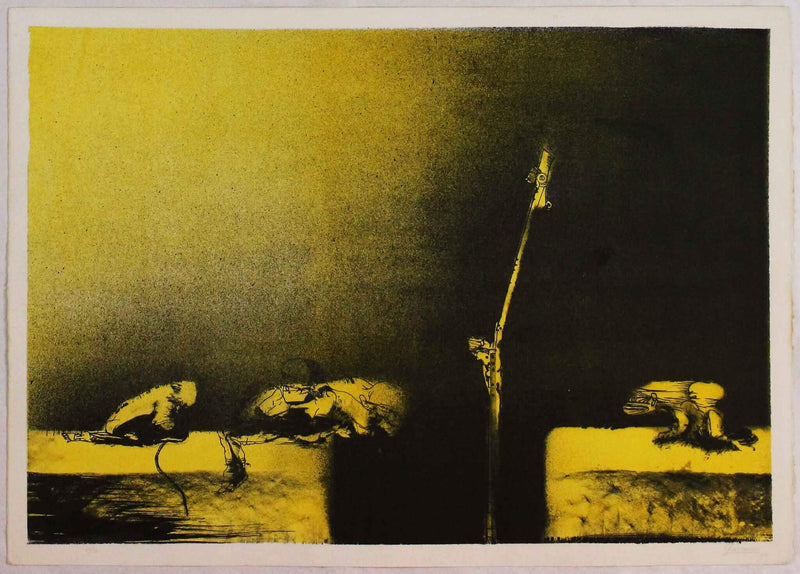
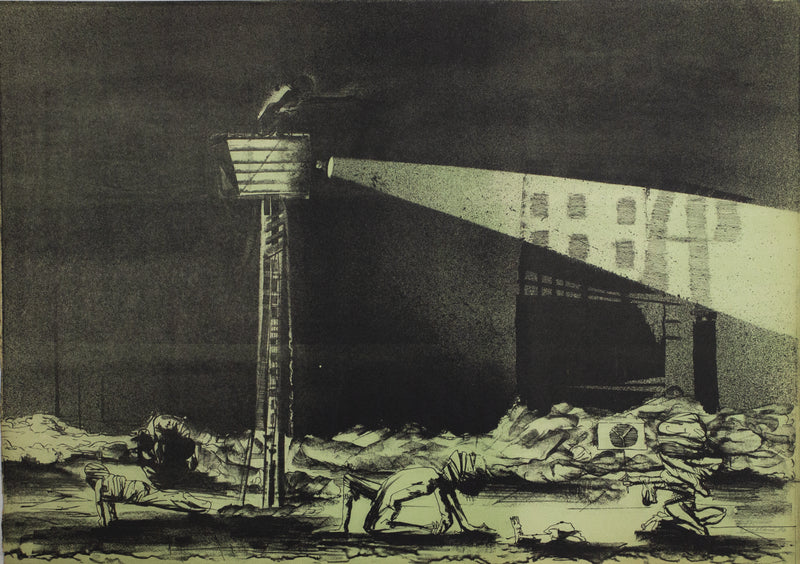
Alongside paintings, artworks on paper offer an important observation point for understanding the relationship between line, material and image construction.
The transition to the reduced format can make the energy of the sign and the construction of relationships between full and empty spaces more evident. A drawing allows you to follow the progression of the line, while a painting technique on paper can preserve the interest in the overlap and density of the surfaces. However, it is not appropriate to automatically attribute a preparatory function to these artworks: a sheet of paper can have its own autonomy and condense research developed also in the canvases into a few elements. When examining a print attributed to Orellana, it is necessary to precisely distinguish the original drawing, the fine art graphics and the editorial reproduction. It is not possible to attribute a specific engraving or lithographic technique to each artwork without documentation of the specimen: title, date, signature, print run, support and possible publisher must be verified on a case-by-case basis.
The strength of his painting lies in the ability to keep the meaning of the image open. The figures seem to come from a broader story, while the color and material prevent them from being reduced to a single story. Looking at an artwork by Orellana means following this movement between appearance and disappearance, between the physical presence of painting and the depth of memory.
Do you like Gaston Orellana?
Leave your email to receive updates on newly available artworks and news about this artist.
Gaston Orellana
Art that lives in your spaces
Choosing an artwork by Gaston Orellana means making room for an individual artistic language. The artworks gathered here suggest combinations and perspectives to bring into your own surroundings, letting art guide your gaze.

DISCOVER THE ARTIST
Frequently asked questions
Answers to common questions about Gaston Orellana, the artist’s life, artworks and value on the art market.
Who is Gaston Orellana?
Gaston Orellana is a painter born in Chile in 1933, active internationally. His research combines figuration, abstraction, matter and signs, with a personal language that has gone through various phases of painting in the second half of the twentieth century.
What are the characteristics of Gaston Orellana's painting?
His compositions alternate chromatic backgrounds, recognizable shapes and gestural traces. The pictorial surface is often constructed by superimpositions, so as to suggest a stratified space rather than a traditional descriptive scene.
Is Gaston Orellana an abstract or figurative painter?
His production crosses both languages. In several artworks figurative elements coexist with abstract signs and structures: this is why a single label does not describe the artist's entire career.
How do you recognize an original graphic by Gaston Orellana?
It is necessary to verify the declared technique, the presence of signature and numbering when required, the sheet, the possible publisher and the provenance. A photographic reproduction is not automatically an original art print.
What does the value of an artwork by Gaston Orellana depend on?
Technique, dimensions, dating, quality of the specimen, provenance, state of conservation and comparisons with documented sales matter. Prices requested online do not necessarily equate to realized market prices.