
Painter
Antonio Asis
Argentina, 1932–2019
Stay up to date with this artist
Leave your email to receive updates on newly available artworks and news about this artist.
Artworks by Antonio Asis
1 artwork

Biography of Antonio Asis
Antonio Asis (Buenos Aires, 1932 – Paris, 2019) was one of the leading figures in kinetic art and Op Art in the second half of the twentieth century. Born in Argentina and active in Paris for more than sixty years, he devoted his practice to the relationship between color, light, movement, and visual perception. His artworks are recognizable by their concentric circles, geometric grids, and…
Read the full biographyClose the biography
Antonio Asis (Buenos Aires, 1932 – Paris, 2019) was one of the leading figures in kinetic art and Op Art in the second half of the twentieth century. Born in Argentina and active in Paris for more than sixty years, he devoted his practice to the relationship between color, light, movement, and visual perception. His artworks are recognizable by their concentric circles, geometric grids, and optical vibrations that seem to animate perfectly still surfaces. Through paintings, reliefs, metal structures, and graphic artworks, Asis explored how forms can generate apparent movement and chromatic transformations. His oeuvre directly engages the viewer: simply moving in front of a piece can make lines and colors seem to change, creating a dynamic and surprising visual experience.
Biography and artistic training
Antonio Asis was born in Buenos Aires in 1932, at a time when Argentina was developing an art scene particularly attentive to the European avant-garde. In 1946, at the age of fourteen, he began attending the Escuela Nacional de Bellas Artes, later continuing his studies at the Escuela de Bellas Artes Prilidiano Pueyrredón. His encounter with Héctor Cartier, a teacher who introduced him to Bauhaus theories and the study of visual perception mechanisms, was particularly important. The magazine Arturo, published in 1944, and the concrete art movement helped spread a conception of painting based on the autonomy of forms and colors.
The move to Paris and encounter with kinetic art
In 1956, Antonio Asis moved to Paris, a city that would become the center of his artistic activity. The French capital was experiencing a pivotal period in the development of optical and kinetic art. The previous year, the exhibition Le Mouvement, organized at the Galerie Denise René, had helped bring international attention to a new conception of the artwork, in which actual or apparent movement played a central role. In Paris, Asis came into contact with artists such as Jesús Rafael Soto, Victor Vasarely, Yaacov Agam and Jean Tinguely. Painting was no longer considered merely a surface intended to contain motionless forms.
The first artworks and the 1956 Linéaire relief
One of the first significant artworks of the Paris period is Linéaire, from 1956. The artwork marks the beginning of Asis's experiments with overlapping structures, which would become a defining feature of his oeuvre. Also influenced by the research of Jesús Rafael Soto, the artist begins using perforated metal grids placed in front of geometric compositions. The surface is no longer conceived as a definitive image, identical from every viewpoint. The metal structures also introduce a spatial dimension that brings the artist's oeuvre closer to sculpture.
Concentric Interferences: movement through circles
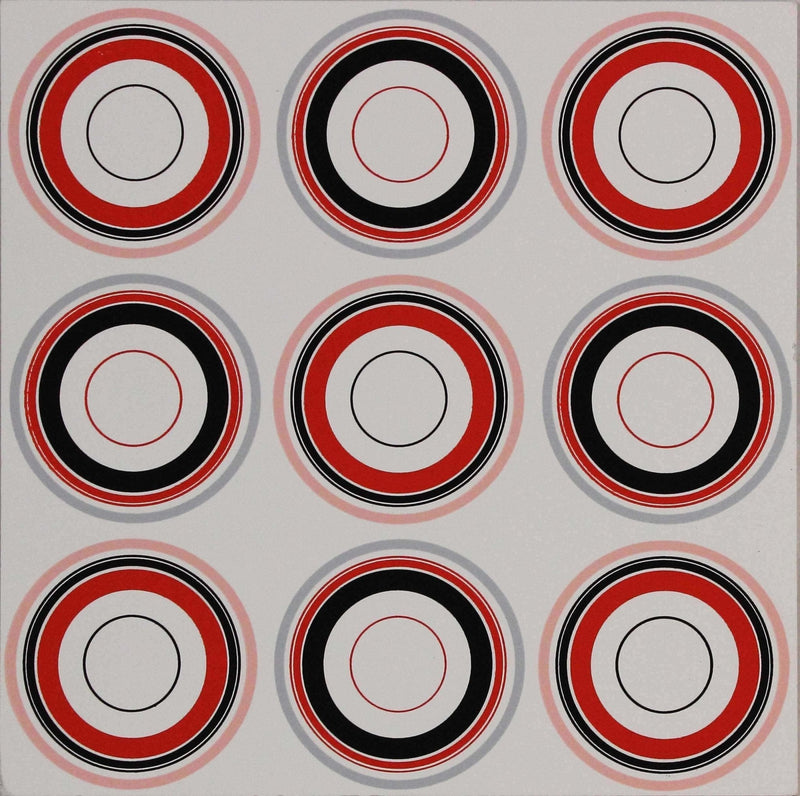
In the late 1950s, Antonio Asis developed one of the most important series of his career: the Interférences concentriques. These artworks are constructed through the repetition and overlapping of concentric circles. In the early compositions, black and white predominate, used to achieve particularly intense contrasts. LThe effect may recall the ripples produced by several drops of water falling onto the surface of a pond. The Interférences concentriques are one of the most recognizable expressions of Asis's artistic vision and demonstrate his ability to achieve complex effects through an extremely rigorous visual language.
From Black and White to Polychrome Interferences
After his early monochromatic experiments, Antonio Asis gradually introduced new color combinations. Thus emerged the Interférences concentriques polychromes, in which color plays a fundamental role. The perception of color depends not only on an individual hue, but also on its relationship with neighboring hues. In some compositions, the lines seem to generate new shades or create the impression of a brightness expanding across the surface. Every variation in the distance between the circles, the thickness of the lines, or the juxtaposition of colors changes the visual result.
Metal Grids and Optical Vibrations
Alongside concentric circles, Antonio Asis developed numerous artworks based on the use of grids, bands, and overlapping geometric structures. In these compositions, often identified by titles that evoke vibrations, a metal structure is placed in front of a painted background. The distance between the two planes helps create different visual effects. In some artworks, Asis uses vertical or horizontal bands, while in others he introduces circles, squares, and more complex compositions. These artworks represent one of Asis's most significant contributions to kinetic art.
The Cercles and Géométries spatiales
His research on concentric circles continued over the decades through new series and variations. Among these, the Cercles and Géométries spatiales are particularly important. In compositions from these explorations, the relationship between form and color is arranged to create effects of depth and virtual movement. The sizes of the circles, the distances between the lines, and the color combinations continually change the visual experience. This exploration spans much of his career, confirming his enduring interest in optical phenomena.
Real movement and artworks to touch
Antonio Asis's oeuvre is not limited to visual illusions. In some artworks, the artist introduces elements that can be physically set in motion, extending the experience beyond simple observation. His experiments with spheres and tactile structures are particularly important, as movement is activated through touch. In 1968, he presented the installation Chambre-Ballon at the Maison de la Culture in Grenoble. The viewer becomes an active part of the artistic experience. Asis thus demonstrates that an artwork can be conceived as an open system in which the viewer's experience helps determine its outcome.
Antonio Asis and Groupe Position
In 1971, Antonio Asis took part in founding Groupe Position, together with other Argentine artists active in Paris. The group's leading figures included Leopoldo Torres Agüero, Armando Durante, Hugo Demarco, and Horacio García Rossi. L's initiative arose from a desire to explore and promote research related to Op Art and kinetic art. Alongside Asis, artists such as Julio Le Parc, Luis Tomasello, Carlos Cruz-Diez, and Jesús Rafael Soto were active. Groupe Position organized exhibitions in several European countries, helping to spread these experiments.
Antonio Asis's artworks: paintings, reliefs, and graphic artwork
Antonio Asis's artistic output includes paintings, gouaches, drawings, reliefs, metal structures, and artworks in print. Despite the variety of materials, his practice maintains a strong continuity. The relationship between geometric form and perception is the fundamental principle through which different compositions are developed. In his paintings and prints, the artist explores above all the possibilities of concentric circles, color sequences, and rhythmic structures. In the gouaches from the Cercles concentriques series, for example, the arrangement of circular lines creates vibrations and interference that seem to alter the stability of the image. In the reliefs, by contrast, the presence of metal grids introduces real depth, transforming the relationship between the surface and the viewer.
Exhibitions and International Recognition
Antonio Asis's career was accompanied by an intense international exhibition schedule. In 1965, he participated in the exhibition Licht und Bewegung, dedicated to the relationship between light and movement. In 1967, he took part in Lumière et Mouvement in Paris, while in 1968 he participated in Cinétisme, spectacle, environnement in Grenoble. In 2014, the Drawing Room Gallery presented an exhibition dedicated to his prints. In 2015, the same gallery organized Antonio Asis: Cercles Concentriques (1961–2011), an exhibition documenting fifty years of experimentation with the theme of concentric circles.
The Final Years and Artistic Legacy
Antonio Asis continued working in Paris until the final years of his life. Asis died in Paris on March 30, 2019. His artworks are held in important international collections, including the Museo Nacional Centro de Arte Reina Sofía in Madrid, the Museum of Fine Arts in Houston, and other institutions dedicated to modern and contemporary art. Antonio Asis's artworks demonstrate that a motionless surface can appear to be constantly changing. Through circles, grids, and colors, the artist created a language capable of directly engaging the viewer and questioning the relationship between what we see and what is actually before our eyes.
Do you like Antonio Asis?
Leave your email to receive updates on newly available artworks and news about this artist.
Antonio Asis
Art that lives in your spaces
Choosing an artwork by Antonio Asis means making room for an individual artistic language. The artworks gathered here suggest combinations and perspectives to bring into your own surroundings, letting art guide your gaze.
DISCOVER THE ARTIST
Frequently asked questions
Answers to common questions about Antonio Asis, the artist’s life, artworks and value on the art market.
Who was Antonio Asis?
Antonio Asis (Buenos Aires, 1932 – Paris, 2019) was an Argentine artist linked to the research of optical and kinetic art. Having moved to Paris, he investigated the visual effects generated by geometric shapes, contrasts and superpositions.
What is Op Art in the artworks of Antonio Asis?
Op Art studies how lines, colors and geometries can produce vibrations and illusions of movement. Asis uses rigorous structures that change perceptually in relation to the viewer's position and light conditions.
What elements characterize the artworks of Antonio Asis?
Lattices, circles, grids and chromatic contrasts are frequent in his language. The interaction between surfaces and structures can create effects of depth, instability and apparent movement, even starting from simple geometric shapes.
Do Antonio Asis's artworks really move?
Not always. Some effects depend solely on optical perception, while other artworks may use overlapping elements or spatial devices. The presence of real movement must be verified on the individual artwork.
How to catalog a screenprint by Antonio Asis?
You need to check the actual technique, signature, print run, dimensions, publisher and conditions. An original edition screenprint is not the same as a photographic reproduction of an optical-kinetic artwork.
Discover more artists
Explore more leading figures in modern and contemporary art


