
Painter
Hans Hartung
1904 – 1989
Stay up to date with this artist
Leave your email to receive updates on newly available works and news about this artist.
Works by Hans Hartung
2 works


Hans Hartung
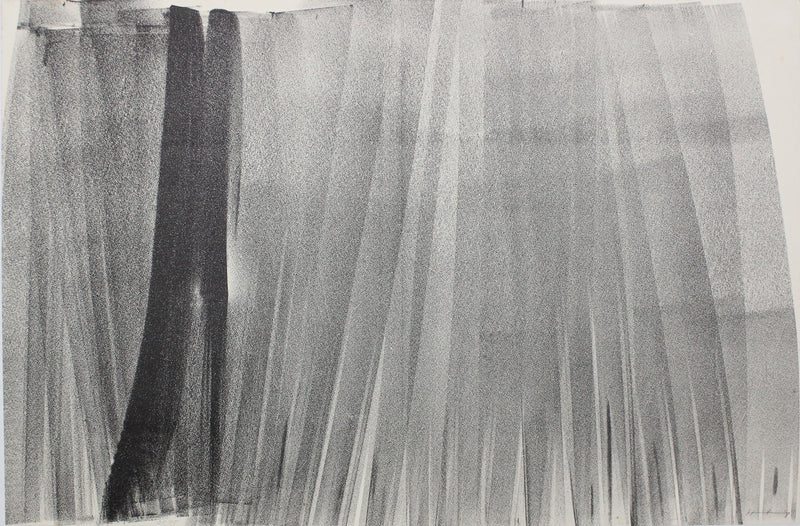
A line can cross a surface like a sudden electric discharge, or stretch out in a sequence of marks that seem to follow a musical rhythm. In the painting of Hans Hartung, gesture takes center stage, but its apparent spontaneity should not mislead us: behind the clusters of black strokes, fields of color, and scratched surfaces lies a rigorous investigation into the relationship between movement,…
Read the full biographyClose the biography
A line can cross a surface like a sudden electric discharge, or stretch out in a sequence of marks that seem to follow a musical rhythm. In the painting of Hans Hartung, gesture takes center stage, but its apparent spontaneity should not mislead us: behind the clusters of black strokes, fields of color, and scratched surfaces lies a rigorous investigation into the relationship between movement, perception, and the construction of the image. Born in Leipzig in 1904, Hartung was a decisive figure in European abstraction, able to span much of the twentieth century without ceasing to reinvent his tools and his language.
The origins of abstraction and the experience of war
From an early age, Hartung cultivated interests beyond painting, from music to philosophy, and this very openness helped shape his sensitivity to rhythm and the organization of marks. In 1922, he created a series of abstract watercolors that, with remarkable precocity, anticipated some of the characteristics of his mature work. After studying in Leipzig and Dresden, his encounter with the European avant-garde led him toward a kind of painting that no longer needed to represent recognizable objects: the picture could become an autonomous space, organized by relationships of tension, direction, and color. His ties to France grew stronger in the following years, and in 1929 he married the Norwegian painter Anna-Eva Bergman, with whom he would share a complex personal and artistic life, marked by a long separation and a subsequent reconciliation.
World War II marked a profound rupture in his life. Hartung fought in the French forces and suffered a very serious injury, as a result of which one of his legs was amputated. L experience of the conflict and the hardships of the postwar years cannot be mechanically translated into a psychological explanation of his paintings, but they help us understand the tenacity with which the artist continued to explore the possibilities of the painterly gesture. In his artworks, the line does not recount a specific episode: rather, it records energy, pressure, and duration, transforming the act of painting into a visible experience.
Between Planning and Freedom of Gesture
In the 1950s, Hartung became widely recognizable through compositions in which black, curved or slanting marks cross luminous backgrounds or gather into clusters of intense tension. L viewers may feel as if they are witnessing an improvisation executed in just a few moments. In reality, for a significant part of his career, the artist carefully prepared his compositions on paper and then transferred them to larger supports. This relationship between preliminary study and an effect of immediacy is one of the most compelling aspects of his painting: freedom of mark does not necessarily mean an absence of planning, but emerges from a constantly sought balance between control and surprise.
From the 1960s onward, his method evolved further. Hartung experimented with tools for spraying paint, scratching surfaces, and creating marks of varying widths and textures, expanding the expressive possibilities beyond the traditional brush. The sprays create atmospheric, almost intangible areas, while the incisions in the painted surface convey the physical force of movement. The surface of the painting is therefore not merely a place where an image is arranged: it becomes the tangible result of different processes, each capable of leaving a distinctive quality of mark. This constant reinvention makes it impossible to reduce Hartung to the formula of a gestural abstraction that repeats itself unchanged.
Etching, lithography, and printmaking research
Original printmaking occupies an important place in Hartung's career because it offered him a field of experimentation parallel to painting. Lhe artist explored techniques such as etching, aquatint, drypoint, lithography, and woodcut, engaging each time with the characteristics of the matrix and the material. In intaglio printing, the mark is created by engraving or working a surface that subsequently holds the ink; in lithography, by contrast, the relationship with drawing can be more immediate. These are not merely technical differences: each process changes the relationship between the speed of the gesture, the resistance of the support, and the quality of the printed image.
L's interest in printmaking should therefore not be interpreted as simply a desire to reproduce paintings in multiple copies. In many graphic artworks, the mark takes on its own autonomy, composed of fine incisions, sharp contrasts, or tonal variations that are difficult to replicate on canvas. In 2013, the Central Institute for Graphics in Rome dedicated an exhibition to his printmaking, underscoring the scope of this exploration. To understand and catalog a Hartung print, it is important to identify the process documented for that specific edition, without confusing an original engraving with a reproduction of a painting.
International recognition
The Grand Prize for Painting at the 1960 Venice Biennale confirmed Hartung's central role on the international scene. His work engages with European Informalism and lyrical abstraction, while retaining a personal character, recognizable in the tension between compositional rigor and the intensity of the gesture. Until his final years, spent in Antibes, where he died in 1989, he continued to seek new possibilities in materials and tools. His legacy is not merely a repertoire of energetic marks: above all, it is the idea that every line, even the simplest, can become the result of a complex relationship between body, technique, time, and space.
Do you like Hans Hartung?
Leave your email to receive updates on newly available works and news about this artist.
Hans Hartung
Art that lives in your spaces
Choosing a work by Hans Hartung means making room for an individual artistic language. The works gathered here suggest combinations and perspectives to bring into your own surroundings, letting art guide your gaze.
DISCOVER THE ARTIST
Frequently asked questions
Answers to common questions about Hans Hartung, the artist’s life, works and value on the art market.
Who was Hans Hartung?
Hans Hartung (1904–1989) was a Franco-German painter, a central figure of twentieth-century gestural abstraction. His research stands out for dynamic lines, incisive signs and experiments with tools and materials. After the war he became one of the protagonists of European abstract art and received the Grand Prize for painting at the 1960 Venice Biennale.
What are the characteristics of Hans Hartung's works?
Hartung's works are recognizable for the energy of the sign, the chromatic contrasts and the abstract compositions built with scratches, rapid strokes and fields of colour. The artist sought to transform gesture and rhythm into an autonomous visual language. The methods of execution vary greatly between paintings, drawings and graphic works.
What techniques did Hans Hartung use?
Hartung experimented with oil and acrylic painting, inks, pastels, etchings and lithographs. At various stages he employed sprayers, scrapers, modified brushes and other tools to obtain particular marks and textures. To understand one of his works it is important to distinguish the technique indicated in the sheet from the visual effect of the sign.
How to recognize an original lithograph by Hans Hartung?
An original lithograph is an art print made using a lithographic process, not a photographic reproduction of a painting. To evaluate the identification it is necessary to examine the technique, paper, possible numbering, signature, publisher and bibliographical references. The mere presence of a signature or a number does not automatically demonstrate authenticity: checks on the specimen are needed.
How much are Hans Hartung's works worth?
The value varies considerably based on technique, date, size, provenance, state of conservation and documentation. A single painting and a limited edition lithograph belong to different market segments. To orient yourself, it is useful to compare auction results and offers of truly comparable works, avoiding applying the price of a painting to a print.