
Painter
Bengt Lindström
Swedish, 1925 – 2008
Stay up to date with this artist
Leave your email to receive updates on newly available works and news about this artist.
Works by Bengt Lindström
1 work

Bengt Lindström
In the paintings of Bengt Lindström (Storsjökapell, Sweden, 1925 – Sundsvall, 2008), color seems to possess a force of its own. Reds, yellows, blues and greens gather into energetic masses from which faces, masks and creatures difficult to define emerge. L'The image may seem aggressive or playful, sometimes unsettling, but it never leaves us indifferent: the artist creates a style of painting in which gesture…
Read the full biographyClose the biography
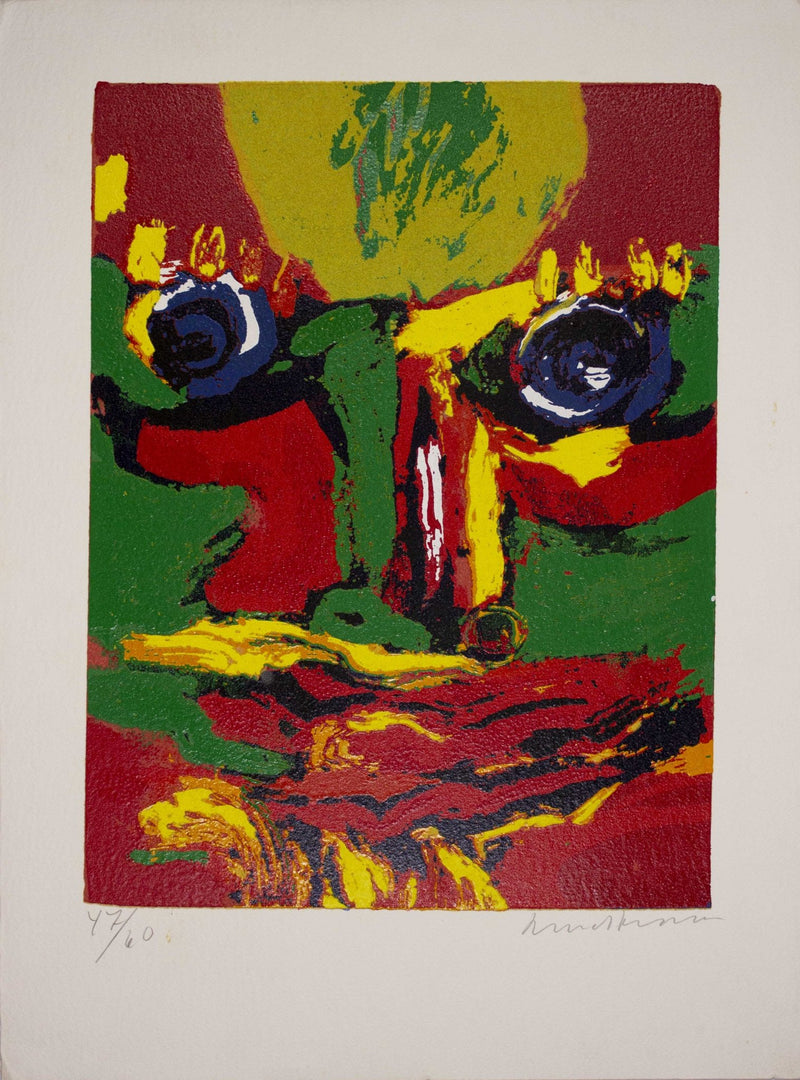
In the paintings of Bengt Lindström (Storsjökapell, Sweden, 1925 – Sundsvall, 2008), color seems to possess a force of its own. Reds, yellows, blues and greens gather into energetic masses from which faces, masks and creatures difficult to define emerge. L'The image may seem aggressive or playful, sometimes unsettling, but it never leaves us indifferent: the artist creates a style of painting in which gesture and material make visible a world of emotions, memories and archaic suggestions. His language crosses the boundary between figuration and abstraction without definitively choosing either.
Between Sweden and Paris
Born in northern Sweden, Lindström developed through diverse experiences and arrived in Paris in the postwar period. In the French capital, he encountered an art scene that placed great importance on freedom of gesture, pictorial matter, and the search for alternatives to traditional representation. His work is often associated with Expressionism and, due to certain formal affinities, with the CoBrA movement; this comparison helps explain its energy but does not imply formal membership in the group. Lindström developed an independent voice, also shaped by the cultural and natural influences of Northern Europe.
The distance from naturalism is most evident in the faces. Eyes and mouths expand, profiles break apart, and heads can occupy almost the entire surface. The distortion does not stem from an inability to depict the body, but from the desire to give it an emotional intensity that a faithful description could not convey. At times, the figure seems to emerge from the painting only after the colors have found their balance, as if the subject were the result of the creative process rather than its starting point.
Masks, myths, and pictorial matter
Lindström's imaginary world includes hybrid creatures, deities, and presences that evoke stories and primordial forces. Linterest in Nordic traditions and Sámi culture contributes to this universe, but his images should not be interpreted as faithful illustrations of specific myths. Lthe artist reworks different influences into a personal pictorial language, where the mask becomes a way to reveal something that goes beyond the individual portrait: fear, vitality, irony, energy, and mystery.
The treatment of matter is fundamental. Color is often applied in thick, lively layers, with vivid contrasts and dark lines crossing or separating the forms. Up close, the surface reveals physical traces of the process; from farther away, those same forms may come together to create a face or a monumental figure. This dual reading, both tactile and figurative, is one of the most compelling aspects of his painting. Color does not merely fill a shape: it helps create it and give it character.
Graphics and monumental artworks
Alongside his canvases, Lindström produced lithographs, prints, and other prints, adapting the power of his imagery to the possibilities of printmaking. Even when the surface lacks the textured layers of paint, the relationship between line and color remains decisive. Color overlays and outlines can suggest movement and depth through processes different from those used on canvas. To accurately describe an impression, it is necessary to distinguish an original lithograph from an offset print or a reproduction by checking the technique, edition size, and documentation; a signature and numbering alone cannot resolve every doubt.
His practice also extends to sculptures, murals, and monumental works, in which his figures take on an even more direct presence in space. His name also appears in catalogs in the form Lindstrom, without the umlaut, but refers to the same artist. His legacy lies above all in having created an instantly recognizable language, in which the energy of gesture coexists with careful control of composition. In front of a work by Lindström, one can begin with the color, be surprised by a figure, and finally return to the material: each step reveals a different aspect of the same expressive intensity.
Do you like Bengt Lindström?
Leave your email to receive updates on newly available works and news about this artist.
Bengt Lindström
Art that lives in your spaces
Choosing a work by Bengt Lindström means making room for an individual artistic language. The works gathered here suggest combinations and perspectives to bring into your own surroundings, letting art guide your gaze.

DISCOVER THE ARTIST
Frequently asked questions
Answers to common questions about Bengt Lindström, the artist’s life, works and value on the art market.
Who was Bengt Lindström?
Bengt Lindström (1925–2008) was a Swedish painter known for energetic compositions, intense colors and often deformed figures. His expressive language is also linked to Nordic mythical and cultural suggestions.
Why did Bengt Lindström use such intense colors and thick pictorial material?
Color and matter are central expressive elements of his painting. Dense brushstrokes, bright contrasts and evident mixtures contribute to creating dynamic images, in which the face or figure can emerge from the tension between shapes and colours.
What subjects recur in Bengt Lindström's works?
Faces, characters, animals and figures with a fantastic or mythological appearance are frequent. The artist reworks them through expressive deformations and strong colours, therefore the subject should not be read only in a descriptive sense.
Did Bengt Lindström make original lithographs?
Yes, his production also includes graphic works. Anyone purchasing a lithograph should check the technique, numbering, possible signature, publisher and state of conservation, distinguishing the original print from the decorative reproduction.
What elements influence Bengt Lindström's prices?
Above all, the technique, size, period, quality and subject of the work matter, as well as its provenance and condition. A material painting and a lithograph in print run have different markets; estimates must be based on comparisons with truly comparable sales.