
Painter
Achille Pace
Italy, 1923–2021
Stay up to date with this artist
Leave your email to receive updates on newly available artworks and news about this artist.
Artworks by Achille Pace
3 artworks

Biography of Achille Pace
Achille Pace (Termoli, 1923 – Rome, 2021) developed one of the most personal researches of Italian abstraction of the second half of the twentieth century, entrusting a simple material such as cotton thread with the task of interrogating the pictorial space. His artworks invite us to observe what normally escapes us: the distance between two points, the path of a line, the tension that is…
Read the full biographyClose the biography
Achille Pace (Termoli, 1923 – Rome, 2021) developed one of the most personal researches of Italian abstraction of the second half of the twentieth century, entrusting a simple material such as cotton thread with the task of interrogating the pictorial space. His artworks invite us to observe what normally escapes us: the distance between two points, the path of a line, the tension that is created when a thin element crosses an apparently immobile surface. In this choice we recognize a conception of art as an investigation, rather than as a representation of the visible world.
From informal experience to the poetics of thread
Having moved to Rome with his family in 1935, Pace approached painting in the 1940s, starting from landscape and a language sensitive to Expressionism. The comparison with Paul Klee and European painting, together with the attention to the American experiences of action painting, contributed to shifting his interest from the subject to the sign. The Informal offered the freedom to consider the surface as a place of action, but Pace was also looking for a principle capable of giving continuity and measure to the gesture.
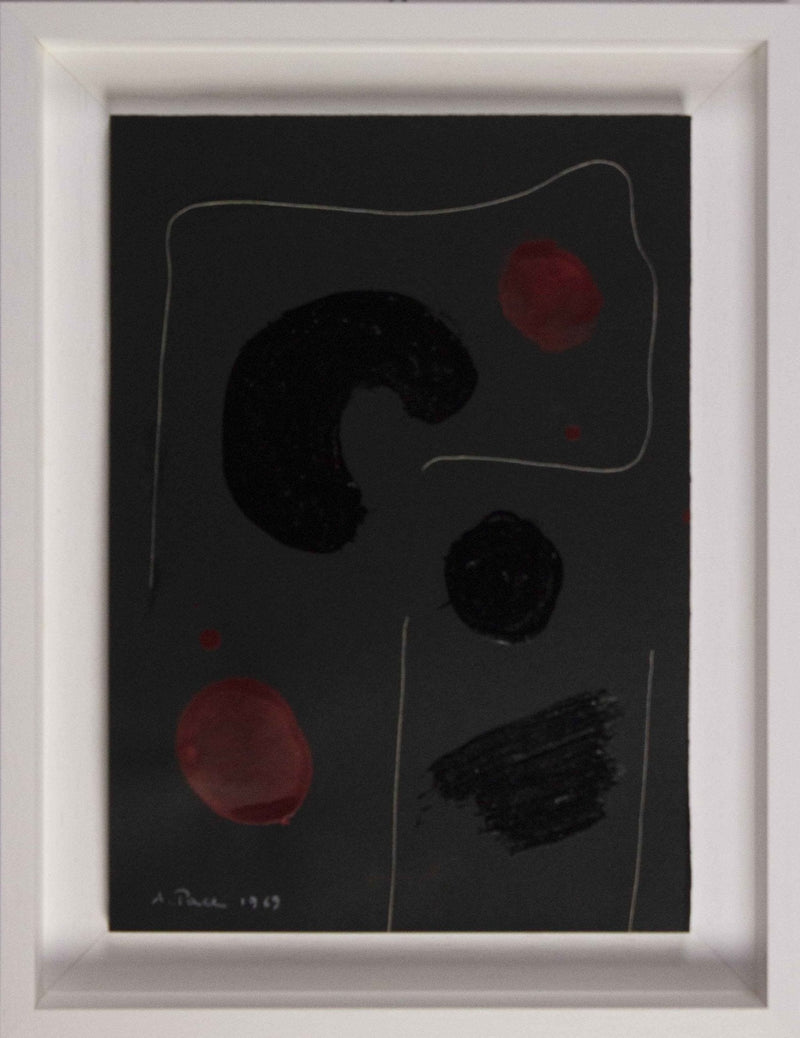
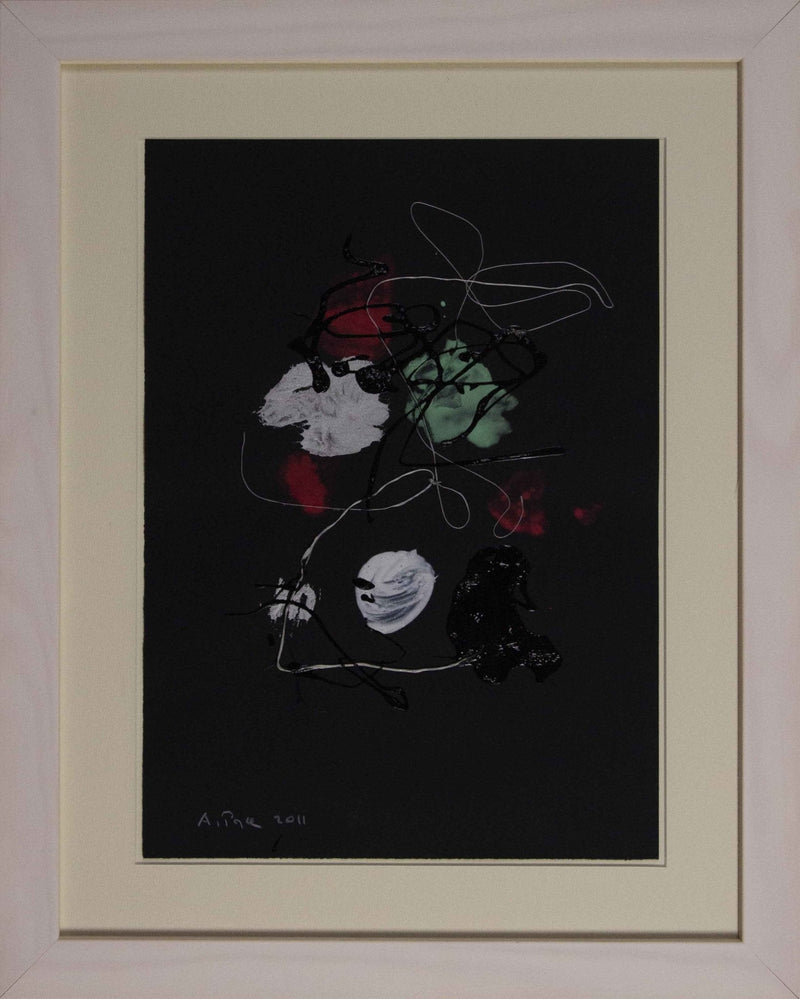
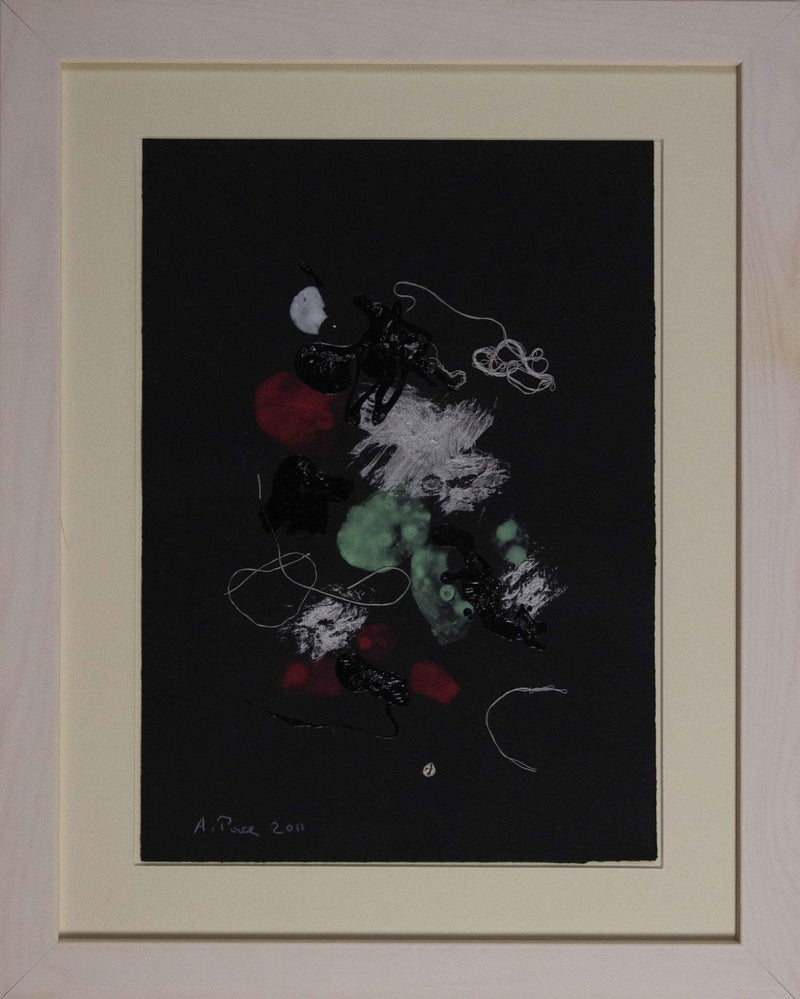
Starting from the second half of the 1950s the thread entered his compositions steadily. Applied to often monochrome backgrounds, it did not function as an ornament or as a simple collage material: it became a real drawing, physically present, which ran across the surface and modified its perception. Sometimes the line seems to advance naturally; elsewhere it tends, deviates or encounters an interruption. The viewer follows that journey with his gaze and ends up perceiving the space as a continuously evolving relationship.
The transition from the painted sign to the applied thread involves a decisive change. A line drawn with the brush belongs entirely to the surface; the thread, however, maintains a thickness, projects a slight shadow and establishes a physical relationship with the support. This gap, minimal but perceivable, introduces an almost sculptural dimension into the painting. It's not about abandoning the painting, but about testing its boundaries with an everyday element that becomes an instrument of knowledge.
The continuity of the path matters as much as the final result. Following the thread means imagining the time needed to tighten it, fix it, interrupt it and start it again. Pace's oeuvre thus suggests a measure of time different from that of the spectacular gesture: a slow temporality, made of minute choices. Even the deviations and empty intervals participate in the rhythm of the artwork; what is not occupied by the material is as important as its visible path.
Size, color and Group One
The essentiality of the artworks must not make one think of cold painting. The black, grey, white, blue or red backgrounds possess a precise emotional intensity, while the thread introduces a discreet but decisive presence. The artist thus builds a balance between matter and immateriality: the thread can be touched, but what it suggests is above all a mental movement. The tension between the chromatic field and the line gives life to compositions that change profoundly depending on the distance from which they are observed.
In 1962 Pace participated in the foundation of Gruppo Uno, with artists including Nicola Carrino, Giuseppe Uncini, Nato Frascà, Gastone Biggi and Pasquale Santoro. The group tried to overcome some assumptions of the Informal through greater attention to the structures and relationships between artistic research and society. While sharing this horizon, Pace maintained an autonomous voice, recognizable in the continuity of his poetics of the thread.
The comparison with Gruppo Uno helps to place this research in the debate on overcoming the Informal. For many post-war artists, it was no longer enough to entrust the image to the spontaneity of the gesture: it was necessary to question the rules with which an artwork is constructed and the relationship between form and environment. Pace responds to this need without adopting an impersonal geometry. The cotton line in fact maintains a fragility and a tactile quality that make the artist's hand recognisable.
Even seemingly uniform color fields deserve attention. The background is not a simple scenario on which the thread is placed: it conditions its visibility and expressive power. On a dark surface a light line may appear as a bright streak; on close tones, however, it can only emerge when the gaze gets closer. The relationship between presence and almost invisibility becomes an integral part of the experience.
Artworks on paper and research identity
His production includes paintings, assemblages and artworks on different supports. In artworks that use applied thread, the distinction between unique artwork and print is essential: the presence of a visible line does not demonstrate that it was drawn with a graphic process, and a photographic reproduction is not equivalent to the material original. When cataloging an example, it is therefore necessary to check the support, materials, possible edition, signature and provenance, without automatically attributing a technique.
Founder of the Termoli Prize in 1955, Pace also contributed to the cultural life of his hometown. He participated in the Venice Biennale in 1980 and 1982 and in important Italian and international exhibitions. His legacy lies in having demonstrated that a minimal gesture, repeated and deepened over time, can open up inexhaustible visual possibilities: a simple line becomes the place where thought, matter and perception meet.
Pace's production invites us to carefully distinguish the process from the final appearance. Two similar images can be obtained through a truly applied thread, a drawn sign or a print that reproduces the progression of a line. The difference does not only concern the commercial classification: the relationship between the artwork and space changes, because the material element reacts to light and distance in a way that the reproduced image cannot fully convey.
For those who observe one of his artworks, it is useful to also check the relationship between the support and the wire fixing points, when present. In frontal photographs some details may disappear; close-up images and exact indications on the materials help to understand them without altering the appearance of the original. Attention to conservation is equally important, because tension, adhesion and conditions of the support contribute to the stability of the whole. The poetics of the essential therefore requires an equally precise and respectful description.
Do you like Achille Pace?
Leave your email to receive updates on newly available artworks and news about this artist.
Achille Pace
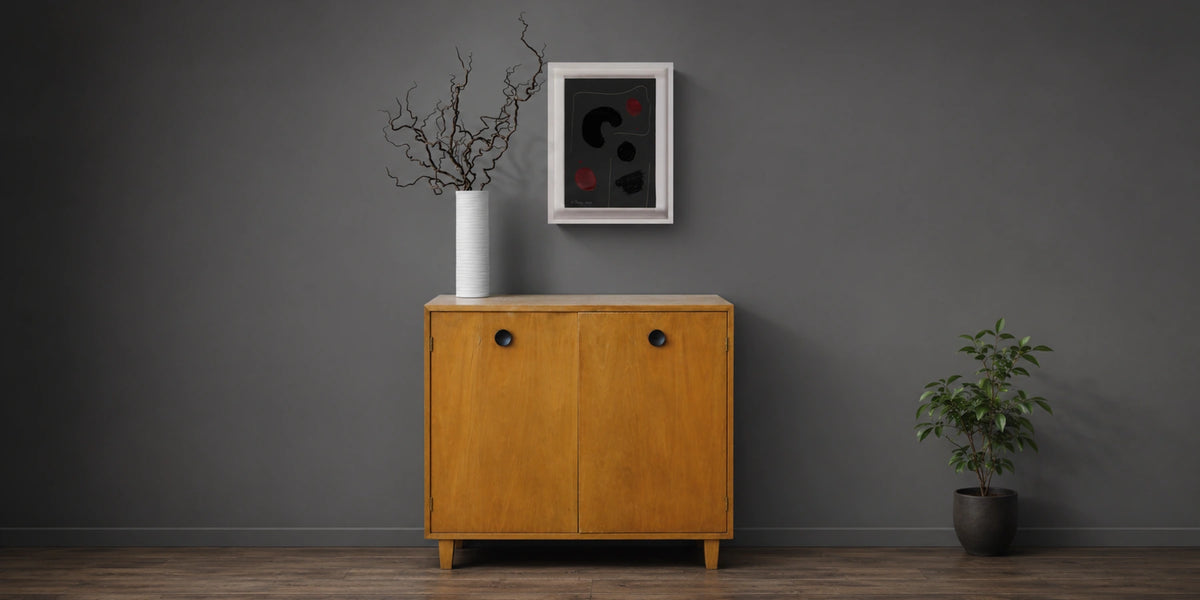
Art that lives in your spaces
Marks, rhythms and forms: artworks by Achille Pace bring a new sense of balance to a space. Understated furnishings give the composition room to breathe and invite you to rediscover it every day from a different perspective.
DISCOVER THE ARTIST
Frequently asked questions
Answers to common questions about Achille Pace, the artist’s life, artworks and value on the art market.
Who was Achille Pace?
Achille Pace (1923–2021) was an Italian artist known above all for his abstract research and for the use of thread as a visual and structural element. His oeuvre explores the relationship between sign, space and matter.
Why did Achille Pace use thread in his artworks?
The thread allows you to transform the sign from a simple drawn trace to a physical element applied to the surface. He introduces tension, direction and a concrete perception of space, central aspects in his research.
What is Gruppo Uno and what relationship does it have with Achille Pace?
Gruppo Uno was an Italian artistic experience of the early 1960s oriented towards non-figurative research. Pace participated; the context helps to understand the dialogue of his oeuvre with the abstract experimentation of the period.
How to recognize an artwork by Achille Pace made with thread?
It is necessary to observe whether the thread is actually applied to the support and how it interacts with the surface and composition. Photographs and reproductions may not convey the material component: the technical data sheet is therefore essential.
What factors affect the value of Achille Pace's artworks?
Technique, period, size, quality of composition, provenance and conservation are important, especially when delicate materials are present. It is appropriate to compare homogeneous artworks by type.