
Painter
Lucio Ranucci
Italy, 1925–2017
Stay up to date with this artist
Leave your email to receive updates on newly available artworks and news about this artist.
Artworks by Lucio Ranucci
2 artworks

Biography of Lucio Ranucci
The story of Lucio Ranucci (Perledo, 1925 – Nice, 2017) crosses post-war Italy and Latin America, intertwining painting, journalism and theatre. His figurative language, often similar to realist cubism, was born from the need to represent the human being and social tensions without giving up the freedom of modern form. Faces, bodies and groups of figures occupy his compositions with an intense presence, built through…
Read the full biographyClose the biography
The story of Lucio Ranucci (Perledo, 1925 – Nice, 2017) crosses post-war Italy and Latin America, intertwining painting, journalism and theatre. His figurative language, often similar to realist cubism, was born from the need to represent the human being and social tensions without giving up the freedom of modern form. Faces, bodies and groups of figures occupy his compositions with an intense presence, built through chromatic planes and deformations that make emotions, conflicts and relationships visible.
Travel as an artistic experience
After a childhood spent in various Italian cities, Ranucci experienced the dramatic events of the Second World War and worked as a journalist in Milan. In 1947 he left for Argentina, inaugurating a long period of travel between various Latin American countries. His education did not take place only in classrooms or ateliers: it was fueled by encounters with different social environments, daily life and the most varied professional experiences. He continued to paint while traveling and in 1949 he had a solo exhibition in Lima, Peru.
Geographic mobility is a key to reading his oeuvre, but it should not be transformed into an exotic tale. Each move confronted him with different forms of collective life and with social situations that asked to be understood, not simply observed from afar. Painting became a tool for organizing those experiences into images. The attention to faces and groups also arises from this practice of looking: the human figure remains recognisable, while the formal construction accentuates its emotional character. In this sense, travel is not just a biographical theme, but a method of knowledge.
The relationship with Latin America had profound consequences on his way of understanding art. Social inequalities, poverty and political struggles did not become simple topics for him to illustrate, but a reason to question the public function of the image. Ranucci looked to the tradition of muralism and the ability of painting to address a community, while maintaining its own narrative and chromatic sensitivity.
Costa Rica, theater and social painting
From 1951 Ranucci settled in Costa Rica, where he also contributed to theatrical life. Together with the artist Olga Espinach Fernández he participated in educational and experimental initiatives; he also held a role in the direction of the university theatre. This activity was not foreign to painting: the sense of the scene, the disposition of the characters and the ability to condense a story into a gesture or a look also recur in his images.
The theater offered Ranucci a different laboratory from the canvas. A scene requires thinking about the movements of the bodies, the distances between the characters and the relationship between gesture and audience. In pictorial compositions these elements can translate into collected figures, marked poses and directions of gaze that guide reading. The narrative dimension does not necessarily depend on an identifiable episode: even a silent group can suggest tension, expectation or solidarity. The relationship between theatrical activity and painting therefore allows us to understand how the artist sought an accessible language without giving up the complexity of the forms.
Among the most significant public artworks of the period is the mural Alegoría a la Segunda República, created in the 1950s and linked to the history of the Costa Rican Republic. The monumental format allowed him to address collective themes through a dynamic figurative language. The political experiences of Central America were sometimes difficult; after further movements, in 1963 he returned to Europe, continuing his artistic activity.
Dismantled figures, color and emotional participation
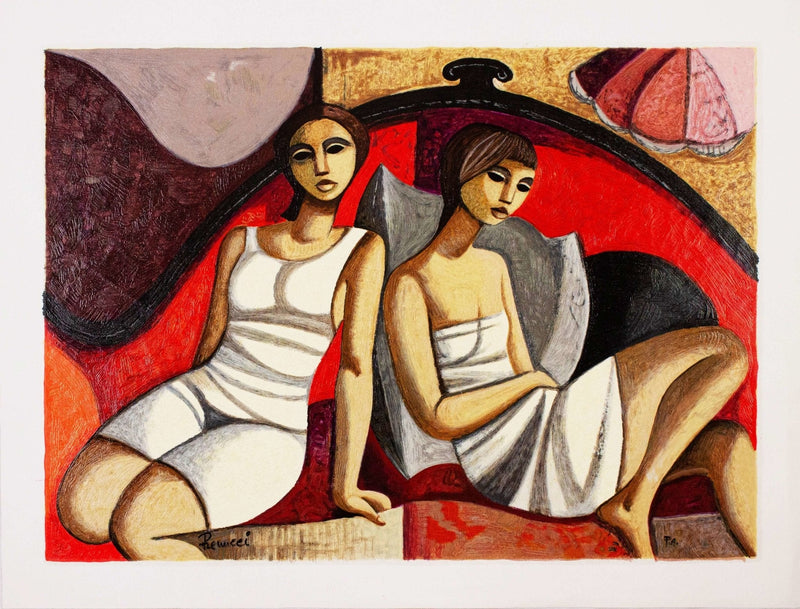
The reference to realist cubism helps to understand the structure of Ranucci's paintings, but should not be understood as rigid belonging to a school. The figures are often organized by planes, with marked contours, simplified perspectives and volumes recomposed for expressive purposes. The face can appear frontal and in profile at the same time; the hands and eyes acquire a central role in conveying the tension of the scene. The result does not aim to describe the world with photographic accuracy, but rather to make people perceive the human weight of events.
The decomposition of the planes does not, in his case, have the function of erasing the subject. On the contrary, it allows the presence of the figures to be intensified, making more aspects of the same experience visible. An enlarged hand can evoke artwork or protest; a tilted head can suggest vulnerability; the juxtaposition of different bodies can transform into an image of community. It is important to read these choices without automatically attributing a precise political meaning to every detail. The expressive value arises from the relationship between deformation, color and construction of the whole, not from a fixed symbolic code.
The artist worked with oil and acrylic, sometimes enriching the surface with materials such as sand and earth. These choices allow us to accentuate the consistency of the bodies and backgrounds, while the chromatic contrasts make the story more immediate. Even when the subjects are intimate or intimate, there remains a sensitivity to the dignity of people and their social condition.
Drawing, engraving and artworks on paper
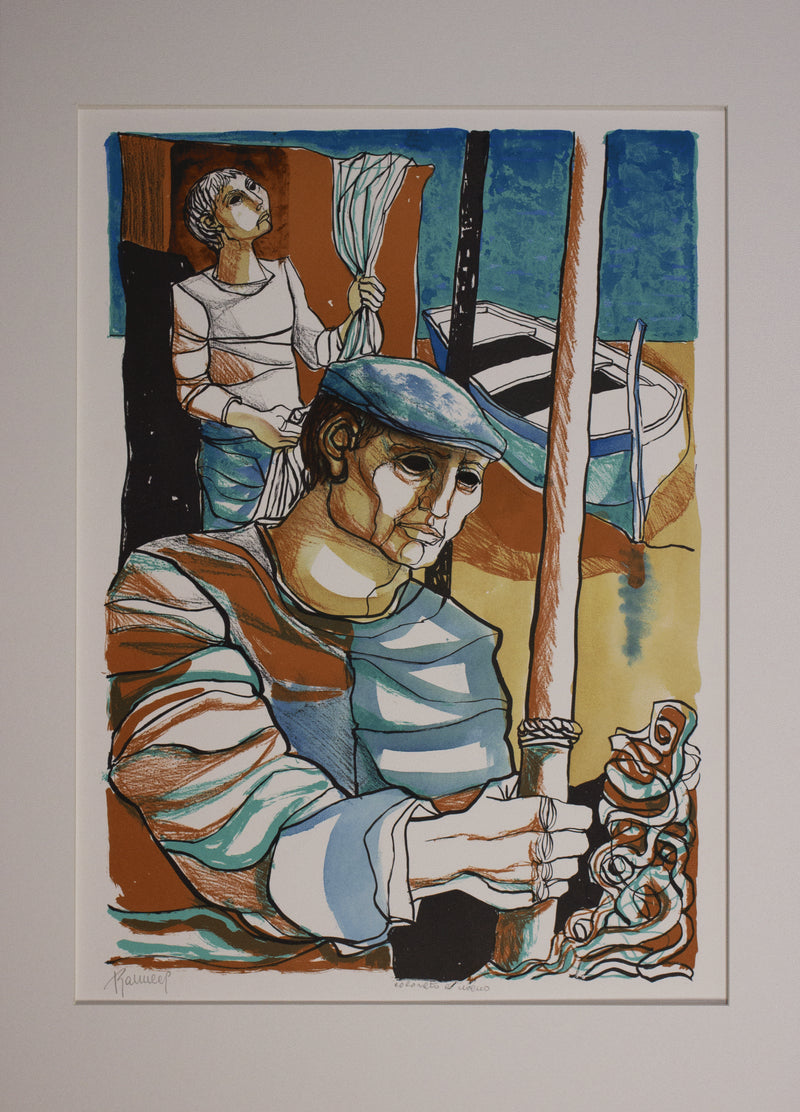
Alongside paintings, his production includes drawings and graphic artworks. The documented engraving activity makes it possible to encounter specimens on paper of different nature, but the technique must be identified case by case: an original etching, a lithograph and a reproduction of a painting are not equivalent. Signature, print run, support, possible publisher and documentation help to correctly recognize the artwork. As a whole, Ranucci's path testifies to a conception of art as participation in life: the human figure is never just a formal subject, but the center of a reflection on freedom, memory and society.
Artworks on paper can offer a particularly direct insight into his way of constructing characters. The drawing highlights the role of the contour and the lines of force; in prints, the matrix instead introduces a technical mediation that can modify the character of the sign. For this reason, a reliable card must distinguish the image from its material realization. Possible belonging to a series or folder is also an important piece of data: it allows the specimen to be placed in a precise project and to understand the relationship between the single scene and the production as a whole.
Do you like Lucio Ranucci?
Leave your email to receive updates on newly available artworks and news about this artist.
Lucio Ranucci
Art that lives in your spaces
Choosing an artwork by Lucio Ranucci means making room for an individual artistic language. The artworks gathered here suggest combinations and perspectives to bring into your own surroundings, letting art guide your gaze.
DISCOVER THE ARTIST
Frequently asked questions
Answers to common questions about Lucio Ranucci, the artist’s life, artworks and value on the art market.
Who was Lucio Ranucci and what type of painting did he create?
Lucio Ranucci (1925–2017) was an Italian painter, whose research is linked to a cubist figurative language. His compositions use deconstructed shapes and intense colors to describe people, emotions and social issues. A significant part of his journey also took place in Latin America.
Why is Lucio Ranucci's style defined as realist cubism?
The expression "realist cubism" recalls the combination of recognizable figures and geometric decompositions. Ranucci does not give up the story of human reality: the fragmentation of faces and bodies becomes an expressive means to underline feelings, tensions and social contents.
What subjects appear in Lucio Ranucci's paintings?
Human figures play an important role in Ranucci's artworks, often organized in groups or scenes with a strong emotional content. Characters can be simplified into color planes and angular shapes. The precise meaning, however, depends on the individual composition and its title.
Has Lucio Ranucci created silk-screen prints and graphic artworks?
Yes, in addition to paintings, the production associated with the artist includes serigraphs, engravings and drawings. Before purchasing a graphic it is advisable to check the actual technique, the possible print run, the signature and the documentation of the edition, avoiding considering all prints equivalent.
How is the authenticity of an artwork by Lucio Ranucci verified?
It is necessary to examine the signature, provenance, documents and technical characteristics of the specimen. The lucioranucci.com website, managed by a commercial operator, claims to offer authentic and authorized expertise. Before entrusting a verification, it is necessary to ascertain the ownership and currency of this authorization and that the documentation specifically concerns the proposed artwork.