
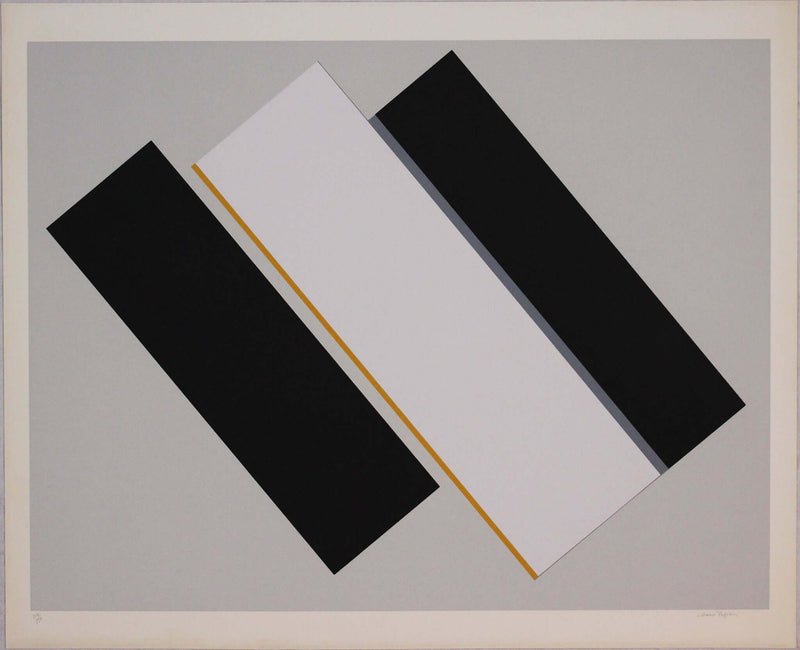
Painter
Mauro Reggiani
Italy, 1897–1980
Stay up to date with this artist
Leave your email to receive updates on newly available artworks and news about this artist.
Artworks by Mauro Reggiani
1 artwork

Biography of Mauro Reggiani
Mauro Reggiani (Nonantola, 1897 – Milan, 1980) is one of the protagonists of the birth of Italian geometric abstractionism. His painting represents a fundamental transition from the figurative language of the early twentieth century to a conception of the artwork based on autonomous forms, proportions and chromatic relationships. His path, however, is not that of an artist who suddenly abandons reality: abstraction arises from a…
Read the full biographyClose the biography
Mauro Reggiani (Nonantola, 1897 – Milan, 1980) is one of the protagonists of the birth of Italian geometric abstractionism. His painting represents a fundamental transition from the figurative language of the early twentieth century to a conception of the artwork based on autonomous forms, proportions and chromatic relationships. His path, however, is not that of an artist who suddenly abandons reality: abstraction arises from a long reflection on the structure of images, on space and on the ability of painting to express an interior order.
The formation and the turning point of the Thirties
After his artistic studies between Modena and Florence, Reggiani moved to Milan in 1924, coming into contact with a cultural environment characterized by different trends. The first experiences were still figurative and influenced by the climate of the Italian twentieth century. The trips to Paris, made in 1926 and 1930, however allowed him to get to know the European avant-garde more directly and to deal with the research of artists such as Alberto Magnelli, Jean Arp and other protagonists of modernity.
The passage through figuration is essential to understand his abstractionism. The first experiences allowed him to deepen the relationships between volumes, light and organization of space; the subsequent reduction of the elements did not erase this heritage, but transformed it. A rectangle or a curve are not chosen because they are simpler than a figure: they become tools for highlighting the very structure of vision. From this perspective, the comparison with the European avant-gardes was decisive above all because it showed the possibility of a painting capable of existing without a recognizable subject.
At the beginning of the 1930s his painting was oriented towards a progressive reduction of representative elements. The figures and objects left room for compositions built through lines, planes and chromatic backgrounds. It was not a question of renouncing complexity: on the contrary, the artist was looking for a language in which each form acquired value through its relationship with the others.
1934 marked a decisive moment. Reggiani participated in the historic exhibition experience of the Galleria del Milione in Milan and was among the signatories of a declaration-manifesto of Italian abstract art. In a context in which figuration maintained a strong cultural weight, supporting the full autonomy of geometric form meant proposing a profoundly new idea of painting.
The Galleria del Milione represented an important place for discussion and circulation of ideas. Exhibiting an abstract artwork in Italy in the 1930s meant entering a still open debate on the function of painting and the relationship with tradition. The geometric choice was therefore not a purely formal solution: it stated that the painting could be an autonomous reality, based on internal relationships. Reggiani contributed to this transition with patient research, in which compositional precision did not exclude the risk of experimentation.
Geometry, balance and space
In Reggiani's compositions, rectangles, circles, lines and colored surfaces seem to belong to a rigorous system. Yet the result is not coldly mechanical. The rhythm arises from the difference between full and empty spaces, from the proximity of contrasting shades and from the tensions created between vertical, horizontal or inclined shapes. A small shift can change the entire perception of the image, demonstrating how balance depends on subtle relationships.
His membership of the international group Abstraction-Création in 1935 confirmed the European breadth of the research. After the war, Reggiani continued to develop non-figurative painting, also participating in the experience of the Concrete Art Movement (MAC) in the 1950s. Concrete art, in this perspective, is not a simplified representation of the external world, but a visual reality that has its own laws.
The international horizon helps to understand his production without reducing it to a local episode. The experiences of European abstraction proposed different solutions, sometimes more constructive, sometimes more lyrical. Reggiani sought a personal position, maintaining particular attention to rhythm and balance. Even after the war, the continuity of research does not coincide with immobility: the proportions change, the colors take on different intensities and the surfaces can be articulated according to more open relationships. The painting remains a space of verification, in which every variation produces consequences on the whole.
Color plays an essential role. Sometimes the backgrounds are clear and separate; elsewhere the composition seems to acquire greater fluidity. The precision of the contours coexists with a chromatic sensitivity that prevents the geometry from being reduced to a simple diagram. The artworks invite slow contemplation, during which correspondences and differences that are not immediately evident emerge.
Design, graphics and published artworks
Alongside the paintings, Reggiani created drawings and graphic artworks which allow us to closely observe the process of image construction. The size of the sheet focuses attention on the essential relationships: a line can establish the dominant direction, while a chromatic background can alter the apparent weight of the other shapes. Even in the artworks on paper the language remains consistent with his pictorial research.
Artworks on paper also allow you to compare solutions that in painting require different times and materials. A sequence of studies can show how a shape is moved or scaled until a satisfactory balance is achieved; a completed sheet, however, can have an autonomy that does not depend on the existence of a corresponding painting. In the original prints the process imposes further choices, especially in the definition of the margins and chromatic transitions. It is therefore useful to indicate the technique only when it can be verified, always distinguishing the specimen for sale from the image it reproduces or interprets.
To correctly describe an example it is important to distinguish original drawing, mixed media, lithography, serigraphy and reproduction, when these categories are actually documented. The presence of signature and numbering alone is not enough to identify the printing process. Measurements of the sheet and image, support, possible publisher and catalog references are useful elements for the evaluation. Reggiani's legacy is that he contributed to giving Italian abstraction a rigorous and autonomous voice, demonstrating that geometry can become a form of visual poetry.
Do you like Mauro Reggiani?
Leave your email to receive updates on newly available artworks and news about this artist.
Mauro Reggiani
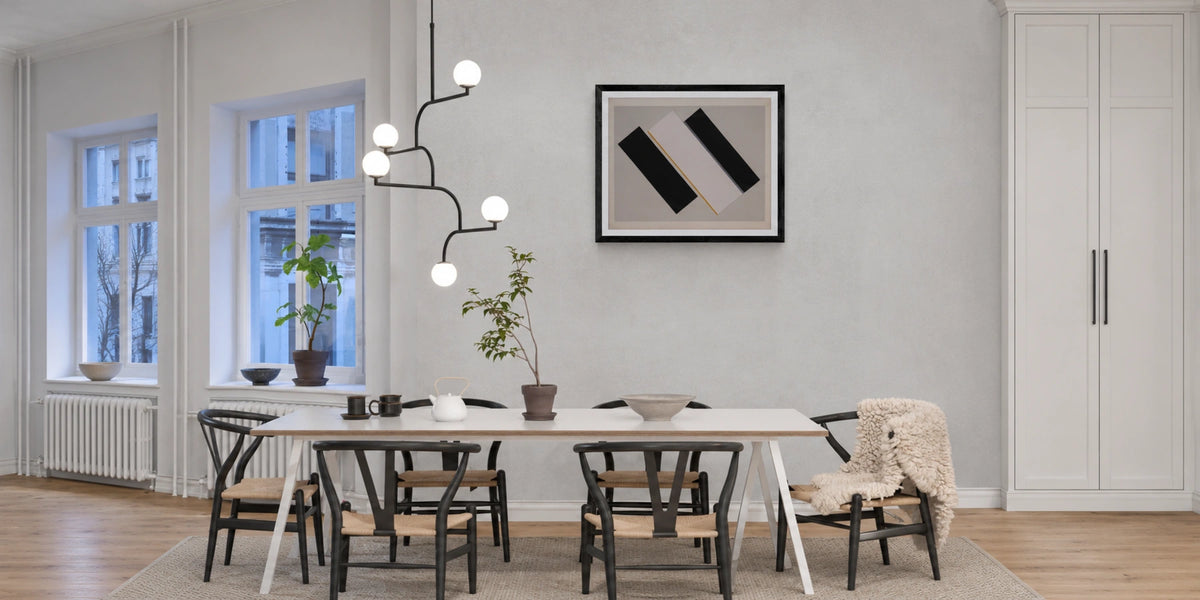
Art that lives in your spaces
Marks, rhythms and forms: artworks by Mauro Reggiani bring a new sense of balance to a space. Understated furnishings give the composition room to breathe and invite you to rediscover it every day from a different perspective.
DISCOVER THE ARTIST
Frequently asked questions
Answers to common questions about Mauro Reggiani, the artist’s life, artworks and value on the art market.
Who was Mauro Reggiani and what role did he play in Italian abstract art?
Mauro Reggiani (1897–1980) was an Italian painter among the protagonists of geometric abstractionism. After a figurative phase he moved towards non-representative compositions, participating in the debate on abstract art of the 1930s. He was also close to environments and groups that promoted non-figurative language in Italy and Europe.
Why did Mauro Reggiani abandon figurative painting?
His evolution matured in comparison with the European avant-gardes, also known through stays in Paris. The research progressively focused on the autonomous relationships between shape, color and space, without the need to represent objects or landscapes. This is a gradual transformation, not a single episode.
What are the characteristics of Reggiani's geometric compositions?
Reggiani's abstract artworks are constructed through backgrounds, lines and geometric shapes organized with balance. Color does not necessarily describe reality: instead it contributes to visual rhythm. To recognize a specific artwork it is important to place it in the correct phase of its production.
Did Mauro Reggiani create lithographs and other graphic artworks?
Yes. In addition to painting, Reggiani dedicated himself to graphics. In a lithograph or other original print it is important to check the declared technique, the signature, the numbering if applicable and the publisher's data. The presence of multiple copies does not automatically make a graphic a simple reproduction.
What does the value of Mauro Reggiani's artworks depend on?
The period, technique, quality of composition, size, provenance and conservation have an impact. Historical abstract artworks and graphic artworks belong to different market segments. For a reliable estimate it is necessary to compare truly comparable artworks and verify the authenticity of the documentation.