
Sculptor
Henry Moore
1898 – 1986
Stay up to date with this artist
Leave your email to receive updates on newly available works and news about this artist.
Works by Henry Moore
2 works


Henry Moore
The reclining figures, the bodies crossed by openings and the shapes that recall bones, rocks and hills made Henry Moore (Castleford, 1898 – Much Hadham, 1986) one of the most influential sculptors of the twentieth century. In his works the human figure is not just a subject to be represented: it becomes a way to explore the relationship between matter, space and landscape. Moore often…
Read the full biographyClose the biography
The reclining figures, the bodies crossed by openings and the shapes that recall bones, rocks and hills made Henry Moore (Castleford, 1898 – Much Hadham, 1986) one of the most influential sculptors of the twentieth century. In his works the human figure is not just a subject to be represented: it becomes a way to explore the relationship between matter, space and landscape. Moore often works on the border between recognizability and abstraction, transforming the body into an organic structure that seems to belong simultaneously to nature and the imagination. His research, developed through sculpture, drawing and graphics, shows how an essential form can communicate protection, vulnerability and monumentality.
Training and dialogue with ancient sculpture
Born in Yorkshire, Moore experienced the First World War before dedicating himself fully to artistic studies. He trained at the Leeds School of Art and the Royal College of Art in London, deepening his knowledge of European sculpture and non-European traditions. The observation of ancient works and artefacts from different cultures leads him to question the idea that sculptural beauty must coincide with the faithful reproduction of anatomy. He is fascinated by compact shapes, simplifications and the ability of a figure to occupy space with an immediate presence.
The principle of direct carving, the direct processing of stone and wood, took on an important role in the first decades of its activity. In this practice the material is not a passive support: its consistency, grain and resistance suggest formal possibilities. Moore learns to think of sculpture not just as an image of something, but as an object with its own physical life. Even when he later dedicated himself extensively to bronze, this sensitivity towards the material remained fundamental.
His attention to natural forms is also nourished by the observation of stones, bones, shells and fragments collected in the landscape. These objects do not function as models to be copied, but suggest relationships between external surface and internal structure. A cavity can recall the erosion of a rock, while a rounded volume can evoke both a torso and a hill. It is a way of thinking about sculpture in which nature offers principles of growth and transformation, not just subjects.
The comparison with non-European sculptural traditions requires a historically aware look: Moore found alternatives to Western naturalistic representation, reinterpreting them within modern research. The main interest remained the ability of the form to communicate through weight, balance and presence in space.
Reclining figures, mothers and children: the body as landscape
The reclining figure is perhaps the most recognizable theme of his production. Over the years the body is progressively simplified: torso, head and limbs can transform into rounded masses, arches and cavities. The openings that pass through some sculptures are not simple voids cut into the material. They allow the surrounding space to enter the work, creating a continuous dialogue between inside and outside. A figure placed outdoors can recall the profile of a hill, while a rocky shape can suggest the presence of a human body.
Alongside this motif, the theme of the mother with the child expresses the relationship between protection and fragility. Moore does not necessarily seek the sentimental tenderness of a family scene: he works on the tension between two volumes, on the physical relationship between a form that welcomes and another that is welcomed. Even family groups and seated figures can be read through this interest in human bonds translated into plastic relationships. The monumentality of public works does not erase the intimate dimension of the subjects, but amplifies it.
In outdoor sculptures the landscape is not a simple background. The shape of a meadow, the line of trees and the changing light enter into the perception of the work. A reclining figure can appear compact when viewed from the side and transform into a system of arches and openings from another perspective. The viewer is invited to move, not to seek a single privileged point of view.
The void thus acquires a positive function: it does not represent a lack of matter, but an active component of the composition. In some works the separate parts of the body suggest a continuity that the gaze mentally reconstructs. This ability to make presence and absence dialogue is one of the most innovative aspects of Moore's sculpture.
The drawings of the shelters and the role of graphics
During the Second World War Moore created the famous Shelter Drawings, dedicated to the people who took refuge in the London Underground during the bombings. The rows of lying bodies, wrapped in blankets and immersed in underground spaces, show a different face of his research. The drawing becomes a tool for observing collective vulnerability, and the figures take on an almost sculptural character thanks to the treatment of shadows and volumes. These works reveal how important the relationship between human experience and the construction of form was for Moore.
The designs of the shelters also show particular attention to the relationship between the individual and the community. The figures are often close together, gathered in limited spaces, yet they retain a dimension of solitude. The chiaroscuro gives weight to the bodies and makes the vulnerability of people forced to share an extreme condition perceivable. They are not simple news notes: they transform a historical experience into images of universal value.
Drawing also remains important as a tool for plastic invention. A line can suggest a volume before it is created on the subject; shadows and tonal transitions allow us to imagine cavities and surfaces. But not every sheet is necessarily preparatory: many drawings have their own expressive autonomy.
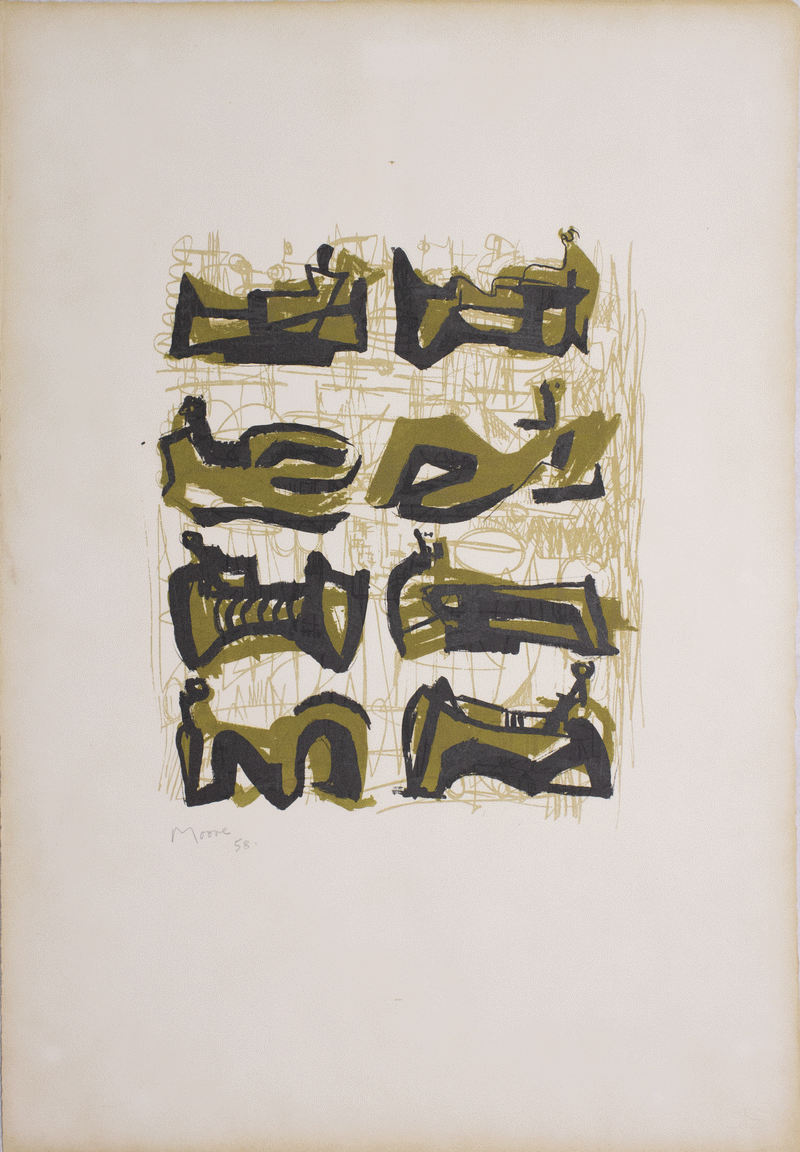
His production also includes lithographs, etchings and other original graphic works, often linked to the themes of the figure and landscape. In lithography, drawing can preserve the fluidity of the gesture, while engraving allows signs and tones to be articulated through the processing of a matrix. An original print must be distinguished from a photographic reproduction of a sculpture or drawing: technique, edition, signature, numbering and catalog references must be verified for the individual sheet. Moore's value does not lie only in the large monumental sculptures, but in the continuity of a research which, from stone to paper, has rethought the way in which the human body can inhabit space.
In graphic works the reclining figure, family groups and organic forms can take on a different character than in sculptures. Foil focuses attention on the relationship between outline, tone and white space, while print allows you to explore repetitions and variations of a pattern. The distinction between lithography, etching and reproduction remains fundamental even when the images appear very close.
To correctly describe an example it is useful to check not only signature and edition, but also title, date, publisher, possible belonging to a folder and bibliography. The dimensions of the image may differ from those of the sheet; a photograph does not always make the quality of the impression evident. This information helps to enhance the graphics as an integral part of Moore's work, not as an accessory product of his sculptures.
Do you like Henry Moore?
Leave your email to receive updates on newly available works and news about this artist.
Henry Moore
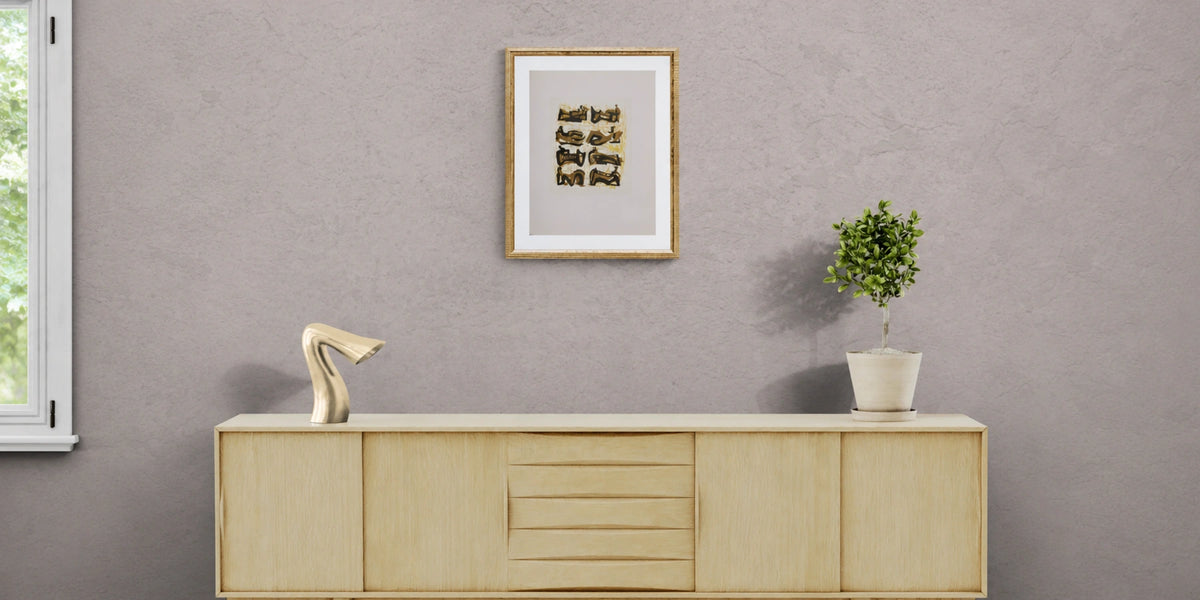
Art that lives in your spaces
Choosing a work by Henry Moore means making room for an individual artistic language. The works gathered here suggest combinations and perspectives to bring into your own surroundings, letting art guide your gaze.
DISCOVER THE ARTIST
Frequently asked questions
Answers to common questions about Henry Moore, the artist’s life, works and value on the art market.
Who was Henry Moore?
Henry Moore (1898–1986) was one of the greatest British sculptors of the twentieth century. He is known above all for his reclining human figures, organic forms and monumental sculptures, in which the relationship between solids, voids and landscape becomes an essential part of the work.
What do Henry Moore's reclining figures represent?
The reclining figure is one of Moore's most famous themes. The artist continually reinterpreted it, transforming the body into abstract shapes that recall hills, rocks and landscapes. There is no single interpretation: the theme connects the human figure, space and nature.
Why are there gaps in Henry Moore's sculptures?
Moore considered the voids active elements of the composition, not simple absences of matter. Openings and cavities allow the gaze and light to pass through the sculpture, creating an internal and external dialogue and accentuating the relationship with the environment.
Did Henry Moore also make lithographs and etchings?
Yes. In addition to sculptures and drawings, Moore produced an important graphic work, including lithographs and engravings. The original sheets can document recurring themes in his research, but each example must be identified by title, technique, edition size and bibliographical references.
How do you verify the authenticity of a graphic work by Henry Moore?
It is important to compare the work with the graphic catalog raisonnés, checking technique, dimensions, possible signature and numbering, publisher and provenance. The condition of the sheet affects the evaluation; a simple reproduction should not be confused with an original print.