

Ceramic artist and sculptor
Betty Woodman
United States, 1930–2018
Stay up to date with this artist
Leave your email to receive updates on newly available artworks and news about this artist.
Artworks by Betty Woodman
2 artworks

Biography of Betty Woodman
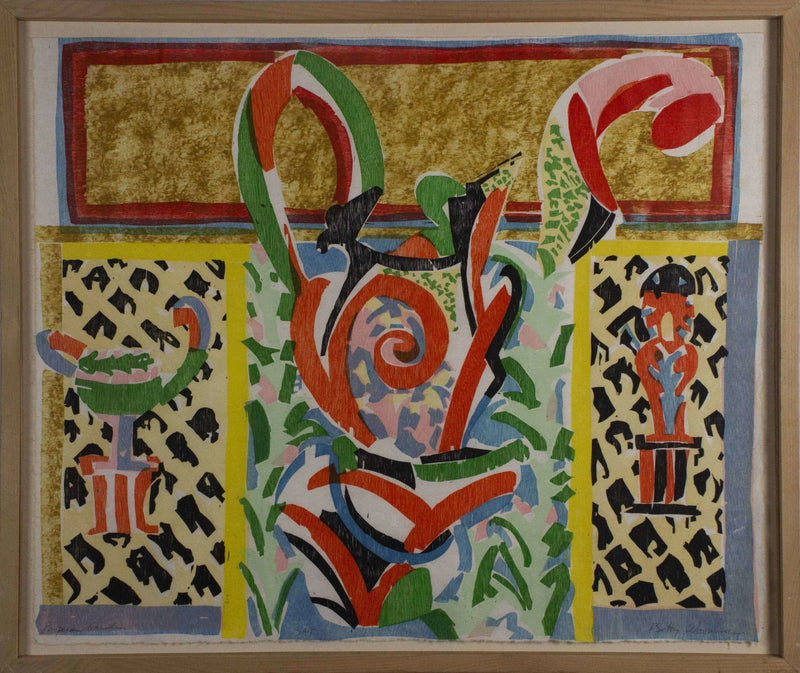
Betty Woodman (Norwalk, Connecticut, 1930 – New York, 2018) contributed decisively to transforming contemporary ceramics, overcoming the traditional distinction between everyday objects, sculpture and painting. Her vases, installations and wall compositions stand out for their extraordinary formal freedom: handles that become wings, profiles that recall architecture, surfaces painted with bright colors and gestures that seem to go beyond the confines of the object.
Read the full biographyClose the biography
Betty Woodman (Norwalk, Connecticut, 1930 – New York, 2018) contributed decisively to transforming contemporary ceramics, overcoming the traditional distinction between everyday objects, sculpture and painting. Her vases, installations and wall compositions stand out for their extraordinary formal freedom: handles that become wings, profiles that recall architecture, surfaces painted with bright colors and gestures that seem to go beyond the confines of the object.
From craftsmanship to artistic research
Woodman approached ceramics at a very young age and studied at the School for American Craftsmen at Alfred University in New York State. Initially she dedicated herself to the production of functional objects, developing an in-depth knowledge of clay, pottery, enamelling and firing. This technical expertise will remain the foundation of subsequent experiments, even when the artworks lose any real practical purpose.
A trip to Italy in 1952 brought her into contact with Mediterranean ceramic traditions, in particular majolica. The relationship with Italy, and especially with Florence, will become long-lasting. Woodman also looks at Etruscan, Minoan, Asian and Baroque ceramics, not to faithfully reproduce their models, but to understand their decorative and structural possibilities. The vase, one of the oldest forms of material culture, becomes the starting point of a surprisingly modern language.
The laboratory experience remains decisive even in the freest artworks. Woodman knows the limits and possibilities of clay: she knows that a wall that is too thin can deform, that a handle changes the balance of the vessel and that the glaze reacts to firing in ways that are not entirely predictable. This awareness allows her to treat tradition not as a set of rules to be respected, but as a repertoire of possibilities to be reinvented. The relationship with Italian majolica is particularly fruitful because it highlights the relationship between colour, design and ceramic surface. A vase can thus evoke a figure, a building or a painted scene, without completely losing the memory of the domestic object from which it comes. Her research is part of a long history, but speaks with the experimental language of the present.
The vase beyond function
In mature artworks the vase is no longer just a container. The body can open, expand or break down; the handles acquire autonomous dimensions and the painted surface suggests volumes that sometimes contradict the real ones. Woodman exploits this ambiguity with irony and intelligence: an object that we immediately recognize becomes something unexpected, suspended between sculpture and image.
Color plays a fundamental role. The enamels, decorations and painted backgrounds are not limited to covering an already defined shape: they contribute to modifying its perception. In some artworks, three-dimensional ceramic elements are combined with pictorial backdrops or architectural supports, constructing installations in which the wall becomes part of the composition. The observer does not encounter a simple decorative object, but an environment of relationships between matter, painting and space.
The transformation of the handles is an effective example of its freedom. Elements created to be grasped become expressive profiles, lateral wings or autonomous forms that dialogue with the central body. The decoration can accentuate the three-dimensionality or contradict it, making a curved surface appear like a painted plane. This ambiguity recalls the dialogue with modern painting, but arises from a direct knowledge of the ceramic object. Woodman continually questions the boundary between what belongs to the structure and what is added as an image. The arrangement of the artworks in the space also plays an important role: the vase is not necessarily intended to be observed frontally, because profiles and colors change with the movement of the visitor. The playful dimension does not exclude rigor; behind the apparent spontaneity we can recognize a carefully thought-out composition.
Ceramics as a contemporary language
Woodman taught at the University of Colorado at Boulder and received important international recognition. The retrospective organized in 2006 at the Metropolitan Museum of Art in New York contributed to consolidating its position in the history of contemporary art, showing how ceramics could be approached with the same ambition as painting and sculpture.
Her oeuvre invites us to reconsider the categories with which we describe artworks. A modeled and glazed piece, a ceramic multiple, a preparatory drawing and a print on paper have different production processes. In the catalog cards it is therefore important to distinguish material, technique, possible edition, signature and provenance, without reducing everything to the generic definition of ceramic.
The strength of her legacy lies in having made tradition a resource for invention. Ancient forms are not treated as immutable models, but as possibilities to be reinvented through gesture, color and a joyful compositional freedom.
Wall installations and artworks further expand the problem of scale. Ceramic fragments, painted elements and relationships with architecture can construct images that extend beyond the isolated object. In this passage, ceramics claims a full place in the language of contemporary art, without having to deny its own artisanal history. The comparison with painting does not consist in masking the clay: it is precisely thicknesses, shadows, edges and glazes that make the image different from a canvas. To read an artwork by Woodman it is useful to distinguish a single piece, a composition divided into several elements and an edition created according to a specific project. Any restorations, fragility of the edges, condition of the enamels and mounting methods must also be observed. Its historical importance lies in having shown that the vase can be simultaneously a memory of a function, a sculptural form and a field of pictorial invention. The presence of her artworks in museum contexts dedicated to contemporary art and not just applied arts also signals a broader change in the perception of ceramics. The technique is no longer considered a genre limit, but an expressive choice capable of competing on an equal footing with painting and sculpture.
Do you like Betty Woodman?
Leave your email to receive updates on newly available artworks and news about this artist.
Betty Woodman
Art that lives in your spaces
Choosing an artwork by Betty Woodman means making room for an individual artistic language. The artworks gathered here suggest combinations and perspectives to bring into your own surroundings, letting art guide your gaze.
DISCOVER THE ARTIST
Frequently asked questions
Answers to common questions about Betty Woodman, the artist’s life, artworks and value on the art market.
Who was Betty Woodman and why is she important in contemporary art?
Betty Woodman was an American artist who helped redefine the relationship between ceramics, sculpture and painting. Her artworks often overcome the traditional distinction between everyday object and artwork, transforming ceramic forms and decorated surfaces into autonomous and highly expressive compositions.
What are the characteristics of Betty Woodman's ceramics?
Her ceramics are recognizable for their inventive shapes, bright colors and a continuous dialogue between volume and decoration. Vases and structures can become sculptural elements, while painted surfaces broaden the perception of space. However, each artwork must be described based on the materials and techniques actually used.
Is Betty Woodman considered a ceramist or a sculptor?
Both definitions can be useful, but neither is exhaustive. Betty Woodman has used the language of ceramics to create artworks that dialogue with sculpture, painting and installation. It is precisely the crossing of boundaries between disciplines that is one of the most significant aspects of her oeuvre.
Has Betty Woodman also created artworks on paper and prints?
Alongside ceramic production, her activity includes two-dimensional artworks and graphic artworks. Before purchasing it is important to distinguish the drawing, original print and reproduction, checking the technique indicated in the data sheet, the possible print run and the characteristics of the support.
How to evaluate an artwork by Betty Woodman?
Valuation depends on technique, dating, size, complexity, provenance, conditions and relevant market comparisons. A unique ceramic and an edition print are not directly equivalent. Documentation, authenticity and state of conservation must be verified on a case-by-case basis, avoiding expectations of guaranteed revaluation.
Discover more artists
Explore more leading figures in modern and contemporary art

