

Afro Basaldella biography
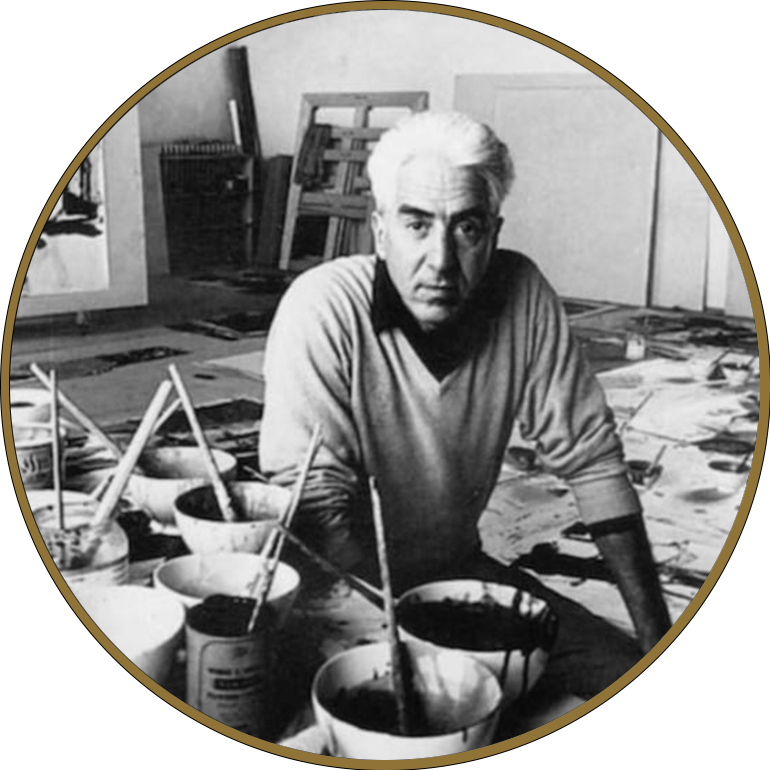
Afro Libio Basaldella was an Italian painter and one of the main exponents of Italian Informal art. He was born in Udine in 1912 to Leo Basaldella and Virginia Angeli. After the death of his father, also a painter and decorator, he pursued his first studies in Florence and Venice where he graduated in painting in 1931. Afro Basaldella's talent was soon noticed; in fact, in 1928, at only sixteen years old, together with his brothers Mirko and Dino, he exhibited at the I Exhibition of the Friulian School of Avant-garde and the following year at the XX Exhibition of the Bevilacqua La Masa Artwork in Venice.
In 1930, thanks to a scholarship received from the Marangoni Artistic Foundation of Udine, which was awarded to promote and support young local artists, Afro Basaldella, together with his brother Dino, went to Rome where he had the opportunity to come into contact with the artistic environment of the capital. It was here that he met the artists Scipione, Mario Mafai and Corrado Cagli and became part of the Roman School. From 1931 he began participating in various Trade Union Exhibitions. In 1932 he spent a period in Milan with his brother Mirko, starting to frequent the studio of Arturo Martini and coming into contact with artists such as Renato Birolli and Ennio Morlotti. In 1933 Basaldella exhibited at the Galleria del Milione in Milan, together with the artists Bosisio, Pittino and Taiuti. In the same year he also exhibited at the I Exhibition of the National Fascist Fine Arts Syndicate in Florence. In 1935 he participated in the Quadriennale di Roma. In 1936 he participated in the Venice Biennale, where he also exhibited in 1940 and 1942. In 1936 and 1937 his first solo exhibitions were held at the Cometa Gallery in Rome. Also in 1937, in collaboration with Cagli, he worked on the decorations of the International Exhibition in Paris. In 1939 he participated in the Third Quadriennale in Rome. From 1941 Afro Basaldella began teaching mosaic at the Academy of Fine Arts of Venice.
In the post-war period, after the experience at the Roman School, Afro Basaldella approached Neocubism. In 1950 he went to the United States, specifically New York, where, thanks to the introduction by his friend Corrado Cagli, he began a twenty-year collaboration with the Catherine Viviano Gallery. During this period Basaldella was fascinated and influenced by the cultural climate and artistic movements present at the time. These experiences deeply influenced the Artist, who reworked them personally, ultimately moving closer to abstraction. In 1952 he joined the Group of Eight and with them took part in the XXVI Venice Biennale. In the following edition Lionello Venturi dedicated a critical essay to Afro Basaldella. Within this essay, Venturi highlighted many of the artist's qualities such as technical skill, precision, passion for painting, and natural elegance. In 1955 he was among the artists exhibiting at the traveling exhibition in the United States, The New Decade: 22 European Painters and Sculptors, and his works were included in the first edition of Documenta I in Kassel.
By the mid-fifties Afro Basaldella's artwork had gained acclaim and fame especially internationally. Recognition from his native country was not long in coming. In fact, in 1955 he became part of the invitation commission for the VII Quadriennale di Roma. The turning point, however, came when, in 1956, he won the award for best Italian artist at the Venice Biennale. In 1957 Afro Basaldella taught at Mills College in Oakland, California. Moreover, several exhibitions were held in this state during his stay. In 1958 he was commissioned a mural for the UNESCO headquarters in Paris. The artwork is titled The Garden of Hope. Alongside him, for the decoration of the new UNESCO building in Paris, worked artists such as Karel Appel, Jean Arp, Alexander Calder, Roberto Matta, Joan Mirò, Henry Moore, Pablo Picasso and Rufino Tamayo. Between 1959 and 1960 he participated in Documenta II in Kassel and won the prize for Italy at the Solomon R. Guggenheim Museum in New York. The Guggenheim purchased his painting Night Flight from 1957.
In 1961 the curator of the Guggenheim Museum in New York, J. J. Sweeney, dedicated a splendid monograph to him. In 1966 he began teaching at the New College of the Fine Arts Institute in Sarasota, Florida. From 1968 until 1973 he taught at the Academy of Fine Arts in Florence. In 1967 Afro Basaldella suffered a severe loss, the death of his brother Mirko. From the early seventies, Basaldella began to have health problems. His last years were characterized by an intensification of graphic artwork and a reduction in both painting and exhibition activity. In 1971 Afro Basaldella won the President of the Republic's award for the Academy of S. Luca. That year he held several exhibitions both in Italy and abroad. The main countries hosting his exhibitions were Paris, New York, and Germany. Afro Basaldella died in Zurich in 1976.