


Giuseppe Ajmone (Carpignano Sesia, 1923 – Romagnano Sesia, 2005) was one of the leading figures in Italian painting in the second half of the twentieth century. Trained in postwar Milan, he developed a distinctive style in which landscapes, the human figure, and still lifes became opportunities to explore light, color, and memory. From his early experiences with Realism and Post-Cubism to the maturity of a freer, more lyrical style of painting, Ajmone maintained a deep connection with the natural world without giving up experimentation. In his paintings, bodies sometimes seem to emerge from the painted surface, while river landscapes become images suspended between observation and recollection. Alongside painting, he developed a significant body of graphic work, also linked to poetry and Italian literature.
Giuseppe Ajmone: biography and artistic training
Giuseppe Ajmone was born on February 17, 1923, in Carpignano Sesia, in the province of Novara.
His artistic training began in 1937 in the studio of sculptor Riccardo Mella, where he was introduced to drawing and the study of form.
In 1941, he moved to Milan and enrolled at the Brera Academy of Fine Arts, attending classes taught by Achille Funi and Carlo Carrà.
Meeting these masters allowed him to explore the Italian pictorial tradition in greater depth, but it was above all his relationships with the young artists of his generation that shaped his later choices.
During his years at the Academy, he met Ennio Morlotti, Bruno Cassinari, and other painters interested in renewing figurative art.
These were the war years, marked by profound political and cultural changes. For many artists, engaging with contemporary reality became an expressive necessity.
Ajmone graduated from Brera in 1944 and began taking an active part in Milan's artistic debate.
In this environment, he developed the idea of a kind of painting that could engage with modern life without abandoning formal experimentation.
The postwar years, Corrente, and the Oltre Guernica manifesto
In the 1940s, Giuseppe Ajmone came into contact with the artistic circle of Corrente, the movement that had brought together painters and intellectuals opposed to cultural isolation and interested in developments in European art.
Pablo Picasso's work, particularly Guernica, was an essential point of reference for many young artists.
The work demonstrated that the distortion of figures and compositional freedom could become tools for expressing the drama of history.
In 1944, Ajmone helped launch the magazine Numero, which later continued under the title Pittura.
In 1946, he was among the signatories of the Manifesto of Realism, known as Beyond Guernica, alongside artists and intellectuals including Ennio Morlotti, Emilio Vedova, and Giovanni Testori.
The manifesto expressed the desire to create a new kind of painting, capable of engaging with reality without simply returning to the forms of traditional Realism.
For Ajmone, this experience was an important, but not definitive, phase.
In the following years, his research gradually moved away from Post-Cubist structures, favoring a more direct and personal relationship with nature and visual experience.
From Picasso's influence to the painting of Bonnard and Cézanne
At the end of the 1940s, Giuseppe Ajmone went through a period of change.
His interest in the Post-Cubist construction of the image gradually gave way to a style of painting more attentive to color, light, and the sensations evoked by reality.
Artists such as Paul Cézanne, Pierre Bonnard, and Georges Braque became important influences.
From Cézanne, Ajmone drew above all an interest in the structure of the landscape and the relationships between forms.
Bonnard's painting, in turn, suggested new possibilities for using color and depicting interiors through light.
This was not a passive adoption of existing models.
Ajmone reworked these influences to develop a personal sensibility, in which the image emerges from the encounter between observation and memory.
His colors became freer, while forms seemed gradually to lose the rigidity of their outlines.
Reality remained the starting point, but it was transformed through the painter's gesture and emotional perception.
Giuseppe Ajmone's landscapes: nature and the Sesia River
Landscape occupies a central place in Giuseppe Ajmone's work, especially from the late 1950s onward.
Nature is not depicted as an immobile backdrop, but as a living presence, shaped by light and atmospheric change.
River landscapes and places connected with the Sesia area, to which the artist remained deeply attached, are particularly important.
In his paintings, water, riverbanks, vegetation, and open spaces are often rendered in compositions where forms seem to emerge slowly from the painted surface.
Color does more than describe a place. It helps evoke the feeling of a moment, the brightness of an atmosphere, or the memory of a landscape seen before.
Silvery tones, luminous grays, and darker contrasts became characteristic elements of his palette.
A significant example is The Sesia from 1967, a painting held in the art collection of the Chamber of Deputies.
In this work, as in other landscapes from the same period, Ajmone sought a balance between a recognizable subject and expressive freedom.
The landscape does not disappear into abstraction, but neither is it reproduced like a photographic view.
Instead, it is an image filtered through experience, in which nature takes on an inner dimension.
Giuseppe Ajmone between Art Informel and the New Figuration
Ajmone's artistic development encompassed several of the major movements in postwar Italian art.
In the 1950s, his work came close to the sensibility critics associated with the last Naturalists and with particular developments in Art Informel.
During this phase, the painted surface became freer and the representation lost some of its traditional definition.
Forms were not necessarily bounded by precise outlines, but seemed to arise from the interplay of color, light, and gesture.
Unlike completely abstract painting, however, Ajmone's work retained a constant connection with the visible world.
Landscape, the human body, and objects continued to serve as points of reference for his artistic exploration.
In the 1960s and 1970s, this relationship with reality developed further, moving closer to the New Figuration movement.
The figure once again became recognizable, while remaining immersed in a free and sometimes unsettling style of painting.
Ajmone did not see Realism and abstraction as necessarily opposing possibilities.
In his works, observation of the world coexists with the painterly transformation of the image.
Female nudes: the body between light and memory
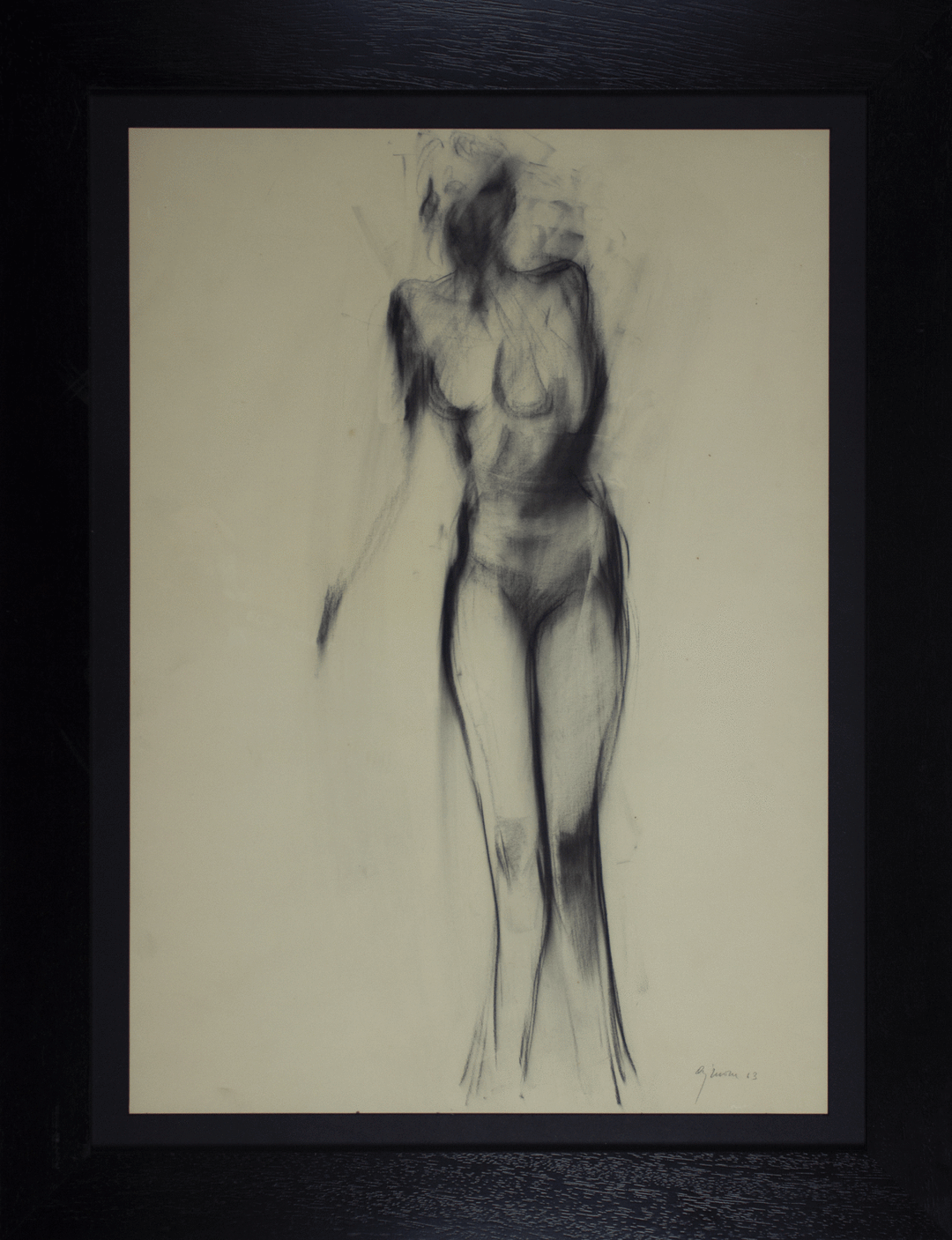
Alongside landscape, the female nude is one of the central themes in Giuseppe Ajmone's painting.
The artist explored this subject over several decades, creating compositions in which the body takes on a presence that is sometimes luminous and delicate, sometimes more intense and dramatic.
The figures are not always defined by precise drawing.
At times, they seem to emerge slowly from the background, like images surfacing from memory.
In other paintings, the body takes on greater solidity while remaining closely connected to the painted surface and color.
Light plays a decisive role.
It can make a figure seem almost immaterial or emphasize its weight and physical presence.
In Ajmone's nudes, the relationship between figure and setting is not merely compositional: it helps create an emotional atmosphere.
This exploration reached particular intensity in the large canvases he created between the 1970s and 1980s.
In 1982, at the Palazzo della Permanente in Milan, the artist presented an important group of works devoted to the so-called drowned nudes, inspired by a news story from the Romagnano Sesia area.
In these paintings, the human figure takes on a tragic dimension.
The body is not merely a subject for painting, but becomes the means through which the artist addresses pain, vulnerability, and memory.
Still lifes and flowers
Still lifes form another important chapter in Giuseppe Ajmone's work.
Flowers and everyday objects gave the artist the opportunity to explore the relationship between color, light, and composition in greater depth.
Here, too, the subject is not approached with a purely descriptive aim.
The arrangement of elements, the tones, and the quality of the painted surface help create an image in which reality appears transformed.
Flowers, in particular, allowed Ajmone to develop a style of painting attuned to shifts in color and the effects of light.
Forms may appear clearly defined or partially dissolve into the background.
This oscillation between presence and indeterminacy is a recurring feature of his work.
His still lifes also reveal a connection with the French painting tradition, particularly the work of Bonnard.
Ajmone nevertheless used these influences to develop an independent vision, in which color became the main means of interpreting the subject.
Giuseppe Ajmone's graphic artworks and his relationship with literature
Giuseppe Ajmone's work was not limited to painting on canvas.
From the 1940s onward, the artist devoted considerable attention to printmaking and graphic art, creating etchings, drypoints, and lithographs.
This work developed alongside his painting and took on particular significance through its connection with literature.
Between 1946 and 1949, Ajmone worked with the Einaudi publishing house, also overseeing the artistic design of its publications.
In 1947, he created a series of etchings related to Cesare Pavese's Hard Labor, while in 1949 he turned to Giacomo Leopardi's The Infinite.
These projects reveal a profound dialogue between image and word.
Ajmone did not regard illustration merely as a visual translation of a literary text.
His artistic sensibility enabled him to create images that evoke atmospheres and meanings through an independent visual language.
In the following decades, he continued to create graphic artworks and collaborate on literary publications.
Among the most significant projects are the portfolios Album Leaves from 1970 and Six Nudes from 1977, as well as works related to texts by Italo Calvino, Antonio Machado, and other authors.
Ajmone's lithographs and prints revisit the central themes of his painting: landscape, the body, nature, and memory.
Graphic art is therefore an important part of his artistic career, making it possible to trace the development of his style beyond the canvas.
Works from the 1970s and 1980s: a more dramatic style of painting
In the 1970s, Giuseppe Ajmone's painting developed an increasingly intense emotional dimension.
His relationship with nature and the human figure remained central, but some works introduced references to historical events and painful experiences.
Works from this period include Nicevò, Another Crime, and The Large Studio, which were also shown in major exhibitions devoted to his work.
His painterly language retained the freedom of gesture and sensitivity to color, but the image sometimes took on a more unsettling character.
The human figure may appear fragile, isolated, or caught up in situations that evoke suffering and loss.
Painting thus became a means of addressing not only the beauty of the natural world, but also the more difficult aspects of human experience.
This tension is particularly evident in the drowned nudes series, presented in 1982.
Ajmone did not, however, abandon landscape or still life.
He continued to explore different subjects simultaneously, united by a distinctive artistic sensibility.
Exhibitions, biennials, and awards
Giuseppe Ajmone's career was accompanied by an active exhibition schedule in Italy and abroad.
In 1948, he took part in the Venice Biennale for the first time, returning in 1950 and 1952.
In 1951, he received the Senatore Borletti Prize for young Italian painters and began working with the Milan Triennale.
In the 1950s, he took part in international events, including the São Paulo Biennial, exhibitions in the United States, and exhibitions of contemporary Italian art in several European countries.
In 1962, he was invited to the Venice Biennale, where he was given a room of his own, an important recognition of his artistic career.
In the following years, he continued to exhibit in galleries and public institutions.
In 1976, the critic Roberto Tassi devoted a study of his painting, The Light of Things, a title that aptly sums up one of the central aspects of Ajmone's work.
In 1984, Palazzo dei Diamanti in Ferrara hosted a retrospective devoted to his work.
In 1997, another exhibition in Arona surveyed works created between 1943 and 1997.
These events helped document the continuity and richness of an artistic career that spanned more than fifty years.
Later years and artistic legacy
From the 1980s onward, Giuseppe Ajmone made his home in Romagnano Sesia, maintaining an ever-closer connection with his native area.
The local landscape continued to be an important presence in his painting.
The artist continued working until his final years, focusing on the subjects that had accompanied him throughout his career: nature, the human body, and everyday objects.
He died in Romagnano Sesia on April 8, 2005.
His work reflects an independent career that encompassed the major transformations of postwar Italian painting without identifying entirely with any single movement.
From Post-Cubism to Art Informel and the New Figuration, Ajmone maintained a constant interest in visible reality and its transformation through color.
River landscapes, nudes, and still lifes are different expressions of an artistic exploration grounded in light and memory.
Today, the Giuseppe Ajmone Association and the artist's archive are dedicated to studying, documenting, and promoting his work.
Giuseppe Ajmone's paintings retain a particular power to engage viewers because they do more than describe what appears before the eye.
Through the painted surface and shifts in light, they transform places and figures into images in which observation, memory, and emotion become inseparable.
Ti piace Giuseppe Ajmone?
Per ricevere gli ultimi aggiornamenti di questo artista, lascia la tua email qui sotto:Il tuo indirizzo email è stato aggiunto alla lista dell'artista.
