
Painter
Bernard Schultze
Germany, 1915–2005
Stay up to date with this artist
Leave your email to receive updates on newly available artworks and news about this artist.
Artworks by Bernard Schultze
1 artwork

Biography of Bernard Schultze
Bernard Schultze (Schneidemühl, today Piła, 1915 – Cologne, 2005) was one of the protagonists of the post-war German Informal. His oeuvre constructs fantastic universes in which painting, drawing and sculpture seem to generate each other. Organic shapes, plots, apparitions and imaginary landscapes emerge from dense surfaces, inviting the viewer to explore a reality that does not coincide with the visible one, but retains its tensions…
Read the full biographyClose the biography
Bernard Schultze (Schneidemühl, today Piła, 1915 – Cologne, 2005) was one of the protagonists of the post-war German Informal. His oeuvre constructs fantastic universes in which painting, drawing and sculpture seem to generate each other. Organic shapes, plots, apparitions and imaginary landscapes emerge from dense surfaces, inviting the viewer to explore a reality that does not coincide with the visible one, but retains its tensions and mysteries.
The artistic reconstruction after the war
Educated in Germany before the Second World War, Schultze saw his artistic career marked by the historical fractures of the time. After the war he participated in the renewal of German painting, in search of a language capable of overcoming the figurative and ideological impositions of the past. In 1952 he was among the founders of the Quadriga group, together with Karl Otto Götz, Otto Greis and Heinz Kreutz, a decisive experience for the affirmation of informal abstraction in Germany.
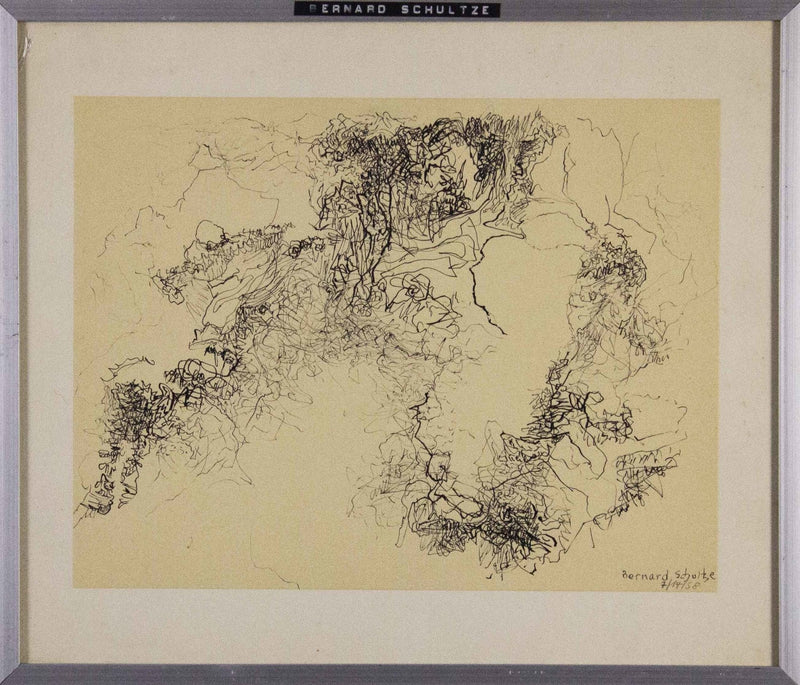
The Informal offered him the possibility of freeing form from pre-established patterns, but his painting is not reduced to gestural automatism. The compositions often develop through a slow accumulation of elements, as if the image grew according to its own internal logic. The artist constructs complex spaces, in which the sign suggests imaginary vegetation, organisms and structures that escape a stable definition.
The post-war cultural climate makes the search for an image not subordinate to official models particularly significant. The Quadriga experience testifies to the desire to engage with international experiments and to regain expressive freedom after the fractures of German history. Schultze, however, does not develop a painting based exclusively on the speed of the gesture. The surfaces may require accumulation and transformation artwork, in which newly suggested shapes are taken up and modified. The image seems to arise through growth, rather than through the application of an initial scheme. This quality makes his Informal different from a purely gestural abstraction: the painting retains the possibility of evoking organisms, landscapes and apparitions, without establishing clear boundaries between what is figurative and what is not.
Migof and organic imagination
Among the most recognizable inventions of his research are the Migofs, fantastic creatures and hybrid forms that cross painting and sculpture. They are not characters from a traditional narrative, but ambiguous presences, halfway between natural organism, object and mental apparition. Their shapes can be curious, disturbing or ironic, revealing an interest in what arises on the margins of classification.
Matter plays a decisive role. Colors, reliefs and weavings produce images that seem to grow beyond the confines of the support. The painting thus takes on an almost biological quality: it does not simply represent a creature, but suggests the process of its formation. In some artworks the density of the signs requires close observation; in others the impression of being in front of a fantastic landscape of great breadth prevails.
Migofs are particularly important because they make the transition between painting and object clear. Their identity remains deliberately unstable: they can suggest fantastic animals, roots, deformed bodies or shapes born from a dream, but no definition exhausts them. The artist constructs an imaginary in which the organic element coexists with the artifice. A structure can appear to have grown spontaneously and at the same time clearly show the artwork of the materials. The observer is invited to recognize analogies without transforming them into a definitive classification. The fantastic dimension should not be confused with a simple escape from reality. Anxieties, memories and questions about the human condition can be reflected in these ambiguous presences. Imagination becomes a tool to give shape to what escapes ordinary representation. The artworks invite you to continuously move from the overall vision to the exploration of the details. A shape that from afar seems like a landscape can reveal, when you get closer, a tangle of signs and reliefs; a seemingly abstract element can suggest a figure. This perceptive instability is an essential part of his imagery. The ambiguity between body, plant and landscape prevents us from assigning a single meaning to the forms. Imagination artworks through continuous transformations: a line can suggest plant growth, while a relief takes on the appearance of an organism. The changing character of the images does not eliminate the precision of the construction; makes it part of the perceptual experience.
Drawing, engraving and artworks on paper
Drawing is fundamental to understanding Schultze, because it makes visible the continuity between gesture, imagination and image construction. In artworks on paper, forms can develop with particular freedom, giving life to plots that oscillate between abstraction and figuration. However, graphic production requires precise cataloging: a lithograph, an engraving and a photographic reproduction of a painting are not technically equivalent.
Signature, numbering, paper, publisher and provenance help identify the individual example. His legacy is linked to a conception of art as a continuous exploration of the imagination. Schultze showed that abstraction can generate worlds populated by presences that are recognizable yet impossible to name, keeping the dialogue between matter and imagination open.
The drawing allows you to closely follow the process of proliferation of forms. A line can branch, interrupt or overlap with others to generate a complex visual organism. In artworks on paper the density of the sign and the relationship with unoccupied spaces take on particular importance. When the original print intervenes, however, the relationship between gesture and image changes according to the process. A lithograph allows certain tonal transitions, while an intaglio engraving depends on the processing of the matrix and the pressure on the sheet. You cannot establish the technique of a specimen just by looking at a digital reproduction. It is necessary to verify materials, measurements, print run, signature, possible publisher and origin. This documentary attention helps to distinguish autonomous artworks from reproduced images and to understand the variety of research that continually crosses the boundaries between two-dimensional and three-dimensional.
Do you like Bernard Schultze?
Leave your email to receive updates on newly available artworks and news about this artist.
Bernard Schultze
Art that lives in your spaces
Choosing an artwork by Bernard Schultze means making room for an individual artistic language. The artworks gathered here suggest combinations and perspectives to bring into your own surroundings, letting art guide your gaze.
DISCOVER THE ARTIST
Frequently asked questions
Answers to common questions about Bernard Schultze, the artist’s life, artworks and value on the art market.
Who was Bernard Schultze and what artistic movement did he represent?
Bernard Schultze (1915–2005) was a German painter associated with the European Informal. He was among the founders of the Quadriga group in Frankfurt in 1952. His research favors organic forms, pictorial gestures and dense compositions that suggest imaginary landscapes and transformations of matter.
What are Bernard Schultze's Migofs?
Migofs are fantastic creatures and forms invented by Schultze, also developed into three-dimensional artworks. They can appear as hybrid organisms, plants or imaginary figures. The term identifies a characteristic aspect of his poetics, in which the form seems to grow and change freely.
What characteristics distinguish Bernard Schultze's style?
His artworks often show an intertwining of lines, colors and biomorphic shapes, with a sense of continuous movement. The composition may appear spontaneous but builds a coherent visual universe. To understand the technique it is useful to distinguish painting, drawing, original print and plastic artworks.
Was Bernard Schultze part of the Quadriga group?
Yes. Schultze participated in the founding of Quadriga, a significant experience for the development of informal art in post-war Germany. The group contributed to promoting a language free from traditional figurative schemes. The artist's subsequent production expanded this research in personal directions.
How to identify an original print by Bernard Schultze?
It is important to ascertain the technique used, verify any numbering, signature, dimensions and information on the edition. An original print does not automatically coincide with a reproduction of a painting. Provenance and state of conservation are elements to consider when evaluating the specimen.
Discover more artists
Explore more leading figures in modern and contemporary art


