

Ardengo Soffici biography
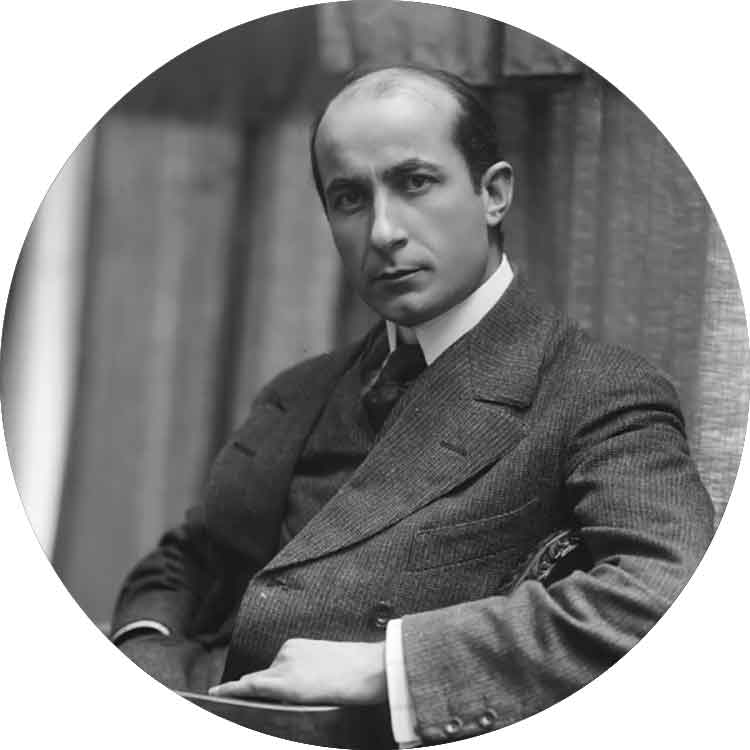
Ardengo Soffici was born in Rignano sull'Arno on April 7, 1879, and established himself as an eclectic Italian artist, known as a painter, writer, poet, and essayist. Raised in a family of wealthy farmers, he spent his childhood in Bombone, developing from a young age a passion for art and literature, expressing himself through painting and poetry. His life took a turn in 1893 when, following a move to Florence, he witnessed his father's financial ruin, an event that led him into poverty and forced him to work in a law office. Despite the difficulties, Ardengo Soffici continued to nurture his artistic vocation, attending the Academy of Fine Arts in Florence and the School of the Nude, where his teachers included Giovanni Fattori and Telemaco Signorini. During this period, he met important figures such as Giuseppe Graziosi, with whom he formed a deep friendship.
In 1900, upon his father's death and his mother's move to Poggio a Caiano, he decided to leave for Paris, a crucial step for his career. In Paris, he worked as an illustrator and came into contact with artists such as Guillaume Apollinaire, Pablo Picasso, and Max Jacob. This Parisian period was fundamental for his formation, not only artistically but also literarily, writing for magazines such as La plume and L'Europe artiste.
Returning to Florence in 1907, Ardengo Soffici strengthened his friendship with Giovanni Papini, with whom he founded the magazine "La Voce" in 1908, actively contributing to the cultural debate of the time. He also became a collaborator for magazines such as "La Riviera Ligure", published by the Novaro brothers, and "Lacerba", which he founded together with Papini and Aldo Palazzeschi in 1913, becoming a reference point for Italian Futurism.
His active participation in the artistic and literary scene led to clashes with the Futurists, as demonstrated by the brawl episode at the "Giubbe Rosse" café in Florence. However, his relationship with the Futurist movement evolved, culminating in his joining thanks to Palazzeschi's mediation.
During World War I, he enlisted as a volunteer, participating in several battles and being wounded twice. This war experience deeply influenced his work, as can be seen in "Kobilek-Battle Diary" and "The Retreat of Friuli".
In the postwar period, Ardengo Soffici became a fervent supporter of fascism, signing the Manifesto of Fascist Intellectuals in 1925 and joining the Accademia d'Italia at Mussolini's proposal in 1939. His support for the regime also manifested through his collaboration with magazines such as "Il Popolo d'Italia" and "Italia e Civiltà".
However, over the years, Ardengo Soffici changed style, moving from an avant-garde approach to a more traditional one, as can be seen in his literary and artistic works. Despite his political commitment, his artistic production continued to receive recognition, such as the Marzotto Prize for literature in 1955.
Ardengo Soffici died on August 19, 1964, in Vittoria Apuana, leaving a complex and multifaceted cultural legacy that reflects the various phases of his artistic and intellectual journey, as well as the changes in the Italian historical and cultural context of the 20th century.