

Painter and printmaker
Vairo Mongatti
Italy, 1934
Stay up to date with this artist
Leave your email to receive updates on newly available artworks and news about this artist.
Artworks by Vairo Mongatti
1 artwork

Biography of Vairo Mongatti
Born in Florence in 1934, Vairo Mongatti is an Italian engraver and painter who dedicated a fundamental part of his research to etching. His oeuvre arises from a patient observation of things: still lifes, interiors and landscapes become opportunities to investigate the light, depth and rhythm of the sign. The apparent simplicity of the subjects should not be misleading. Behind a vase, a bottle or…
Read the full biographyClose the biography
Born in Florence in 1934, Vairo Mongatti is an Italian engraver and painter who dedicated a fundamental part of his research to etching. His oeuvre arises from a patient observation of things: still lifes, interiors and landscapes become opportunities to investigate the light, depth and rhythm of the sign. The apparent simplicity of the subjects should not be misleading. Behind a vase, a bottle or a glimpse there is a complex work on the matrix, in which each stroke contributes to building the atmosphere of the image. His story is linked to the Tuscan engraving tradition and the comparison with Giorgio Morandi, but he stands out for a personal sensitivity towards the density of chiaroscuro and the slow revelation of forms.
The artwork and the context of the research
Mongatti trained at the Academy of Fine Arts in Florence, where he studied with Rodolfo Margheri and Giuseppe Viviani. The training offered him a rigorous knowledge of drawing and artistic procedures, but the decisive move towards engraving took place in 1963, when an exhibition of Morandi's graphic artworks made a profound impression on him. From that moment on, etching became the center of his activity. The comparison with Morandi does not only concern the subjects, often everyday ones: it concerns above all the possibility of transforming a set of objects into a meditation on the relationships between light and space.
The artist also studies the tradition of Rembrandt, Canaletto and Giovanni Fattori, finding in different experiences useful tools for his own language. Rembrandt's attention to chiaroscuro suggests how light can arise from deeply dark areas; the clarity of Canaletto's sign shows the precision possible in the organization of a space; Fattori's compositional energy reminds us that engraving can possess a strong structural presence. Mongatti does not reproduce these models: he assimilates some of their possibilities to develop a recognizable voice.
His still lifes are constructed through measured relationships between objects and intervals. The subject may appear immobile, but the gaze is guided by a pattern of lines that continually modifies the perception of distances. In landscapes, however, the succession of plans and the relationship between architecture, vegetation and atmosphere become tools for exploring the same quality of light. Reality is observed with precision, but is not reduced to a photographic description: the engraving work seeks an internal balance.
The didactic dimension accompanies artistic production. Mongatti taught first in Florence and subsequently at the Academy of Fine Arts in Bologna, where he held the chair of engraving that had previously belonged to Morandi. Since 1994 he has also returned to teaching engraving at the Florentine Academy. The relationship with the students is part of a conception of the profession that attributes value to knowledge of the matrix, patience and the ability to observe. It is not enough to have a good compositional idea: you need to understand its concrete translation into printable signs.
Mongatti is also linked to the birth of «Academia Nova», an initiative that supports the value of the figurative tradition of etching. This orientation does not mean renouncing modernity, but reaffirming the possibility of innovating through profound knowledge of a historical technique. The language can be contemporary even when it starts from a vase, a window or a landscape, as long as the image arises from authentic research.
Drawing, printing and identification of artworks
In etching a metal plate is protected with a varnish and engraved with the artist's drawing; the action of the acid creates grooves capable of holding the ink. Pressure printing then transfers the image to the paper. Mongatti exploits the possibilities of the process to obtain a great variety of tonal values: the signs can thicken to the point of producing deep shadows or thin out, allowing the surface to breathe. The different bites and the control of the coverings allow you to articulate the chiaroscuro without losing precision.
This technical ability is not virtuosity as an end in itself. The hatching organizes the vision and allows the objects to emerge gradually. A shadow can give consistency to a volume, while an area left almost white introduces a pause. The rhythm of the lines accompanies the time of observation: what appears immediately familiar reveals ever new details and relationships. It is a quality particularly evident in still life compositions, where the concentration on a few elements makes each variation significant.
Mongatti's production is documented in collections and repertoires dedicated to Italian graphics, including the archive of the Academy of Drawing Arts in Florence and the Adalberto Sartori Prints Collection. His engraving activity has been presented in exhibitions and reviews, contributing to the knowledge of research based on the continuity between tradition and contemporary sensitivity. Membership in artistic institutions and long teaching confirm the role played in the transmission of the culture of engraving.
For correct cataloging it is essential to distinguish an original etching from a lithograph, a unique drawing or a reproduction. The photographic image is not sufficient to recognize with certainty the matrix used. It is necessary to check the title, dimensions of the engraving and sheet, any numbering, signature, state of conservation and bibliographical references. The quality of the impression and the ratio between ink and paper can also contribute to the reading of the individual specimen.
His journey also demonstrates that an ancient technique can continue to be a current research tool. The attention to the quality of the hatching is not nostalgia for a past language: it is the choice to construct images that resist a hasty reading. In the repetition of a few motifs Mongatti always finds new relationships between light, object and environment. For this reason his engravings can be of interest both to those who know the history of Italian graphics and to those approaching the original print for the first time.
The strength of Mongatti's oeuvre lies in the ability to make ordinary subjects intense. His engraving invites us to slow down and observe how the sign transforms the visible: it does not add spectacle to things, but restores their presence through a patient balance between light, matter and silence.
Do you like Vairo Mongatti?
Leave your email to receive updates on newly available artworks and news about this artist.
Vairo Mongatti
Art that lives in your spaces
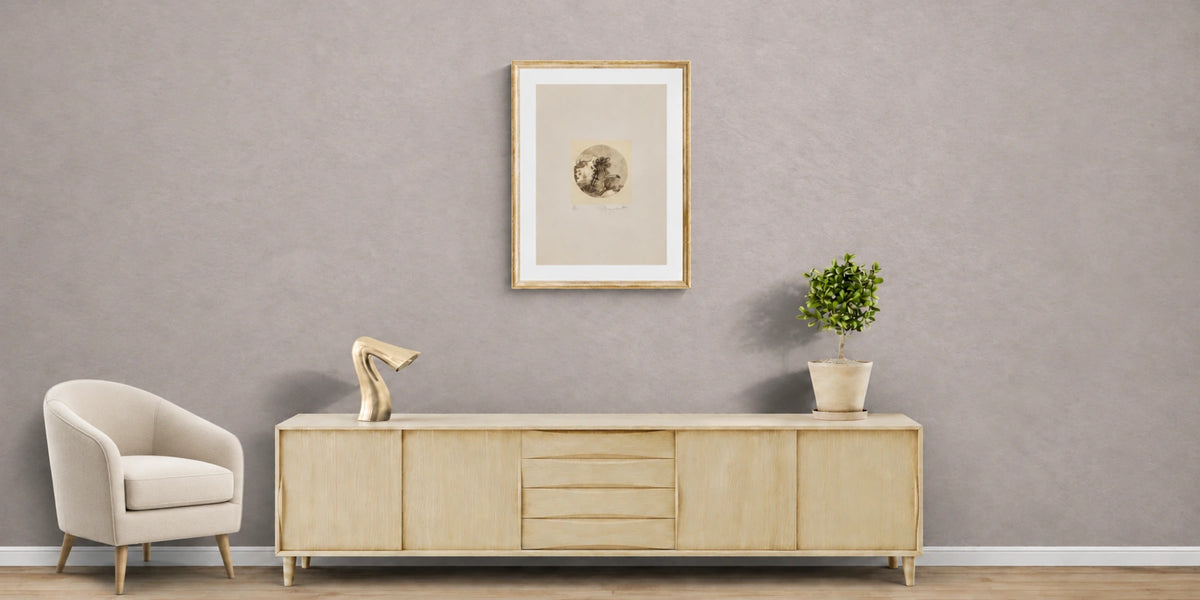
Choosing an artwork by Vairo Mongatti means making room for an individual artistic language. The artworks gathered here suggest combinations and perspectives to bring into your own surroundings, letting art guide your gaze.
DISCOVER THE ARTIST
Frequently asked questions
Answers to common questions about Vairo Mongatti, the artist’s life, artworks and value on the art market.
Who is Vairo Mongatti?
Vairo Mongatti (born in Florence in 1934) is an Italian painter and engraver, known above all for etching. Trained at the Academy of Fine Arts in Florence with Giuseppe Viviani and Rodolfo Margheri, he developed figurative research on landscapes, interiors and still lifes, attentive to the sign and relationships of light.
What engraving technique characterizes Vairo Mongatti's artworks?
Etching plays a central role in its production: the design is engraved on a metal plate using a mordant and then printed on paper. The artwork sheet from the Emporium Art collection also indicates this technique. Aquatint and drypoint should not be attributed to a specimen without specific documentation.
How do you read the numbering of an original print by Mongatti?
A fraction in pencil, for example 12/50, normally indicates the number of the copy and the declared print run. Artist's proofs outside the ordinary numbering may exist; the states instead indicate subsequent modifications of the matrix. Numbering alone does not demonstrate authenticity: it must be consistent with technique, paper, signature and provenance.
What affects the value of an engraving by Vairo Mongatti?
Authenticity, rarity, technique, size, subject, state of conservation and documentation count. A reliable comparison requires homogeneous artworks; the price requested by a seller does not necessarily equal the price actually realized on the market.
How to correctly store a print on Mongatti paper?
It is preferable to use acid-free conservation materials, avoid direct sunlight and high humidity, and do not allow the surface of the artwork to adhere to the glass. Cleaning or restoration work must be entrusted to a paper conservation professional.