




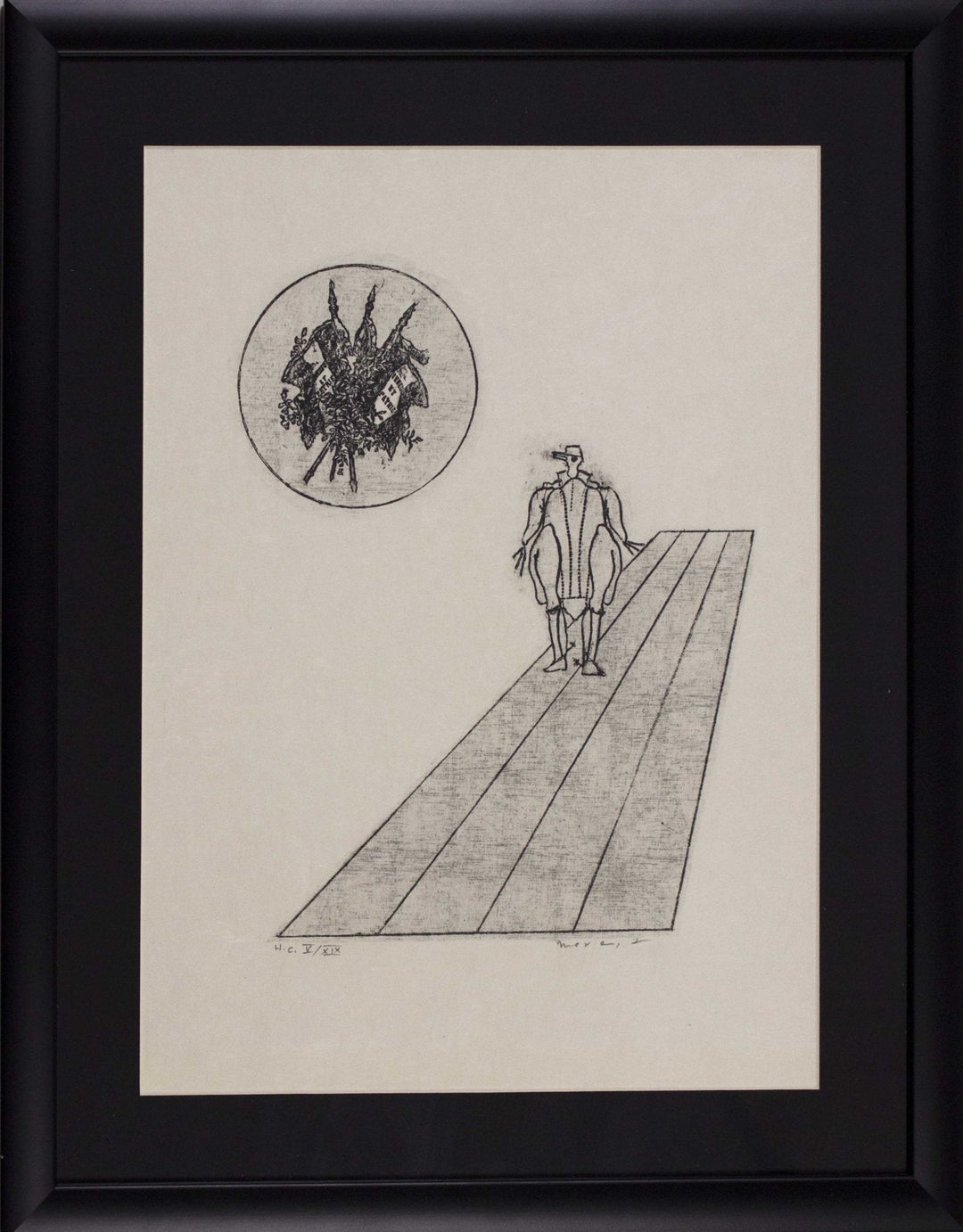
A wood grain, a stain, or a scrap found by chance can become the starting point for a fantastic universe. Max Ernst, one of the great figures of Dadaism and Surrealism, turned this insight into a creative method, bringing the unconscious, materials, and preexisting images into dialogue. In his work, collage, frottage, grattage, and decalcomania are tools for discovering figures that reason would not have designed in advance.
Education, War, and Dadaism
Max Ernst was born in Brühl, Germany, on April 2, 1891. He grew up in a family where painting played an important role: his father, Philipp Ernst, was a teacher and amateur painter. In 1909, he enrolled at the University of Bonn, where he studied philosophy, psychology, and art history. During his university years, he became interested in theories of the unconscious and artistic expressions outside the academic tradition. He was largely self-taught as a painter. His engagement with modern art and Expressionist experimentation helped shape his early artworks.
The First World War marked a profound rupture in Ernst’s life. L’artist served in the German army and experienced the conflict firsthand. The war radically changed his relationship with European culture. Trust in traditional values gave way to a critical stance toward social and artistic conventions. This experience contributed to his later embrace of Dadaism.
In 1919, Ernst took part in founding the Cologne Dada group with Johannes Theodor Baargeld. The movement rejected the traditional rules of art and used irony, provocation, and unexpected juxtapositions. Ernst experimented primarily with collage, constructing images from fragments taken from photographs, illustrations, and publications. The elements were removed from their original context and placed in new compositions. The result was enigmatic images, often characterized by an apparent internal logic. Collage became a tool for freeing the imagination from conventional associations.
Paris and the Techniques of Chance
In 1922, Ernst moved to Paris. He met André Breton, Paul Éluard, and the artists who would go on to create Surrealism. The movement placed particular importance on dreams, the unconscious, and automatic associations. Ernst developed an approach in which the creative process could be guided by chance elements. L’artist did not completely relinquish control over the composition, but used techniques capable of suggesting unexpected images.
In 1925, Ernst developed frottage, one of the most significant techniques in his work. The process involves placing a sheet of paper on a rough surface and rubbing it with a pencil or another material. The texture underneath emerges on the paper through the mark. Wood grain, fibers, and other irregularities may suggest figures, landscapes, or fantastic creatures. Later, the artist intervenes on the resulting images, transforming them into compositions. Frottage makes it possible to introduce chance into the creative process.
In 1926, Ernst published Histoire naturelle, an important collection of images linked to his experiments with frottage. The compositions feature organic structures, imaginary landscapes, and enigmatic forms. The collection attests to his ability to transform material traces into fantastic images. It is important to distinguish the original frottage from the process by which the images are subsequently reproduced in an edition. The technique used to create the drawing and the printing technique used for the book do not necessarily coincide.
Ernst subsequently applies the possibilities of frottage to painting through grattage. The process involves working on the still-wet painted surface, scraping away the paint to reveal textures and structures. The images may suggest forests, rocks, creatures, and imaginary landscapes. Grattage creates a direct relationship between matter and imagination. The surface of the painting is not built solely with a brush. It becomes the result of mechanical interventions and successive transformations.
Collage Novels and Original Prints
Another important technique is decalcomania. The process involves transferring or pressing color between surfaces to create unpredictable textures and patterns. The resulting forms may suggest fantastic landscapes or organic structures. Ernst uses these possibilities to create images in which chance contributes to the composition. Later, the artist intervenes, recognizing and developing the figures suggested by the process.
Among the most original artworks are the collage novels. In these works, Ernst constructs narrative sequences using images drawn from existing publications and engravings. Key titles include La femme 100 têtes from 1929, Rêve d'une petite fille qui voulut entrer au Carmel from 1930, and Une semaine de bonté from 1934. The images depict impossible situations, fantastic transformations, and unsettling juxtapositions. The narrative does not necessarily follow a traditional logic. Readers are invited to build personal connections between the scenes.
Max Ernst’s output includes lithographs, engravings, illustrated books, and artworks in print. Printmaking was an important field of experimentation, especially in the relationship between image and book. The compositions could develop themes already present in his paintings, but through different processes. L'artist uses the language of printmaking to explore line, fantastic structures, and the relationship between forms. Classifying individual artworks requires care. Not every image published in an illustrated book is necessarily an original lithograph.
L’exile, return, and legacy
Lithography allowed Ernst to develop images by drawing on the printing stone. The process was particularly suited to compositions in which line retained a central role. Over the course of his career, the artist collaborated on the creation of important illustrated editions. These included La ballade du soldat by Georges Ribemont-Dessaignes, published in 1972 with original lithographs by Ernst. Print editions constitute a significant part of his mature output.
With the outbreak of the Second World War, Ernst went through a difficult period. He was interned in France as a German citizen and later managed to leave Europe. In 1941, he moved to the United States. His arrival contributed to the spread of European Surrealism in the American art scene. During this period, he continued experimenting with painting and printmaking techniques.
In the 1950s, Ernst returned to Europe permanently. In 1954, he received the Grand Prize for Painting at the Venice Biennale. The award confirmed the central position he had achieved in the history of twentieth-century art. He continued working in painting, sculpture, printmaking, and illustrated books.
Max Ernst died in Paris on April 1, 1976. His work represents one of the most important contributions to the transformation of the artistic language of the twentieth century. Collage, frottage, grattage, and decalcomania radically expanded the possibilities of visual creation. Ernst showed how materials, pre-existing images, and chance procedures can become tools for exploring the imagination.
Ti piace Max Ernst?
Per ricevere gli ultimi aggiornamenti di questo artista, lascia la tua email qui sotto:Il tuo indirizzo email è stato aggiunto alla lista dell'artista.
